Week-7 Challenge: DC Motor Control
1. A. Explain a MATLAB demo model named ‘Speed control of a DC motor using BJT H-bridge.
A-following block is used in dc motor simulations model
H -bridge : The Bipolar Junction Transistor (BJT) when used for power switching applications. its will operates as an IGBT , whilr its is conductiing BJT is operated as an saturated region . the forword vtg vf is developed in betn the collector and emmiter .
while the dc motor used in this model is 5 HP , 24 v and runs at the speed of 1750 rpm .then its wil simulates with the fan load while torque will be the proportionals to the square of speed . The armature mean voltage can be varied from 0 to 240 V when the duty cycle specified in the Pulse Generator block is varied from 0 to 100%.
The H-bridge consists of four BJT/Diode pairs (BJT simulated by IGBT models). Two transistors are switched simultaneously: Q1 and Q4 or Q2 and Q3. When Q1 and Q4 are conduting simulatniously , a positive voltage is applied to the motor and diodes D2-D3 operate as free-wheeling diodes when Q1 and Q4 are switched off. When Q2 and Q3 are conduting simulateniously , a negative voltage is applied to the motor and diodes D1-D4 operate as free-wheeling diodes when Q2 and Q3 are switched off.
Chopper :
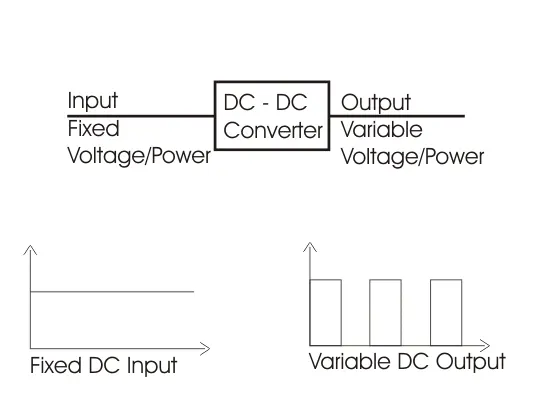
DC to DC converter - chopper is very much needed nowadays as many industrial applications are dependent upon DC voltage sources The performance of these applications will be improved if we use a variable DC supply. It will help to improve controllability of the equipments also. Examples of such applications are subway cars, trolley buses, battery oprated vehicles etc. We can control and vary a constant DC voltage with the help of a chopper.
Chopper is a basically static power electronics device which converts fixed DC voltage/power to variable DC voltage or power. It is nothing but a high speed switch which connects and disconnects the load from source at a high rate to get variable or chopped voltage at the output.
process to work on model :
1. A. Explain a MATLAB demo model named ‘Speed control of a DC motor using BJT H-bridge’.
B. Comment on the armature current shoot-up from the scope results.
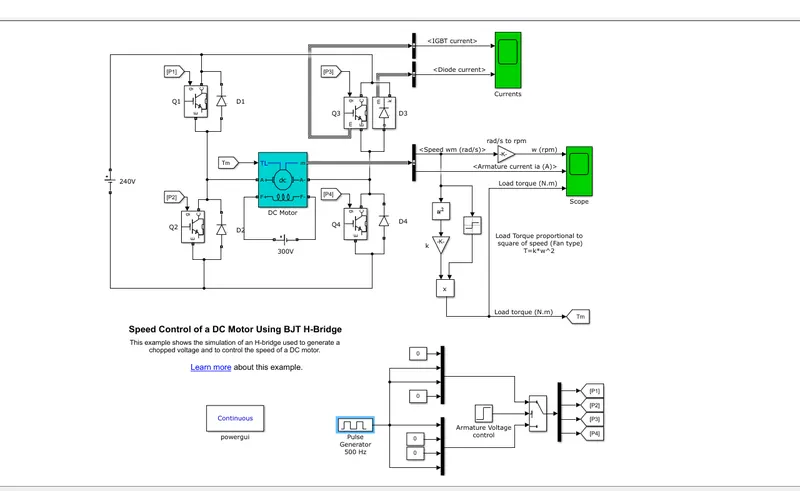
- open the matlab and with help of referance model speed control of dc motor by using BJT with H - bridge from the scope observed the result .
- The models is open in the simulink workspace .
- runs the models and observed the graph of armature current .
- click on the pulse genrator block set the value of pulse width .
- check the outputs , follow the same for 75% and 50% check the results while change in outputs parameter .
1- run the simulation at pulse-width of 75 %
NOTE : image is attached file attachedment page becuase of web issue
2- run the simulations at 50% of pulsewidth
B-outputs from above graph : if yours pulse-width decrease the stepvalue of armature current also decrease .
2: Refer to the help section of ‘The Four-Quadrant Chopper DC Drive (DC7) block’. Compare it with the H-bridge model.
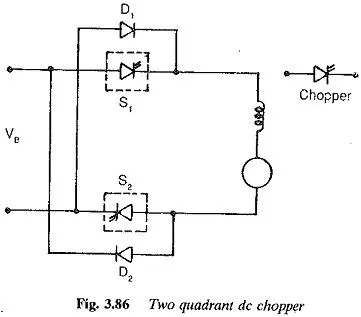
Sometimes a chopper may be required to provide a two quadrant operation by retaining the current direction in both motoring and braking modes. Such a Two Quadrant Chopper is shown in Fig. 3.86, and its waveforms in Fig. 3.87. The chopper permits a change in the polarity of terminal voltage keeping the direction of current constant. S1 and S2 are the choppers working as D1 and D2 are the feedback diodes. Assuming continuous conduction, both S1 anS2 operatesimultaneously.
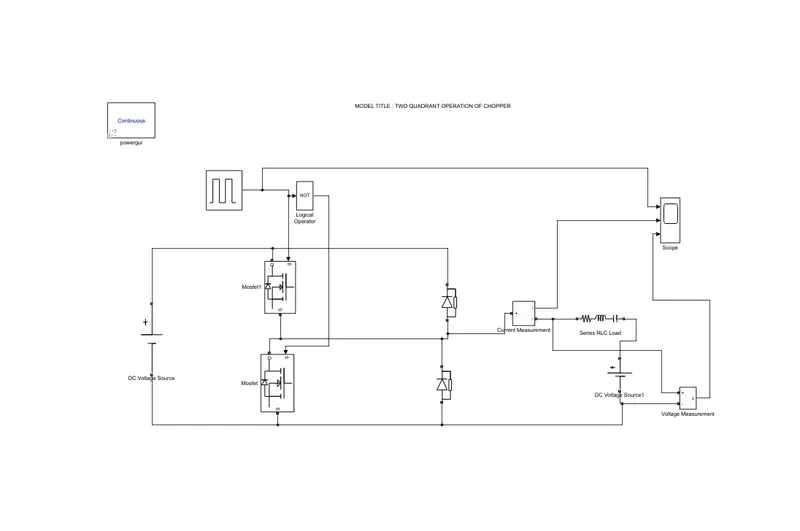
2.1-simulink model of the two quadrant operations of the chopper run the simulations for 0.1 sec
2.2-results after run the simulations :
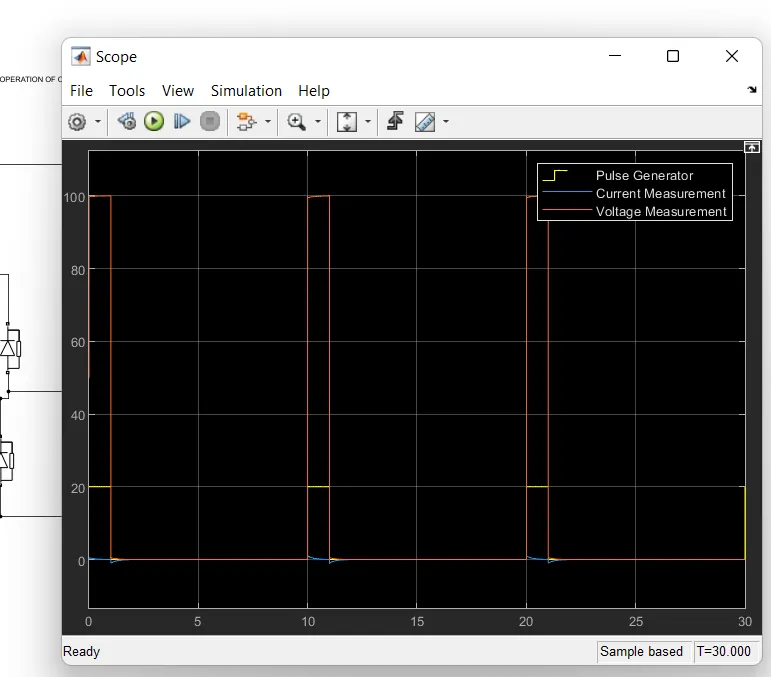
after changing in amplitude its will observed the current remains constants at value of 0 , while pulse genrator will genrate the pulses at 0 to 20 , and the voltage is vary from 0 to 100 .
the positive wave shows the on period of the mosfet .
3. Explain in a brief about operation of BLDC motor.
A brushless DC motor also known as BLDC motor is an electronically commuted DC motor which does not have brushes. The controller provides pulses of current the motor windings which control the speed and torque of thesynchronous motor
These types of motors are highly efficient in producing a large amount of torque over a vast speed range. In brushless motors, permanent magnets rotate around a fixed armature and overcome the problem of connecting current to the armature. Commutation with electronics has a large scope of capabilities and flexibility. They are known for smooth operation and holding torque when stationary.
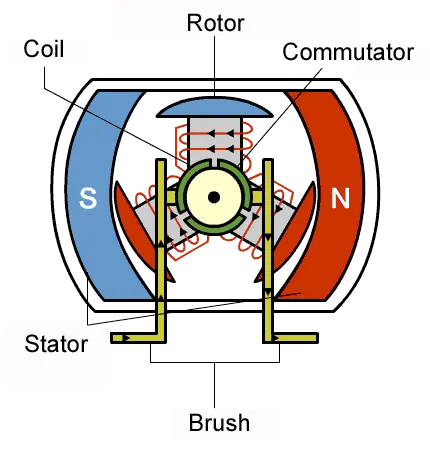
BLDC motor works on the principle similar to that of a conventional DC motor, i.e., the Lorentz force law which states that whenever a current carrying conductor placed in a magnetic field it experiences a force. As a consequence of reaction force, the magnet will experience an equal and opposite force. In case BLDC motor, the current carrying conductor is stationary while the permanent magnet moves.
When the stator coils are electrically switched by a supply source, it becomes electromagnet and starts producing the uniform field in the air gap. Though the source of supply is DC, switching makes to generate an AC voltage waveform with trapezoidal shape. Due to the force of interaction between electromagnet stator and permanent magnet rotor, the rotor continues to rotate.
Consider the figure below in which motor stator is excited based on different switching states. With the switching of windings as High and Low signals, corresponding winding energized as North and South poles. The permanent magnet rotor with North and South poles align with stator poles causing motor to rotate.
Observe that motor produces torque because of the development of attraction forces when North-South or South-North alignment and repulsion forces when North-North or South-South alignment. By this way motor moves in a clockwise direction.
advantage of BLDC motor.
- It has no mechanical commutator and associated problems.
- High efficiency due to the use of permanent magnet rotor.
- High speed of operation even in loaded and unloaded conditions due to the absence of brushes that limits the speed.
- Smaller motor geometry and lighter in weight than both brushed type DC and induction AC motors.
- Long life as no inspection and maintenance is required for commutator system.
- Higher dynamic response due to low inertia and carrying windings in the stator.
- Less electromagnetic interference.
- Quite operation (or low noise) due to absence of brushes.
Disadavantages of bldc motor
- These motors are costly
- Electronic controller required control this motor is expensive
- Not much availability of many integrated electronic control solutions, especially for tiny BLDC motors
- Requires complex drive circuitry
- Need of additional sensors.
Applications :
- Computer hard drives and DVD/CD players
- Electric vehicles, hybrid vehicles, and electric bicycles
- Industrial robots, CNC machine tools, and simple belt driven systems
- Washing machines, compressors and dryers
- Fans, pumps and blowers