Week-7 Challenge: DC Motor Control
Aim:
1.To modify the model Speed control of a DC motor using BJT H-bridge such that armature current does not shoot up when motor changes direction from forward to reverse.
2.Comparison between The four quadrant chopper DC drive (DC7) block and H-bridge model
3.To make a suitable EV model using DC7 block.
Explanation:
The bipolar junction transistor when used for power switching applications it operates as an IGBT.When it is conducting a forward voltage Vf is developed between collector and emitter.Therefore, the IGBT block can be used to model the BJT device.The H-bridge consists of four BJT/Diode pairs.Two transistors are switched simultaneously:Q1 and Q4 or Q2 and Q3.When Q1 and Q4 are fired, a positive voltage is applied to the motor and diodes D2-D3 operates as free-wheeling diodes when Q1 and Q4 are switched off.When Q2 and Q3 are fired a negative voltage is applied to the motor and diodes D1-D4 oprates as free-wheeling diodes when Q2 and Q3 are switched off.
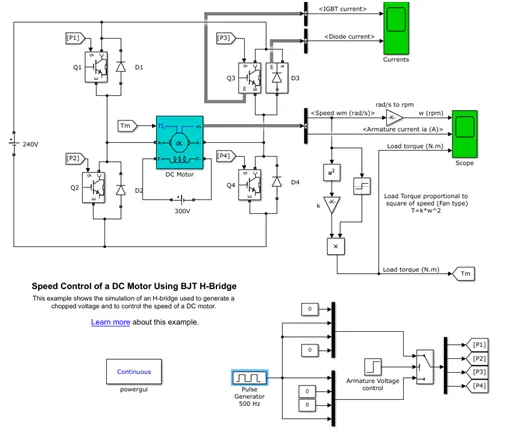
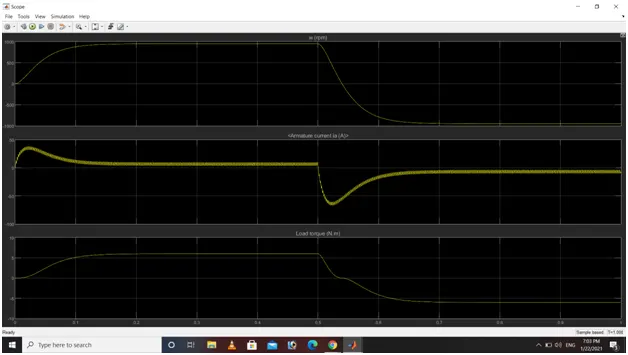
The 100% of Duty cycle is 240V but the process cant takes place at 100% so that at 75% the motor starts in the positive direction and at 0.5 second the armature voltage is suddenly reversed and the motor runs in the negative direction.
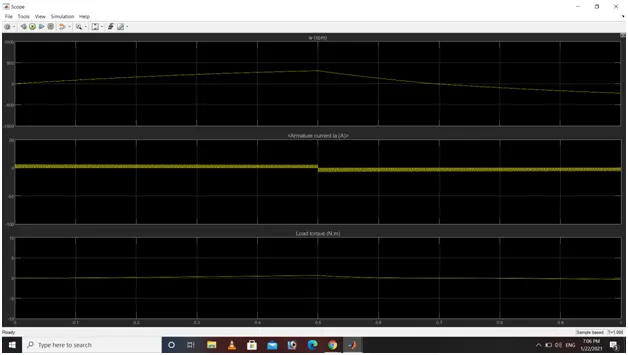
To rectify this the duty cycle is been taken at 40% so that at 0.5 second the motor gets reversed and the transition is smooth for the next half.
2.
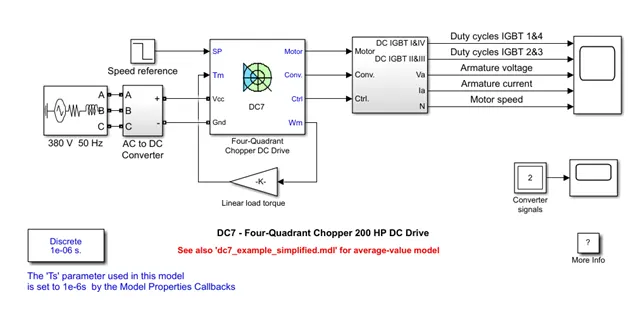
(i)The 200 HP DC motor is separately excited with a constant 150V DC field voltage source.The armature voltage is provided by an IGBT converter controlled by two PI regulators.The converter is fed by a 515 V DC bus obtained by rectification of a 380V AC 50 Hz voltage source. In order to limit the DC bus voltage during dynamic braking mode, a braking chopper has been added between the diode rectifier and the DC7 block.the first regulator is speed regulator, followed by a current regulator.The speed regulator outputs the armature current reference used by the current controlled in order to obtain the electro magnetic torque needed to reach the desired speed.The speed reference change rate followa acceleration and deceleration ramps in order to avoid sudden reference changes that could cause armature over-current and destailize the system.The current regulator controls the armature current by computing the appropriate duty ratios of the 5KHz pulses of the four IGBT devices.For proper system behavior, the instantaneous pulse values of IGBT devices 1 and 4 are opposite to those of IGBT devices 2 and 3.This generates the average armature voltage needed to obtain the desired armature current.In order to limit the amplitude of the current oscillations, a smoothing inductance is placed in series with the armature circuit.
(ii)An H-bridge is a simple circuit that lets you control a DC motor to go forward and backward.If you close switch 1 and 4, you have plus connected to the left side of the motor and minus to the other side. And the motor will start spinning in one direction.If you instead close switch 2 and 3, you have plus connected to the right side and minus to the left side. And the motor spins in the opposite direction.
3.
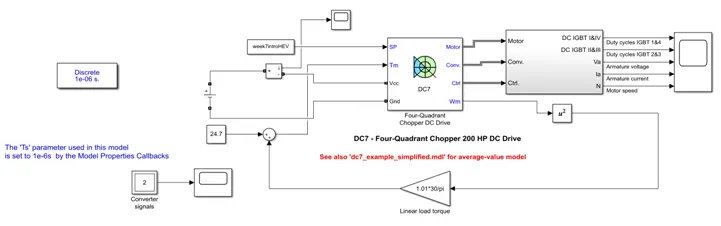
To change the DC7 into an EV,
- Change the AC to DC converter and the rectifier with a DC source battery, positive terminal to the current measurement block and negative to the ground.
- Current measurement bloct’s I terminal to the scope and negative to the Vcc.
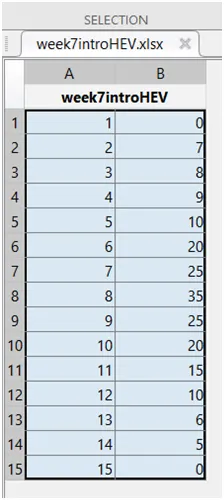
- Give a driving cycle as the input from workspace.
- The torque equation is been implemented using the blocks, square(to square the w), gain, sum(to add the constant and gains),constant(24.7) and give it to the Tm.
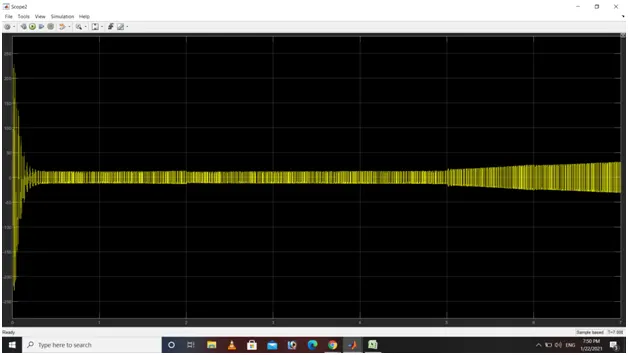
Results:
Thus the answers for the questions is explained , shown and plotted.