Week 7 Challenge
Load the vehicle parameters. Complete the vehicle model by modelling the remaining equations. Set simulation stop time to 598 sec.
The output should be the vehicle velocity.
Vehicle model here is nothing but the equation of forces which comes under velocity ie. when vehicle moves from its rest position for motorized vehicles such as automobiles aircraft and watercraft, vehicle dynamics is the study of vehicle motion. e.g. how a vehicle's forward movement changes in response to driver inputs, propulsion system outputs, ambient conditions air/surface/water conditions etc. Below image shows the force acting on a vehicle
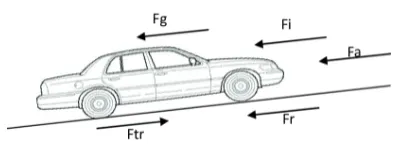
Where
Ftr= Tactive FOrce
Fa= Aerodymanic drag resistant force
Fg= Gradient Resistance force
Fr= Rolling resistance force
Fi= Inertial resistance force
Tractive force is the force applied/produced by the vehiclepoertrain we will now see the quations of three main forces and will implement this sing matlab Fcn block
Aerodynamic drag: Aserodyamic Drag is a force which the oncoming air applies on a moving body. its is the reistance offered by the air to the movement of the body. So when a car is moving it displaces the air However it affects the car's speed and performance Tehncially it is the aerodynamiv drag or the friction offered by the air to a vehicle
Aerodynamic Drag= 1/2*p*Cd*A*V2
Force of aceelration : The acceleration force refers to the vehicle resistance to speed varitaions This force holds you back when you increase your speed and also moves you forward when you slow down in other words it means that you consume energy to acclerate up to as certain speed but can recover part of that energy when you decelerate allowing you to drive a certain distance without consuming fuel in equations it is simply written as
F=m*a ( m is mass and a is acceleration)
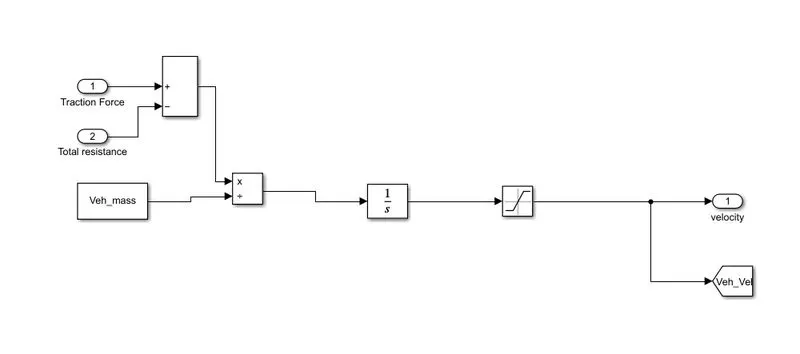
Vehicle model
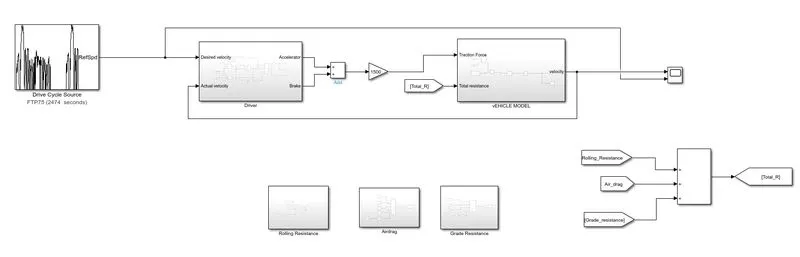
Inside view of vehicle model
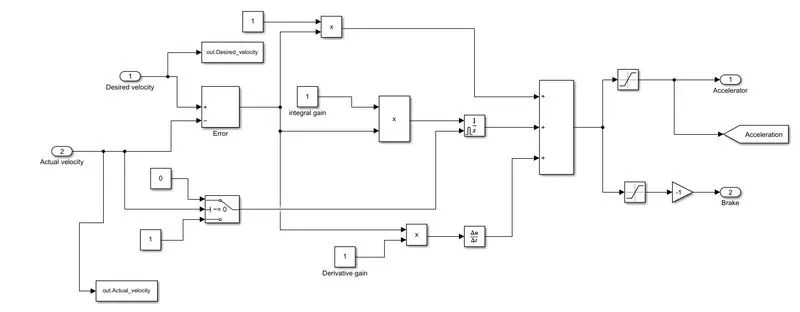
Driver Block
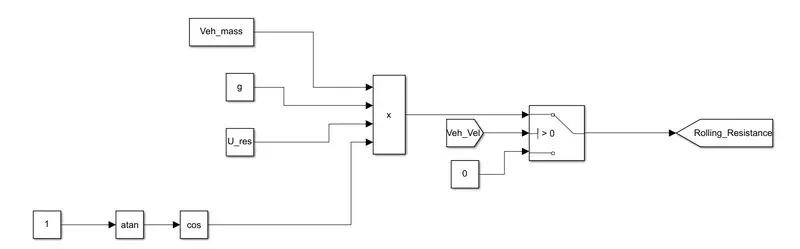
Rolling Resistance
To find the rolling resistant force we have multiplied vehicle mass(Kg), acceleration due to gravity(m/S2), rolling resistance coefficient, and cosine of the angle of gradeability(in radian).
Frr=veh_mass*g*U_res*cos(0)
Aerodynamic drag
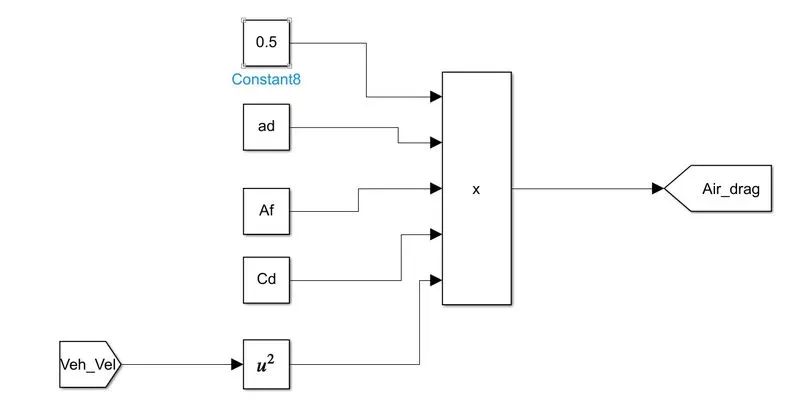
To find the aero drag resistance force we have to multiply vehicle frontal area(m2), Air drag coefficient, air density(Kg/m3) and square of vehicle velocity(m/s).
Faero=0.5*Af*Cd*del*( velocity ^2)
The velocity of the vehicle is get from a From block(output of model) and squared by a square block.All these parameters are get multiplied to get the output as an aero drag resistance force.
Hill climbing resistance
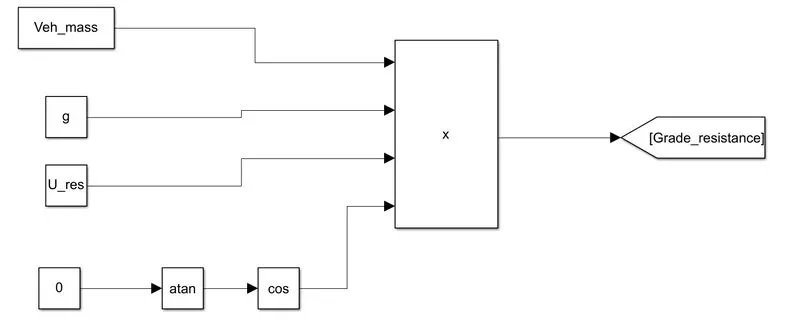
Hill climbing resistance force can be obtained by multiplying the Mass of the vehicle(Kg), Acceleration due to gravity(m/s^2), and sine of the angle of gradeability(in rad).
This can be given in relation as,
Fhc=veh_mass*g*sin(0)
All parameters are get multiplied in a product block and get hill climbing resistance force as shown below,
Matlab file for parameters
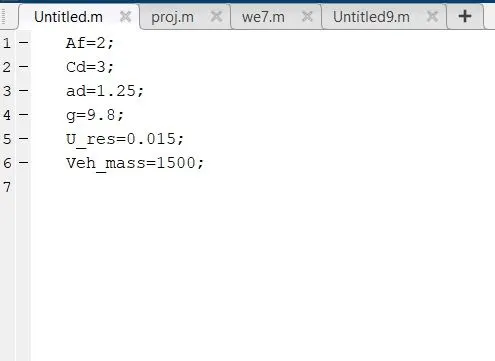
The vehicle paramertes is loaded using mat files. The parameters value is shown below
Parameters value
Vehilce mass 1500kg
Gravitation force 9.8
RR coefficient 0.015
Drag Coff 2.
Air density= 1.25
Frontal area=2
Output simulation results
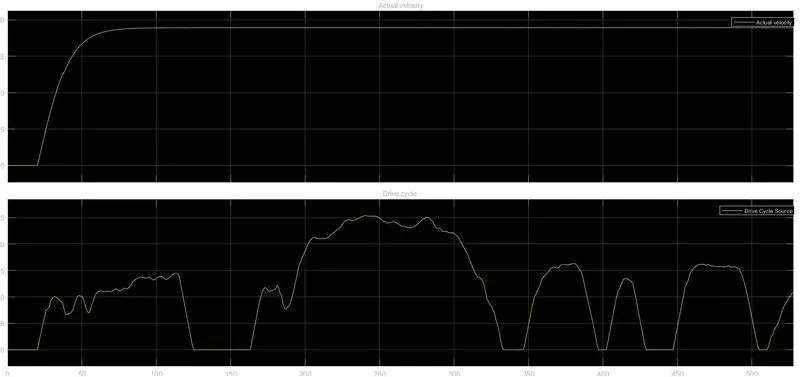
- Run the simulation for 598 secs and the vehicle velocity output as shown for the assigned vehicle parameter values
- The first plot shows the vehicle actual velocity output as per the input traction force given.
- The second plot shows the FTP75 Drive cycle.
CONCLUSION
Completed the vehicle model by modeling the remaining equations.