Week-6 Challenge: EV Drivetrain
Question 1
Which types of power converter circuits are employed in electric and hybrid electric vehicle?
in electric vehicles and hybrid electric vehicles (EV/HEV).power converter circuits .in ev or hev vehicles power converter circuits interface their power sources to drivetrain.power converters like AC TO DC Converters, DC to DC converters, AC to DC converters are the type of converters.
AC to DC converters
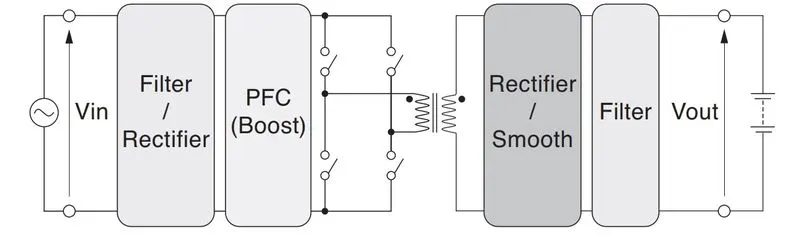
These type of power converters mainly used in EV and PHEV Vehicles.The AC/DC converter consists of a power factor correction (PFC) which converts inputAC voltage into DC voltage, an H-bridge circuit which converts the DC voltage into high-frequency AC voltage, a high-frequency transformer which regulates transformation and insulation, and a circuit which rectifies and smooths high-frequency AC voltage. Generally, an AC/DC converter has higher output power than that of a DC/DC converter for driving auxiliaries, and accordingly AC/DC converter’s coil parts occupy a larger space. As the AC/DC converter is also equipped with reactor for the PFC, the coil parts aloneweigh as much as 20-30% of the total weight of the AC/DC converter.
DC to DC Converter
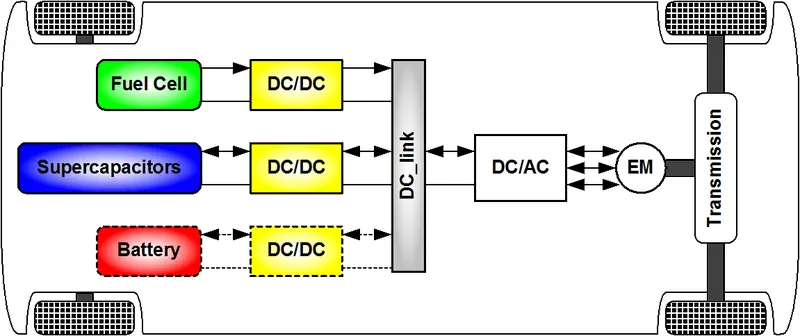
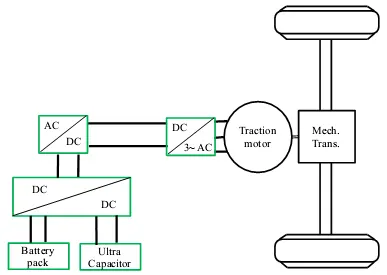
The other parameters of the electric vehicle is given below,
Motor and Controller Parameters:
Rated Armature voltage= 72 V
Rated armature current= 400 A
Ra= 0.5Ω,
KΦ= 0.7 Volt second
Chopper Switching frequency= 400 Hz
The vehicle speed-torque characteristics are given by the below equation

What is EV steady state speed if duty cycle is 70%?
Solution
Battery pack voltage=72V
Rated armature current=400A
Armature resistance=0.5Ω
Motor constant=0.7
Chopper switching frequency=400Hz
Duty cycle=70%
Vv=Battery voltage=72*0.70=50.4V
Equation for vehicle torque is
Tv=(Vv−ω.K∅)⋅K∅/Ra
Tv=(50.4-0.7*w)*0.7/0.5
Tv=70.56-0.98*w--1
Tv=24.7+0.0051⋅ω^2--2
By solving the above two equations into quadratic form we get
w=38.8rad/s and w=-230.9 rad/s
so steady state speed of vehicle is taken as positive so w=38.8 rad/s
Question 3
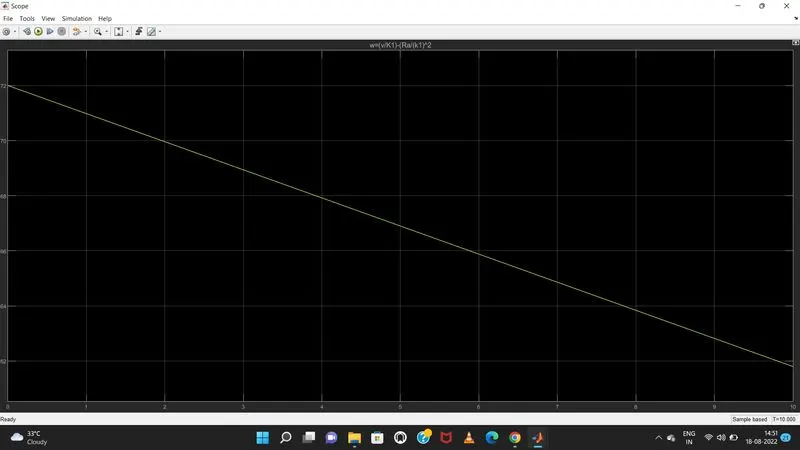
Develop a mathematical model of a DC Motor for the below equation using Simulink.
ω= V/Kϕ-(Ra/Kϕ)^2 .T
V=50.4; %Voltage
Ia=400;  %armature current
Ra=0.5;  %armature resistance
K1=0.7;   %motor constant
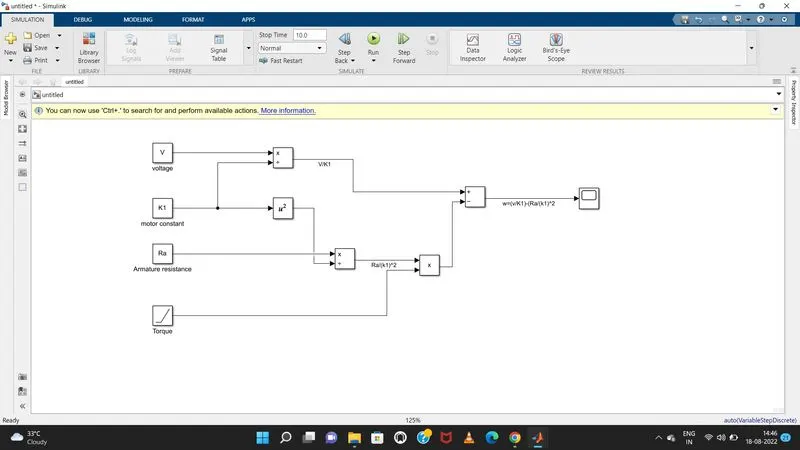
Result
Question 4
wally rippel is a long time proponent of electric vehicles.he helped to develop the ev 1 vehicle of general motors.
at the starting of the blog wally says that no one is the best engine he says different type of engine is used for different requirement.he also said about evolution of batteries dc motor and lead acid type of batteries is replaced by lithium batteries.lso he speak about what differentiate them ? in that he told about DC brushless machine that rotor generate the magnetic field with two or more permanent magnet and this magnetic field enters the stator core
in conclusion wally found elaborated different aspects for dc brushless and induction motor
Dc brushless motor
- dc brushless motor require absolute position sensor.
- heat produced in rotor side is less .
- rotor cooling is easy in dc brushless motor.
- it can operate at unity power factor.
- the torque generated due interaction of rotor and stator magnetic field
- The rotor requires two or more permanent magnet to generate a magnetic field
- power factor upto 100% can be reached
- permanent magnets are costliest and ferromagnet cannot be brought near the magnet
- when size increases losses increases and also load efficiency also got decreases
- The magnetic field strength cannot be adjusted thus only single torque output can be obtained
- Preferred for ev
Induction motor
- AC supply
- induction motor requires speed sensor
- Stators rotating magnetic field induces a current in rotor laminations, which interact with the stator magnetic field and produce torque
- rotor cooling is difficult maximum efficiency is upto 85%
- complex control laws for inverter
- as size increases losses also approximately as same.
- The magnetic field strength can be varied as a function of voltage supply and frequency for optimized torque output.
- preferred for pure ev