Week 7 Challenge
Aim is to fix a foundation which can reinforce the soil, and also carry the applied load down to deeper, stronger soil strata.
Introduction - As with other types of foundations, the purpose of pile foundations is: to transmit a foundation load to a solid ground to resist vertical, lateral and uplift load
Pile foundations are the part of a structure used to carry and transfer the load of the structure to the bearing ground located at some depth below ground surface.
In the cases of heavy constructions, it is likely that the bearing capacity of the shallow soil will not be satisfactory, and the construction should be built on pile foundations. Piles can also be used in normal ground conditions to resist horizontal loads. Piles are a convenient method of foundation for works over water, such as jetties or bridge piers.
Most of pile foundations consist not of a single pile, but of a group of piles, which act in the double role of reinforcing the soil, and also of carrying the applied load down to deeper, stronger soil strata. Failure of the group may occur either by failure of the individual piles or as failure of the overall block of soil. The supporting capacity of a group of vertically loaded piles can, in many cases, be considerably less than the sum of the capacities the individual piles comprising the group. Grope action in piled foundation could result in failure or excessive settlement, even though loading tests made on a single pile have indicated satisfactory capacity. In all cases the elastic and consolidation settlements of the group are greater than those of single pile carrying the same working load as that on each pile within the group. This is because the zone of soil or rock which is stressed by the entire group extends to a much greater width and depth than the zone beneath the single pile
Q-1
Answer - The total numbers of piles in the pile group depends upon the loads that are needed to be transferred to the foundation from the substructure. If the magnitude of the loads are more, that the number of piles required will be more. Various geotechnical, hydrological and topographical factors should be taken in to considerations while deciding the number of piles in group. It is not the least but also depends upon the bearing capacity of the pile group.
Determine the load from superstructure in SLS condition. Suppose 4259.247kN
Choose pile diameter for respective safe working load. Suppose 900mm dia 1210kN as per soil investigation report.
No of piles required for 4259.247/1210 = 3.52 provide 4piles per pier leg.
Wall type Abutment faces earth pressure from approach, fixed from main bridge.
Circular type abutment used in fly over or other such construction where approach is separate structure, RE walls etc, free from main bridge.
Q-2
Answer - Base pressure is the governing criteria for fixing the diameter of well foundation. It is also dependent on the size of super structure, spa, type of well foundation. Depth is being fixed as per soil strata giving skin friction, or end bearing hard strata.
Wells shall be designed to resist the worst condition due to possible combination of the following loads, as may be applicable, with due regard to their direction and point of application.
- Vertical Loads:
- i) Self-weight of well. ii) Buoyancy. iii) Dead load of superstructure, substructure. iv) Live load, and v) Kentledge during sinking operation
(b) Horizontal Forces:
- i) Braking and tractive effort of moving vehicles. ii) Forces on account of resistance of bearings. iii) Forces on account of water current or waves. iv) Centrifugal force, if the bridge is situated on a curve. v) Wind forces or seismic forces. vi) Earth pressure. vii) Other horizontal and uplift forces due to provision of transmission line tower (broken wire condition) etc.
Combination of loads for ULS and SLS
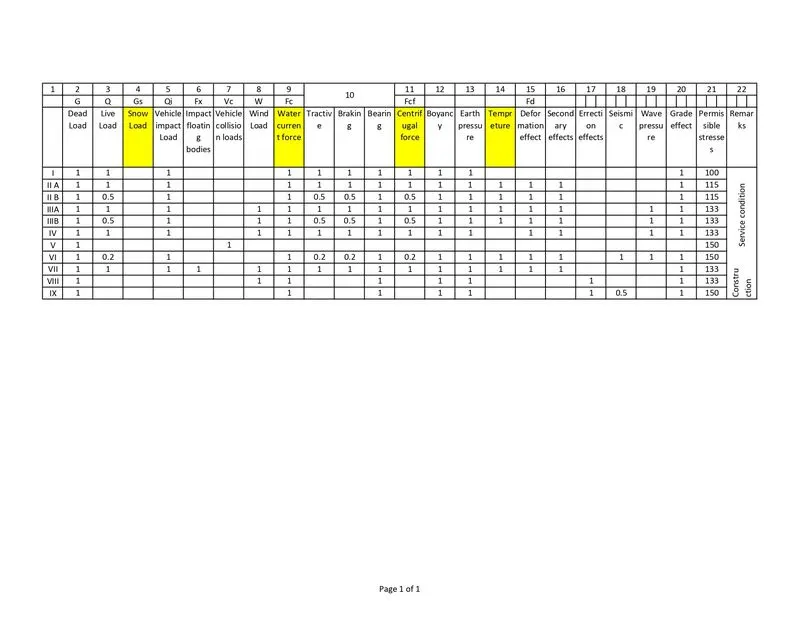
The length of the pile in scouring or liquefaction zone is considered as free standing length of the pile. Free standing length of piles is not considered to take any loads. In order to calculate the free standing length, the scour depth below the natural ground level need to Maximum scour depth for pier and abutment with scour all round is Dm= 2 Dsm, and maximum scour depth for abutment with approach retained is Dm= 1.27 Dsm.
Clause 703.2, 703.3, 703.4 and 703.5 of IRC 78 with it's appendix-1 for clause 703.2.2.2 are relevant codes
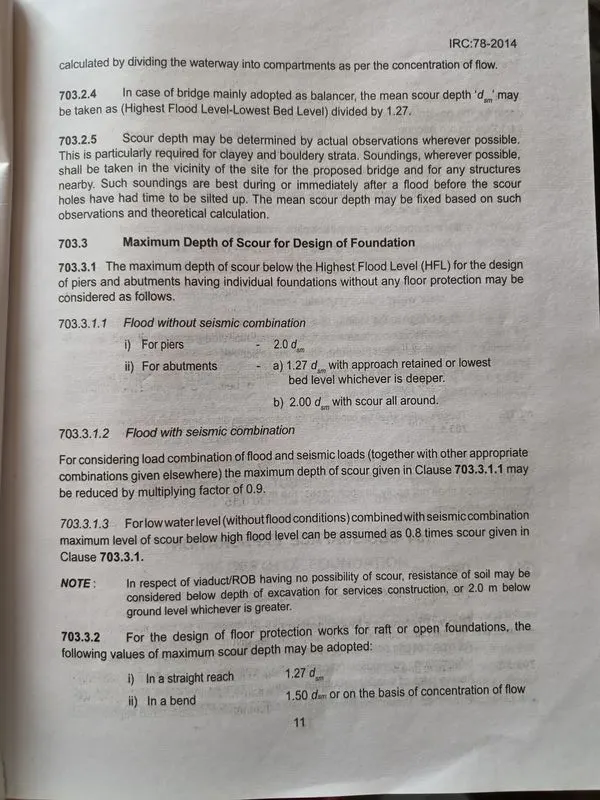
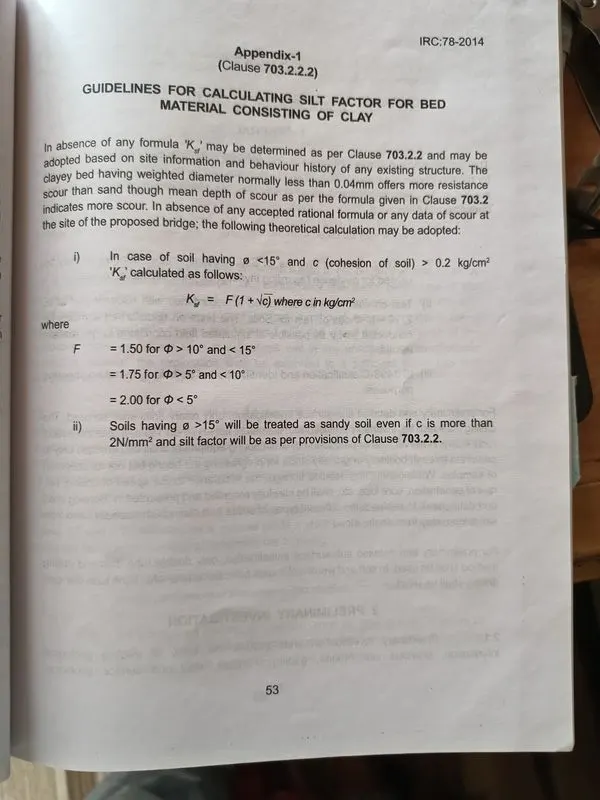
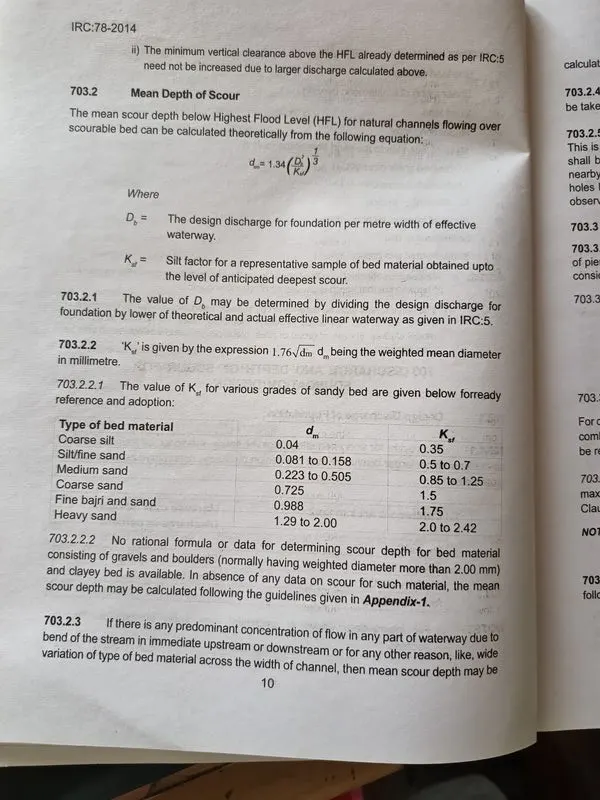
As free standing length of piles is not considered to take any loads, this length wiil be extra to full lenth. Exposed portion of free standing pile to the external environment will require protection of the piles has to be done by liner etc.
- Height of abutment = 5 m
- Wight of abutment = 12 m
- Vertical capacity = 250 tonnes
- Horizonatal capacity = 35 tones
To Calculate No of pile required in foundation.
Assuming total load from the structure is 2500 T
So,
= Total laod from structure / Veritical capacity.
= 2500 / 250
= 10 Nos of pile required.
Deep foundations are preferred in a particular site depending on the various factor such as
the soil type, scouring, liquifaction, span type and oading. The failures that happen in the
deep foundation are mainly because of the surrounding soil.
Failures in deep foundations:-
Uequal settlement of subsoil.
Horizontal movement of the adjoining structure.
Tilt and tolerance failure cause due to boulder in the soil. This results in the uneven sinking
of well.
Lateral escape of soil below the foundation.
Lateral pressure tending to overturn the structure.
RCC failure.
Remedies:-
Symmetrical placing of the piles.
Proper recording of the tilt & shift by checking the site prameters.
Increasing the number of test pile according to the loads.
Checking the horizontal capacity of piles.
Pemoving the liqefiable soil and fill it with some other high density soil.
Various parameters should have to be taken in to consideration before planning for deep
foundation such as pile foundation & well foundations which includes:-
Site clearance and boring should be carried out as per indian standards.
Casting the piles by pouring wet concrete.
Prottective work such as cofferdam & sheet piling should be done around the foundation.
Bottom plug, sinking & top plugging in case of well foundation.
Lowering the steel cage after clearing