Week-6 : Turbocharger Modelling
Types of Turbocharger :
There are a number of different types of turbochargers used within the automotive industry:
- Single-Turbo
- Twin-Turbo
- Twin-Scroll Turbo
- Variable Geometry Turbo
- Variable Twin Scroll Turbo
- Electric Turbo
Locating examples of Turbocharger from GT Power:
The following are the examples of the turbocharger from GT power.
1. Fixed Geometry Turbocharger:
The simplest turbocharger design from a control perspective is one whose turbine and compressor geometry are fixed and that uses no means to control boost pressure. The boost pressure provided by this type of turbocharger is entirely determined by the engine exhaust flow and the characteristics of the turbocharger. The turbocharger is optimized for a particular operating condition.
2. Variable Geometry Turbocharger:
VGTs include a ring of aerodynamically shaped vanes in the turbine housing at the turbine inlet. In turbos for passenger cars and light commercial vehicles, these vanes rotate to vary the gas swirl angle and the cross-sectional area. These internal vanes alter the turbos area-to-radius (A/R) ratio to match the engine's RPM, and so give peak performance. At low RPM, a low A/R ratio allows the turbo to quickly spool up by increasing exhaust gas velocity and. At higher revs the A/R ratio increases, ther4eby allowing increased airflow. This results in a low boost threshold reducing turbo lag and provides a wide and smooth torque band.
3. Wastegate Turbocharger:
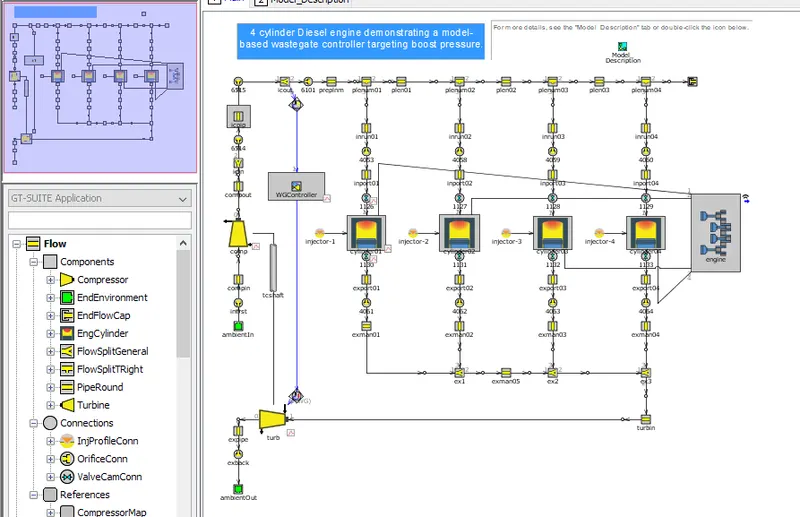
A wastegate is essentially a device that bypasses some exhaust flow around the turbine section of a turbocharger to control maximum boost. A wastegate is usually controlled by a pressure actuator that is connected to manifold pressure.
Exploring tutorial numbers 6 and 7:
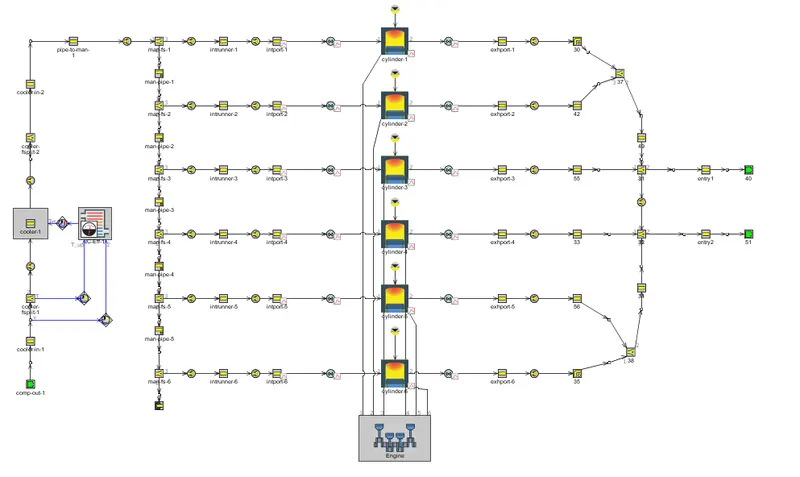
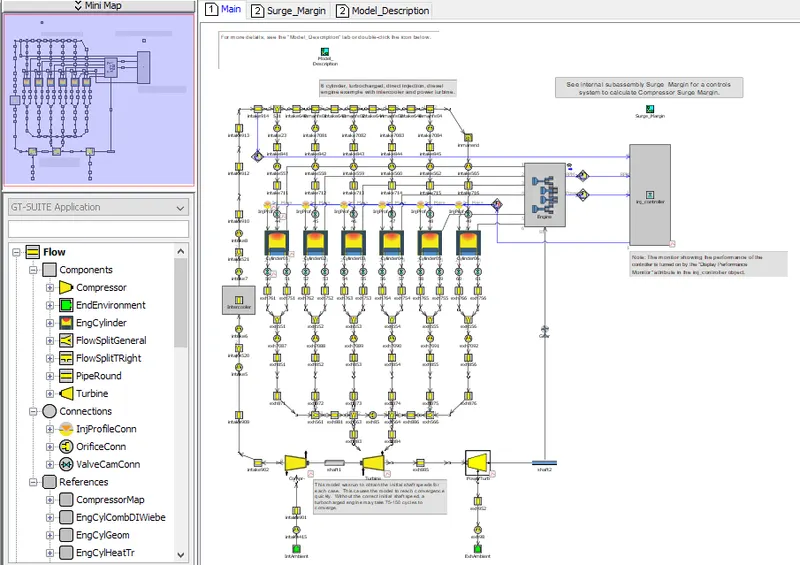
This is a 6cylinder Direct Ignition Diesel Engine with an Intercooler system with no turbocharger. The intake system will consist of an intercooler (aftercooler, charge air cooler) and a log-style intake manifold.
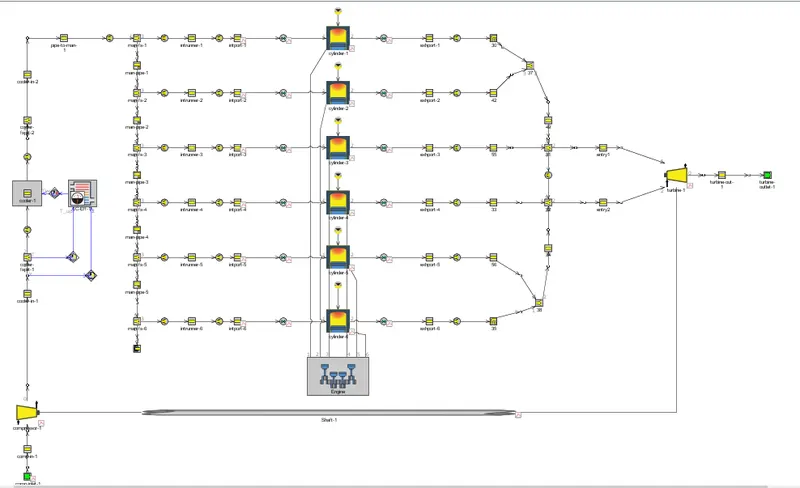
This is a 6cylinder Direct Ignition Diesel Engine with an Intercooler system with a turbocharger which is attached in the exhaust section.
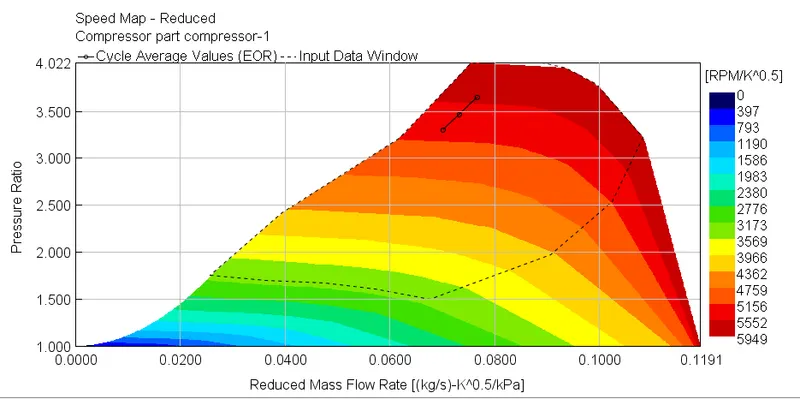
Compressor Map:
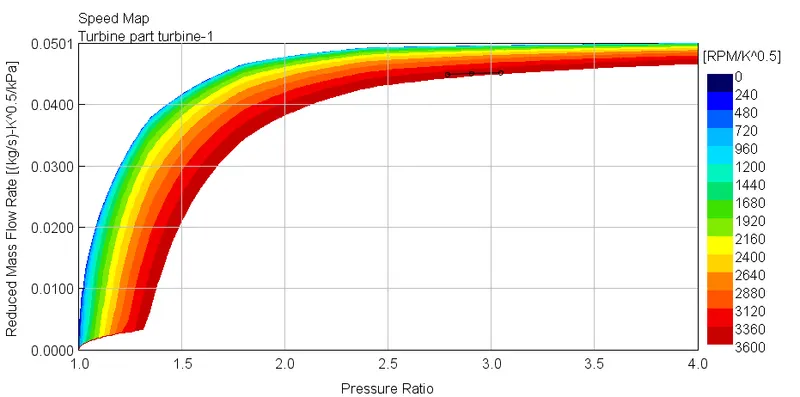
Turbine Map:
In which application Variable Geometry Turbine is beneficial?
VGT is used to increase the Boost Pressure at low speed, reduces response time, increases available torque, decrease the boost at high engine speeds to prevent over boosting, reduce engine emission, improve fuel economy and increase the overall turbocharger operating range.
Exploring example - Diesel VGT EGR and understand the modeling part:
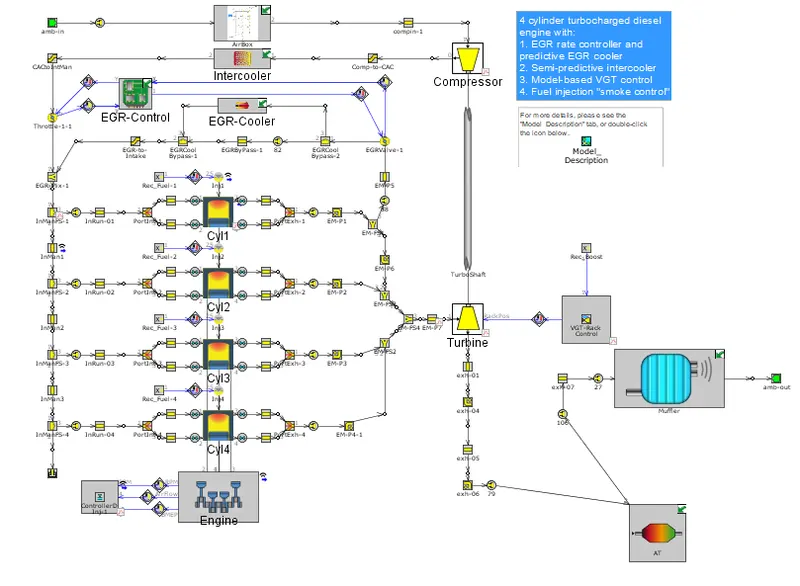
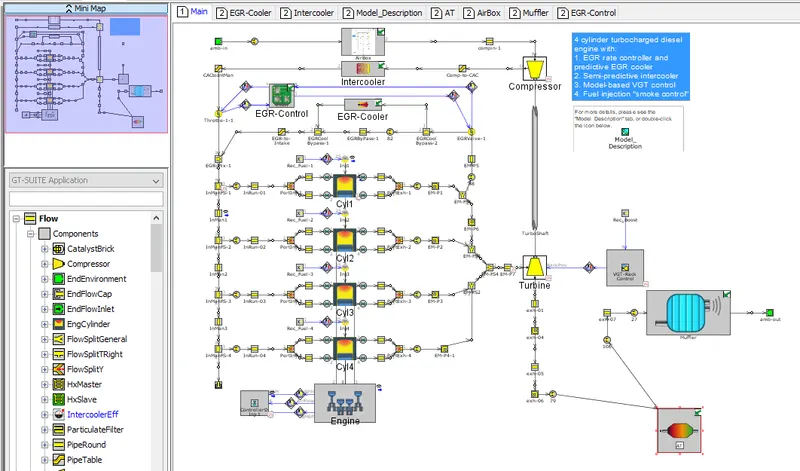
- The example 'Diesel_VGT_EGR' demonstrates several modeling concepts important for automotive diesel engines, including variable geometry turbine, boost control, intercooler, EGR circuit with cooler and EGR rate control, injection limiting for smoke control, and exhaust after-treatment device modeling.
- 4 cylinder turbocharged diesel engine with:
1. EGR rate controller and predictive EGR cooler
2. Semi-predictive intercooler
3. Model-based VGT control
4. Fuel injection "smoke control"
- The Engine:
The engine is a 4-cylinder, four-stroke, direct injection, 2L diesel engine. The engine runs in "speed" mode, where the engine speed is entered by the user and the engine torque is calculated. Combustion is modeled by the DIPulse method, a predictive combustion model using the detailed injection profiles. In-cylinder heat transfer is modeled using the Woschni model. A FE model is used to predict the cylinder, head, and piston temperatures. This simulation will run until it reaches steady-state convergence for six different engine speeds at full load, three-part load operating points, and an additional idle point.
- The Intake System:
The intake system consists of the air piping upstream of the compressor inlet and contains a simple model of an airbox. - The airbox is modeled as a group of interconnected flow splits that represent the total volume of the airbox. At the inlet and outlet of the air box, "bellmouth" orifice connections are used to model smooth transitions.
- The Intercooler:
The intercooler is found downstream of the compressor outlet. This intercooler is an air-to-air intercooler that is modeled using a "semi-predictive" method based on heat exchanger effectiveness.
- ControllerTurboRack - Turbocharger VGT Rack Controller is used to target various engine performance parameters in turbocharged applications. It functions as a targeting controller, analogous to the usage of a 'PIDController', but without the inconvenience of finding good gains for every operating condition. At every timestep, it calculates the rack position based on several physical quantities of the engine and turbocharger system.