Week 6: Conjugate Heat Transfer Simulation
Aim: To Simulate conjugate heat transfer using converge through a pipe and post process the results using paraview for different supercycling stage intervals.
Geometry used in the simulation.
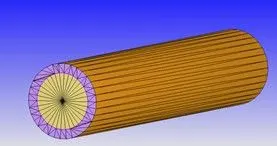
Calculation of inlet velocity:
Inlet Reynolds number =7000
Diameter of pipe = 0.03 m
Dynamic viscocity (air) =1.81*10^-5 pa s
Density(ρ)=1.225 kg/m^3
Re=ρvd/µ
v=Reµ/ρd
= (7000*1.81*10^-5 pa s)/1.225kg/m^3*0.03m
=3.45 m/s
Setup-
Applications-
-Time-Based
Materials-
Selection: Gas Simulation, Solid Simulation, Species
Species-Air-O2, N2, Solid- Aluminum
Simulation Parameters:
Run Parameter: Transient solver | Full Hydro. | Compressible
- Time-Based Simulation
-Start time-0
-End time-0.2 s
-Initial time step=minimum time step=1e-7 s
-Maximum time step=1 s
Max CFL limit(Convection/Diffusion): 1.0/2.0
Boundary conditions-
-Inlet- INFLOW-velocity-5 m/s(z), 300K, Air(Species)
-Outlet- OUTFLOW-velocity- Zero normal gradient,300K, Air(Species)
-Solid outer wall- WALL, stationary, fixed, slip, Heat flux= -10000 W/m2
-Solid wall thickness - stationary, fixed, slip, Temperature-zero normal gradient
-Interface- Stationary, forward side – (solid) Law of wall – Temp and Velocity,
reverse side – (fluid) slip wall treatment
Regions & Initialization:
Boundaries are assigned to region
Solid region: 300k, Species – Aluminum
Fluid Region: Temperature and pressure set to 300K and 101325pa
Species-Air
Grid Dependence test:
Case-1: Grid size- dx=0.04 m, dy=0.04 m, dz=0.04 m
The picture below shows the mesh used in the simulation.
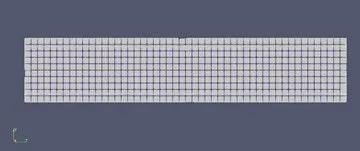
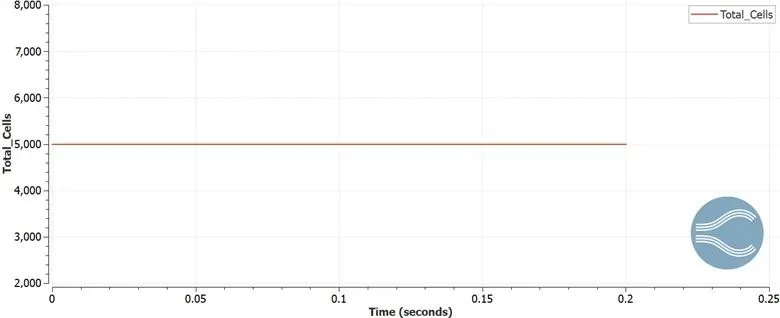
Total cell count present in the geometry is close to 5000 cells.
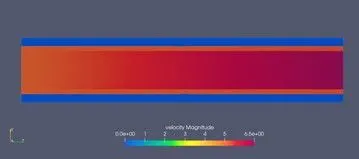
Velocity contour
The velocity contour shows the velocity is higher at the outlet and lower in the region before this.
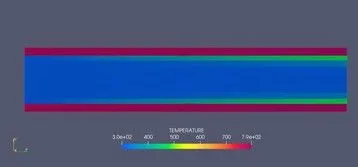
Temperature Contour
The temperature contour shows the temperature is higher at the outlet side at the solid and lower at the inlet at the fluid.
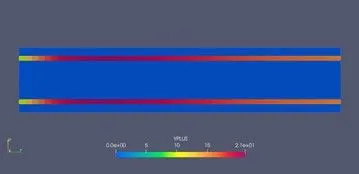
Yplus contour
The maximum number of Yplus is 21 for the mesh size of 0.04m.It is higher in the thickness and lower in the other regions.
Effect of supercycle stage interval:
Super-cycling is used by CONVERGE in the case of conjugate heat transfer problems with solid and liquid regions. The solver for fluid and solid does not run at same speed as heat transfer in fluid region is faster than solid region.
This can cause problems during the solution since the solid solver would not reach a steady state or convergence in the time the liquid solver reaches. This is where the concept of super-cycling can be used. Super-cycling is only meant to speed up the simulation.
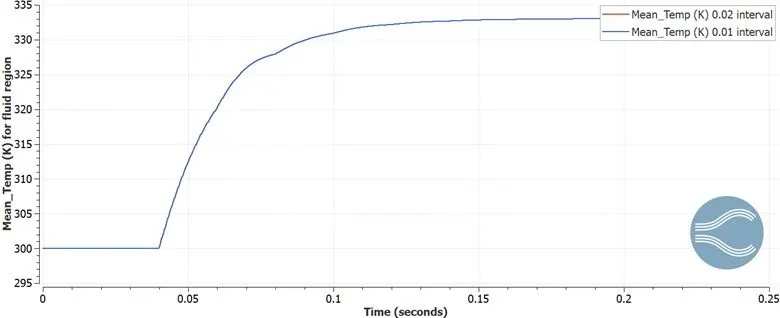
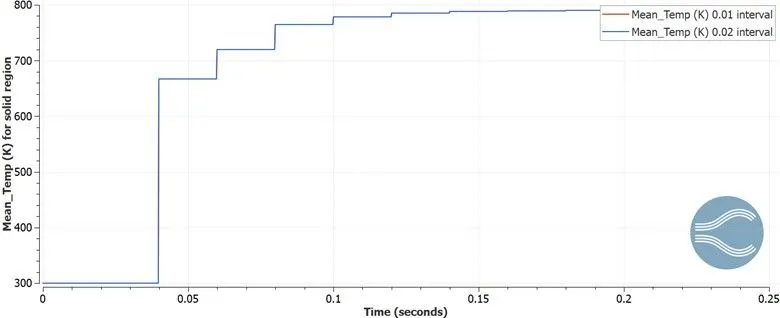
Three supercycle stage interval was set for comparison 0.01 and 0.02 respectively.
The mean temperature graph below shows the mean temperature for fluid region for supercycle stage interval of 0.01 and 0.02 respectively. It can be seen that the convergence rate in both cases is very similar and does not differ. It can be learned that the convergence rate remains same and not dependent on the supercycling stage interval and remains at 333K.
The graph below shows the mean temperature for the solid region for super-cycling stage interval of 0.01 and 0.02 respectively. It can be seen that the convergence rate is same for both for the intervals and does not differ. It can be understood that the effect of supercycling stage is minimal on the mean temperature for solid region which is at 790K.
Simulation time:
349.44s – 0.01 supercycle stage interval
373.62s – 0.02 supercycle stage interval
The time variation between the two supercycle stage interval was about 23 seconds.
Conclusion:
Conjugate heat transfer simulation through a pipe was performed.
The mean temperature in the different regions show no difference with the supercycle stage intervals.
The difference was found in the simulation time and about 23 seconds.
Youtube Animation Link: