Week 6 - CHT Analysis on a Graphics card
REPORT
Project - CHT analysis on a Graphics Card
OBJECTIVE
- To investigate the conjugate heat transfer analysis for the model of Graphics Card in Ansys Fluent.
- To determine the hot spots and heat transfer coefficient at different velocities.
INTRODUCTION
Nowadays electronic devices are produced in small and compact sizes that can be accommodated in given constraint spaces. The heat generated due to active components in such electronic devices is enormous. It becomes necessary to predict the areas with heat concentration and apply measures to reduce the same to increase the product's durability and performance.
Graphics Card
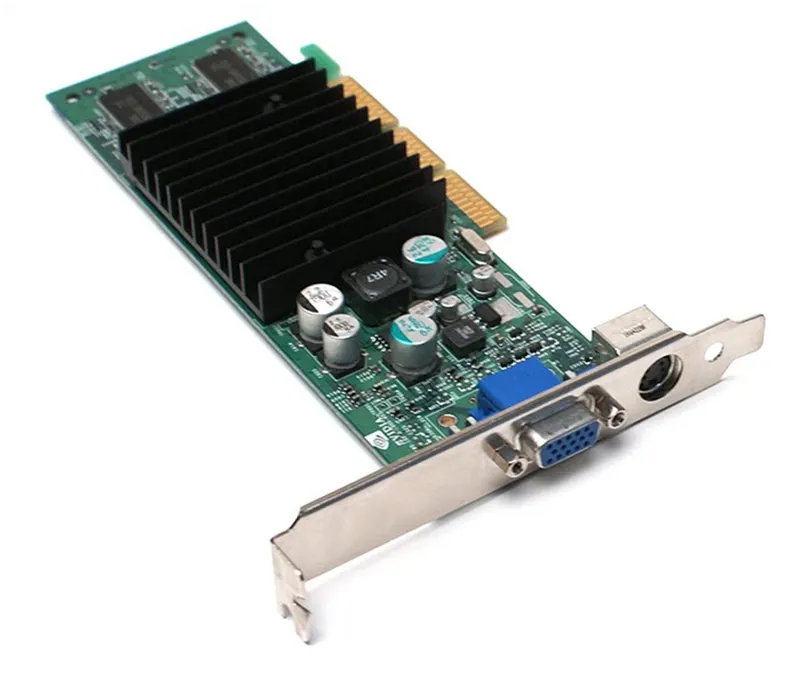
A graphic card is an expansion card which generates a feed of output images to a display device. Like a motherboard, a graphic card is a printed circuit board that houses a processor and VRAM. It also has an input/output system (BIOS) chip that stores the card’s settings and performs diagnostics on the memory, input and output at startup. A GPU is designed specifically for performing the complex mathematical and geometric calculations that are necessary for graphics rendering. A GPU produces a lot of heat, usually located under a heat sink or a fan.
LITERAURE REVIEW
CHT Analysis
Heat transfer is known as the flow of thermal energy from one region to another region occupied by any matter (solids and fluids) where the rate of heat transfer is proportional to the temperature difference between the regions/matter. For a system the thermal energy available is defined by its temperature and the movement of thermal energy is defined by its heat flux through the outer walls. Heat transfer in solid happens through conduction and walls by convection and in the liquid phase through convection. The thermal network consists of conductive, radiative, and convective resistances.
‘CHT’ describes the variation of temperature between the solids and fluids due to the exchange of thermal energy between them. The conjugate heat transfer (CHT) analysis allows the simulation of heat transfer between solid and fluid domains by exchanging thermal energy at the interfaces between them. CHT provides the temperature prediction and the hotspot regions at the solid-fluid interface. It also provides the velocity and pressure distribution of fluid moving inside the solid. CHT can be used in design optimization for the improvement of heat transfer and cooling capacity.
CASE
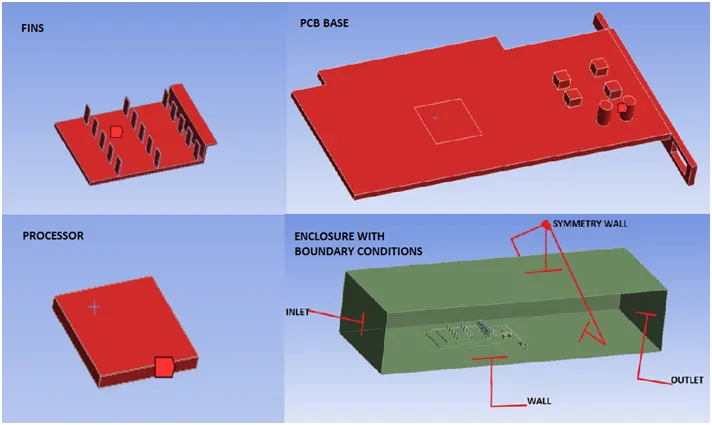
Here, steady-state conjugate transfer analysis on a model of a graphic card is performed. For the start, the material for the components of the graphic card is chosen as per mentioned in the table below.
Material
|
COMPONENT |
MATERIAL |
|
Processor |
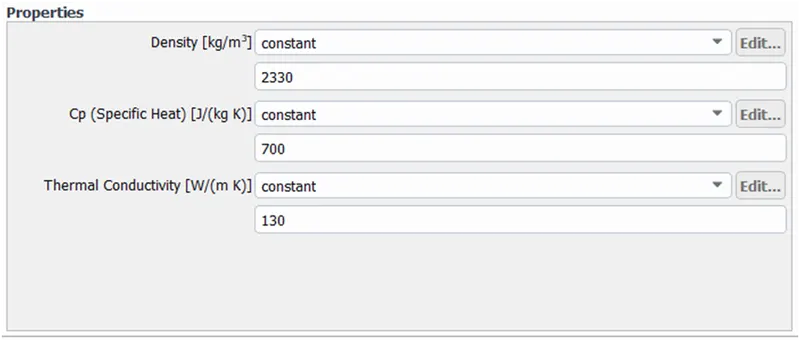
Silicon |
|
Fins |
Copper |
|
Base |
Aluminium |
|
Enclosure |
Air |
These materials are considered according to their properties like thermal conductivity and the component’s task to be performed.
Important Parameters
Heat generated by processor
- Power = P = 10 W
- Volume of processor = V = 64 mm3
- Heat generated = `P/V` = 10/64e – 9 = 156250000 W/m3
PROCEDURE TO SETUP THE CASE
Pre-processing
GEOMETRY
- Combine the parts to form basic individual components of the model.
- Enable share topology.
MESH
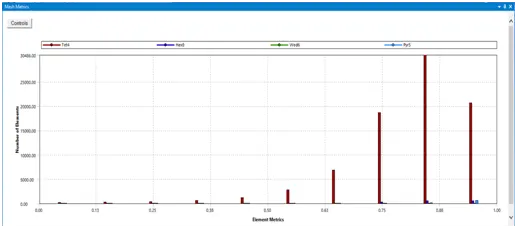
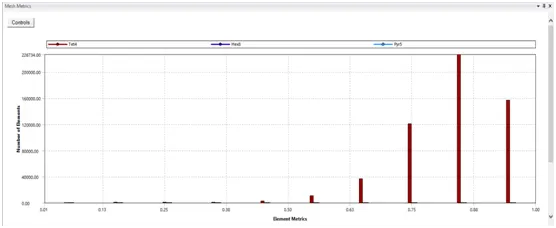
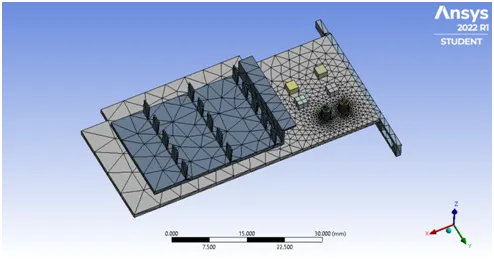
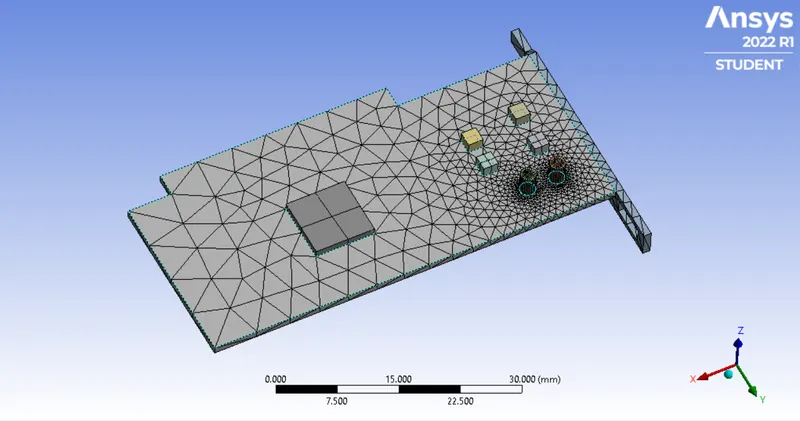
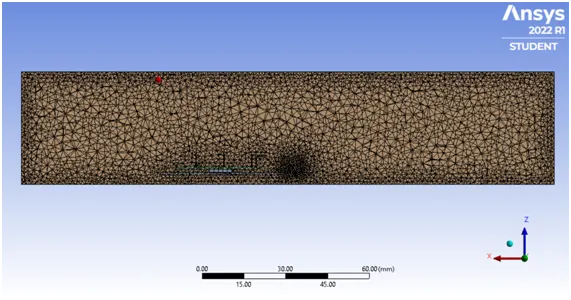
- A basic mesh is generated using the standard values provided by Ansys. This coarse mesh is used to obtain an initial solution which will help us to determine the location where the mesh refinement is required.
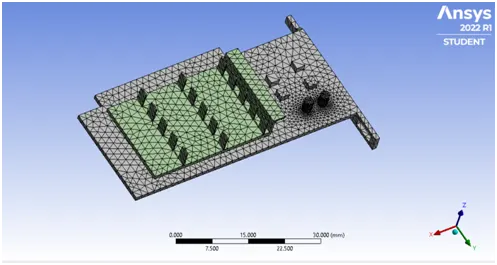
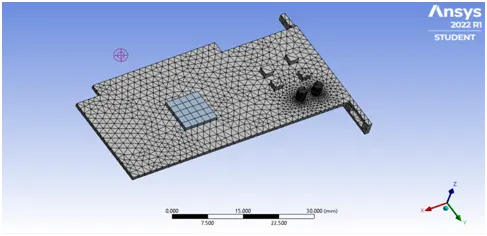
- Coarse and refined mesh generated as described.
|
Coarse Mesh |
Refined Mesh |
|
Element order: Linear Element size: Default |
Element order: Linear Element size: 1.5 mm |
|
- |
1. Hexa Dominant Method Method: Hex Dominant Element Order: Linear Free face mesh type: All Quad 2. Body Sizing PCB base geometry Type: Element size Element size: 2mm 3. Patch Conforming Method PCB base geometry Method: Tetrahedrons Element order: Linear |
|
|
|
|
STATISTICS · Nodes: 15718 · Elements: 83811 |
STATISTICS · Nodes: 94696 · Elements: 506377 |
 |
 |
Setup
Solver
General
- Type – Pressure-based
- Velocity Formulation – Absolute
- Time – Steady
Enable energy equation
Viscous
- Turbulence
- k-omega (2 equation)
- Model – SST
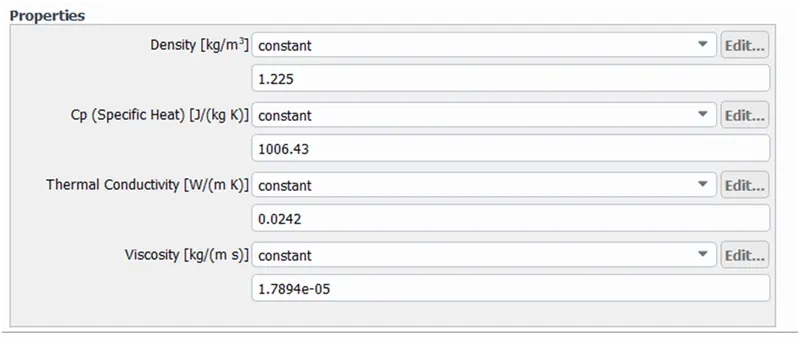
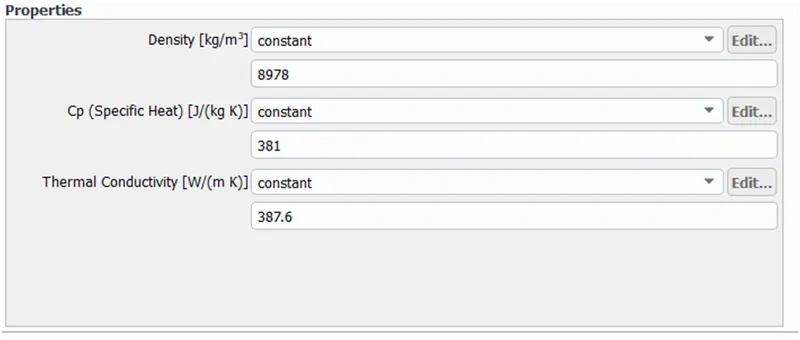
- Material
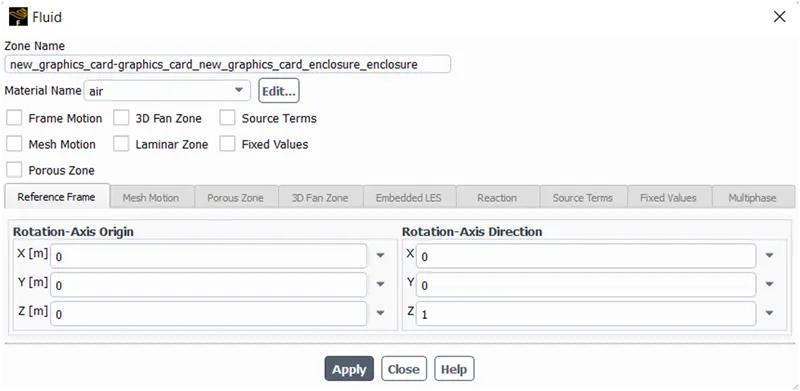
Fluid Volume
Air
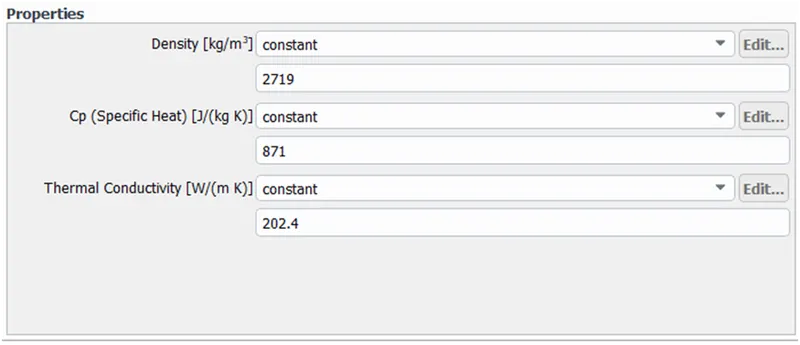
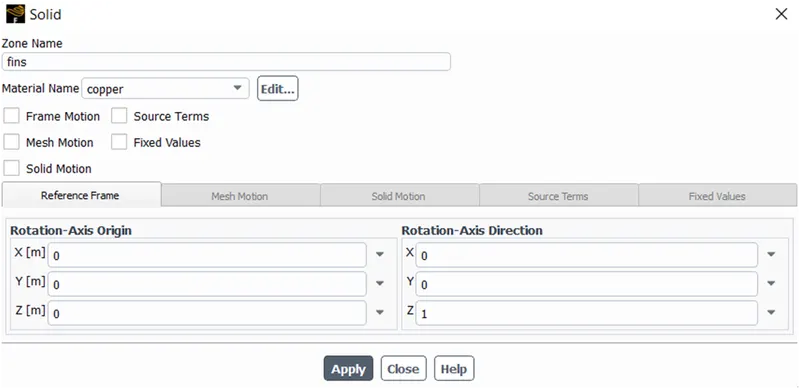
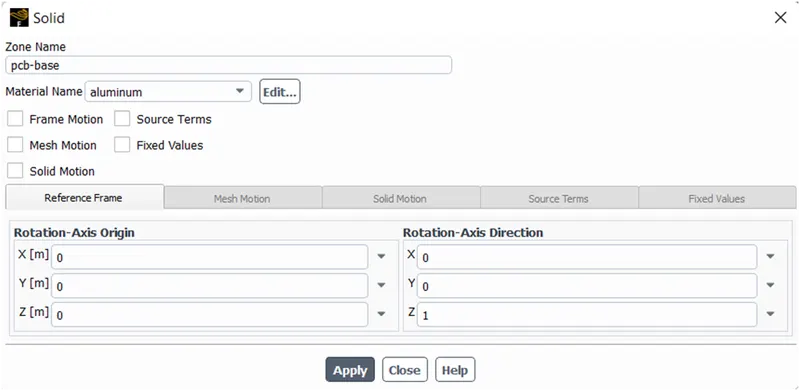
Solid Volume
Aluminium
Silicon
Copper
- Cell Zone Conditions
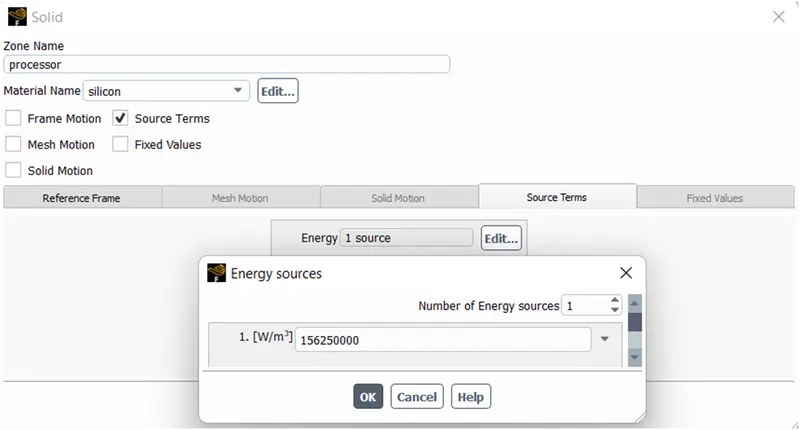
- Boundary
- Inlet
- Velocity magnitude = (input value)
- Temperature = 300 K
- Outlet
- Gauge pressure – zero Pa
- Temperature = 300 K
- Symmetry wall
- Type: symmetry
- Wall
- Inlet
Type: Wall
Solution
- Use definitions to plot important parameters.
- Define necessary contours for tracking the result.
- Initialization using standard
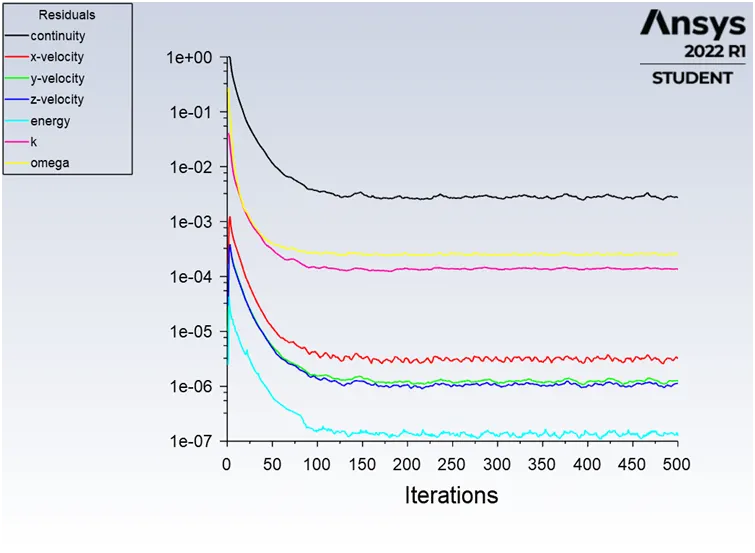
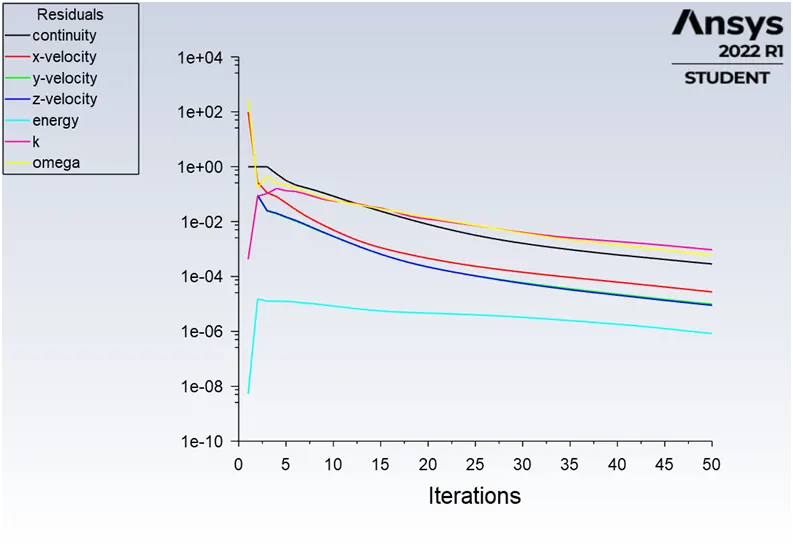
- Calculating with 500 number of iterations.
OUTPUT
Refined Mesh
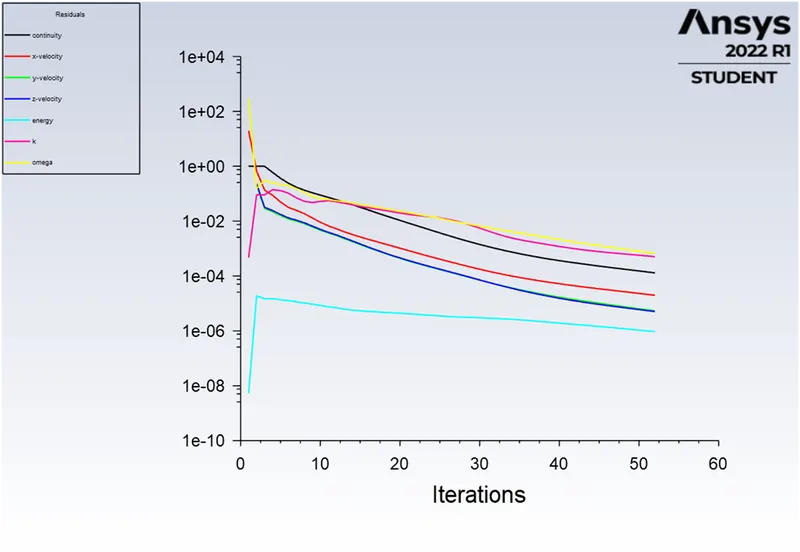
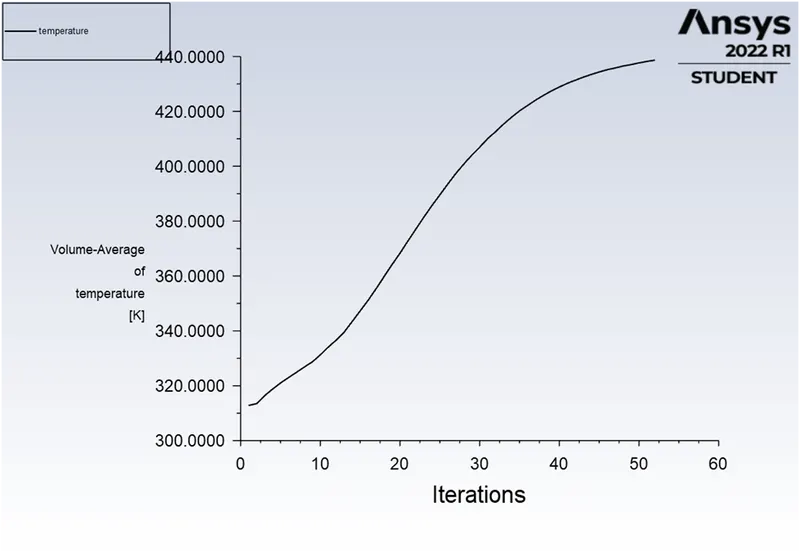
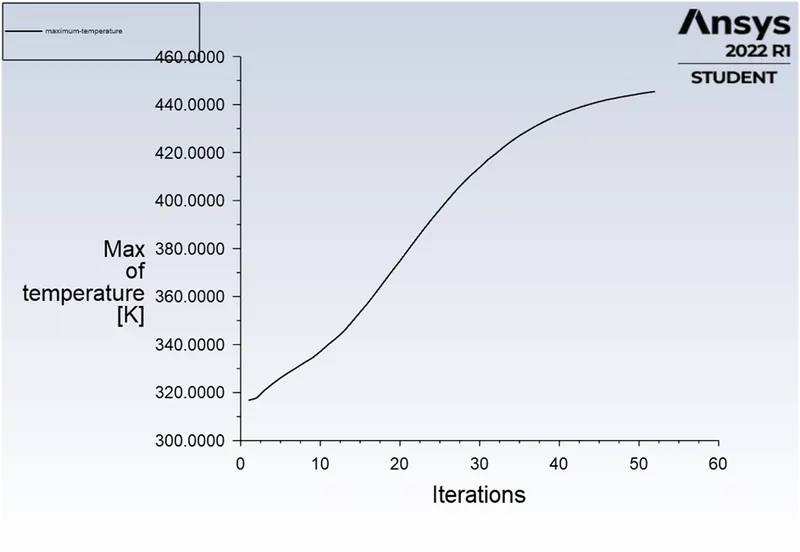
- Velocity = 1 m/s
Residual
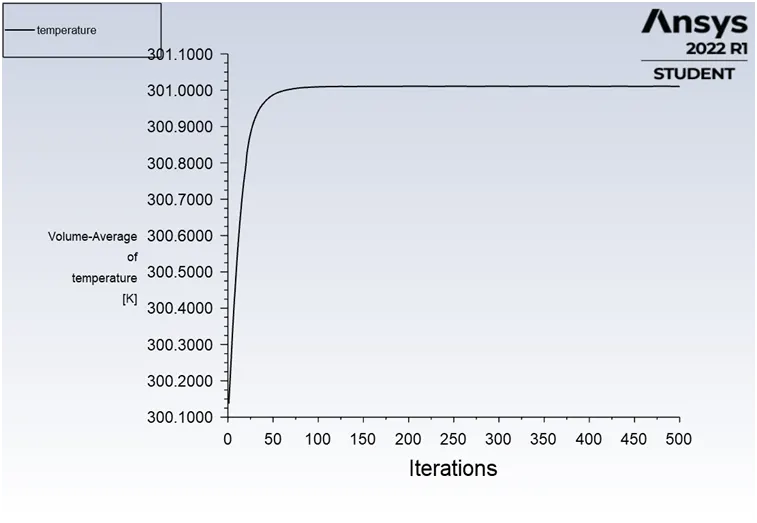
Temperature
Maximum Temperature
IMPORTANT VALUES
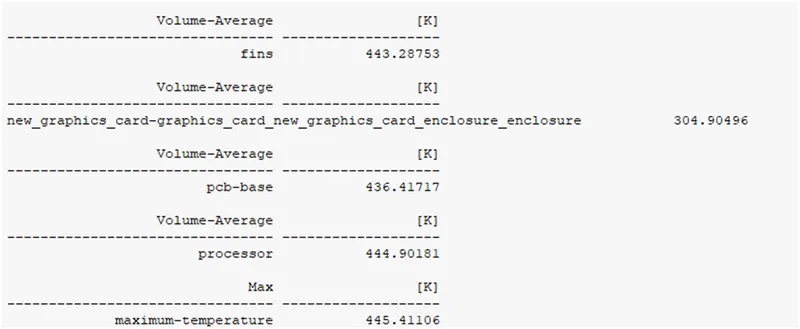
Post-processing
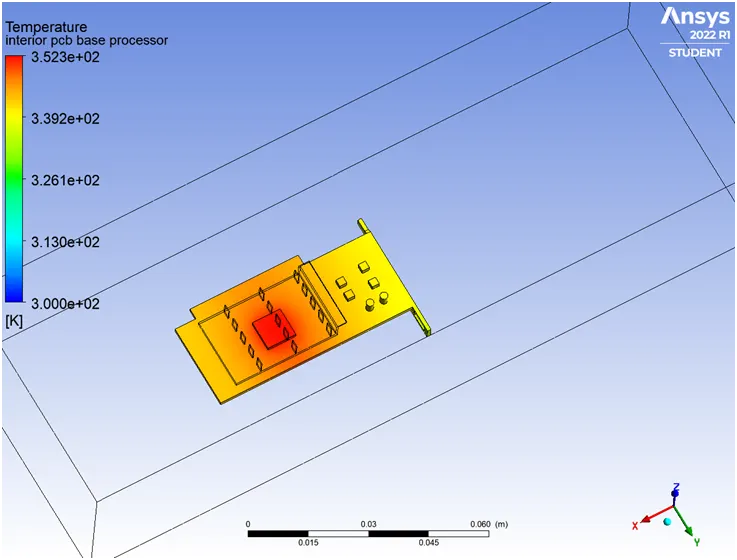
- Global Hotspot Region
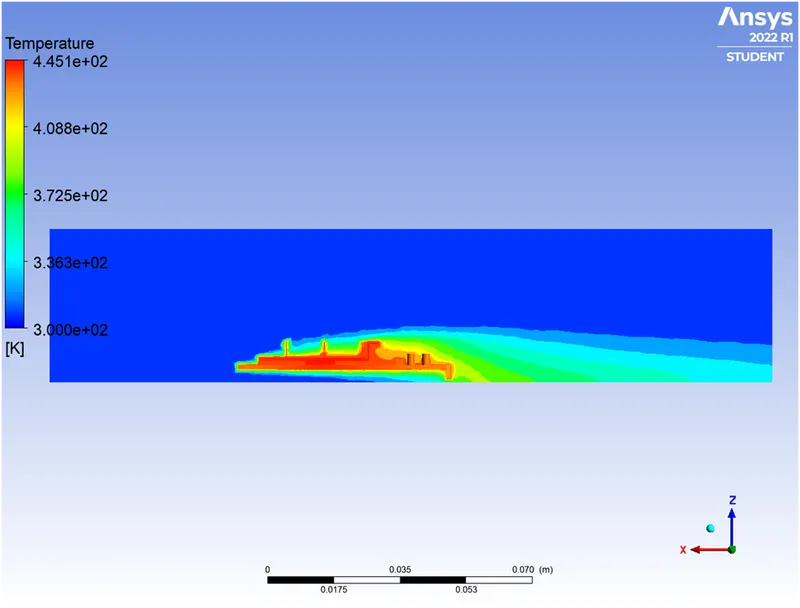
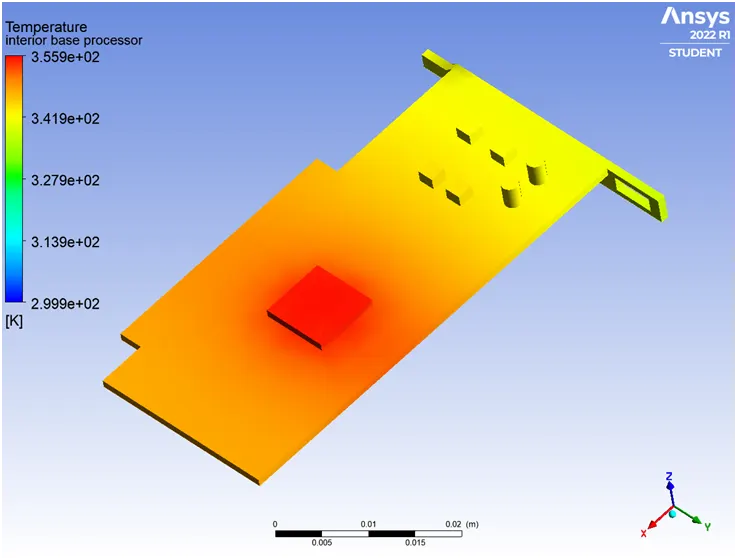
- Hotspot around the Processor
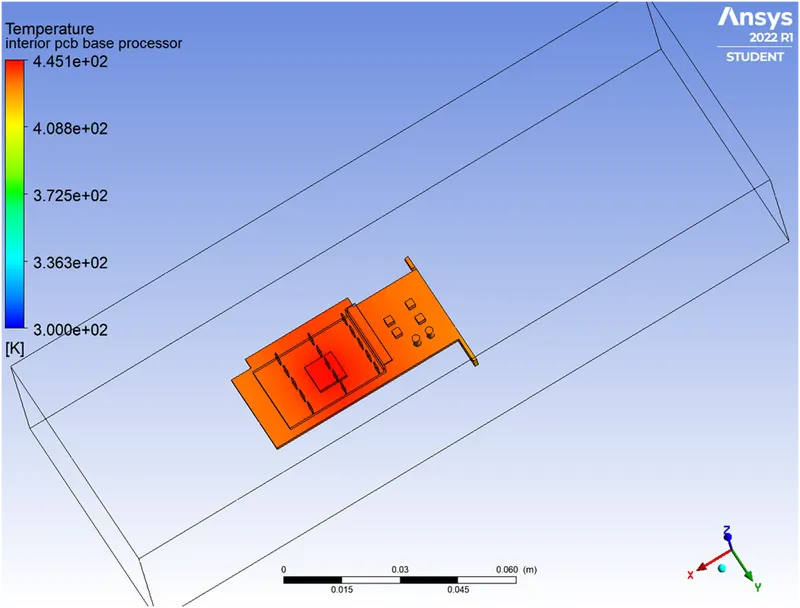
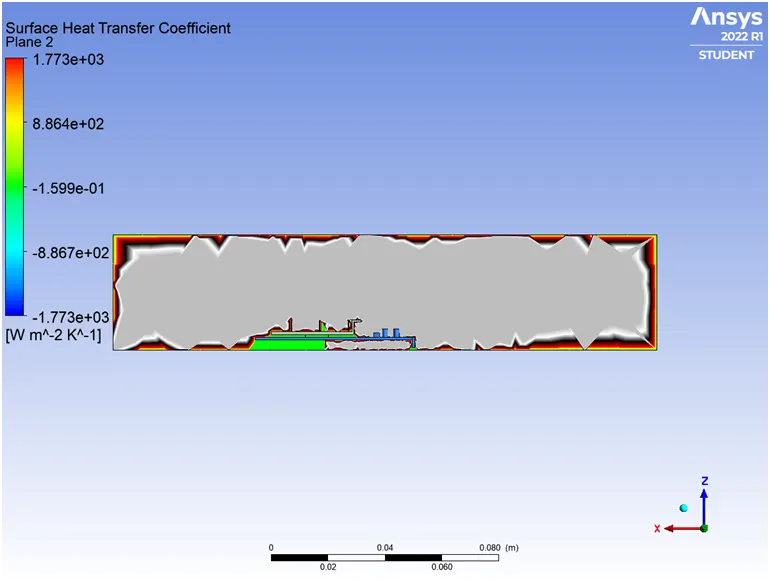
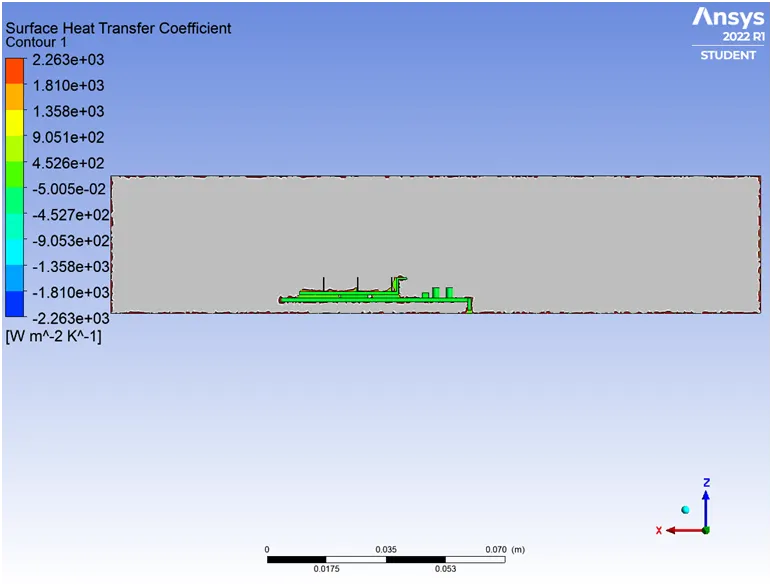
- Wall HTC
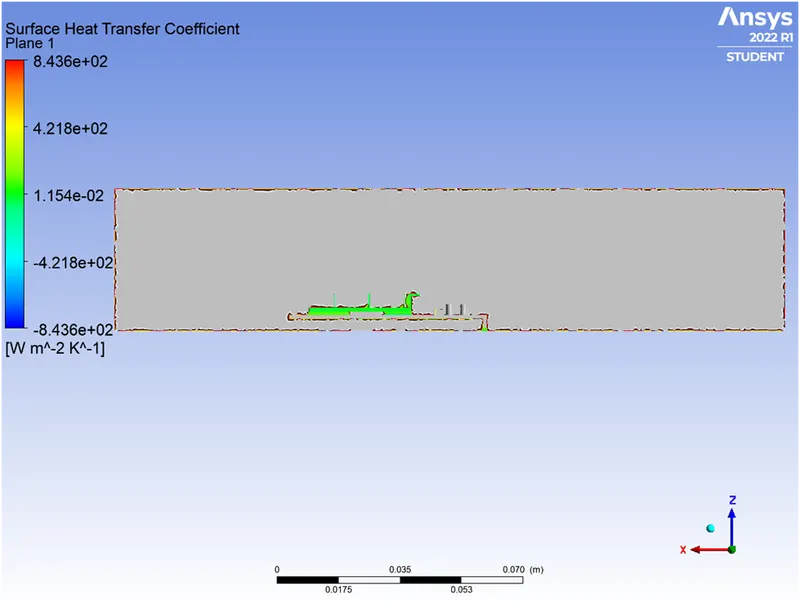
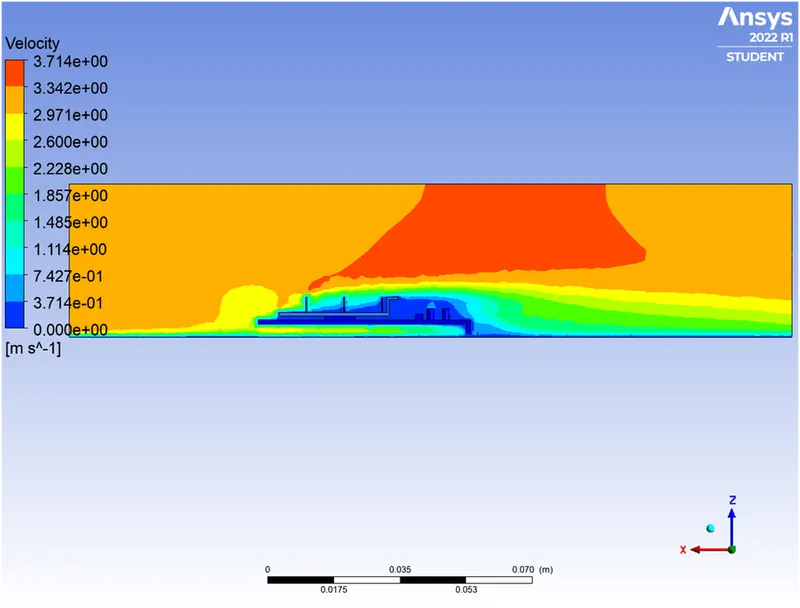
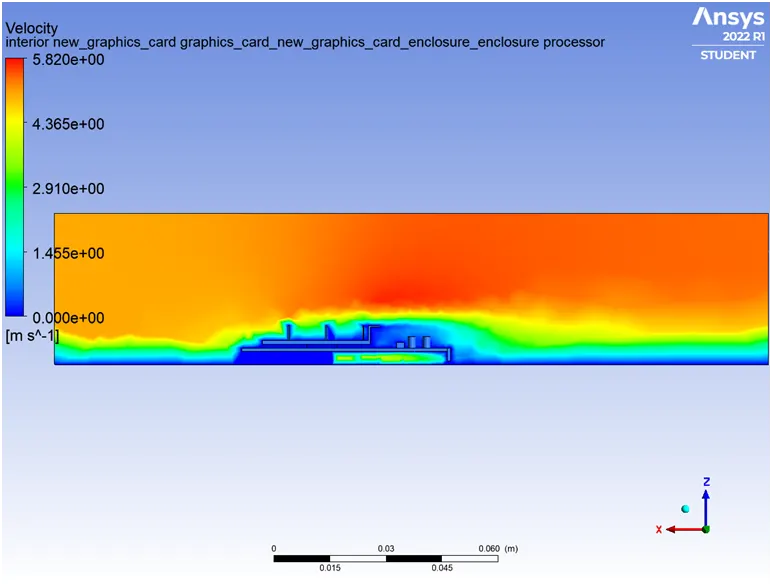
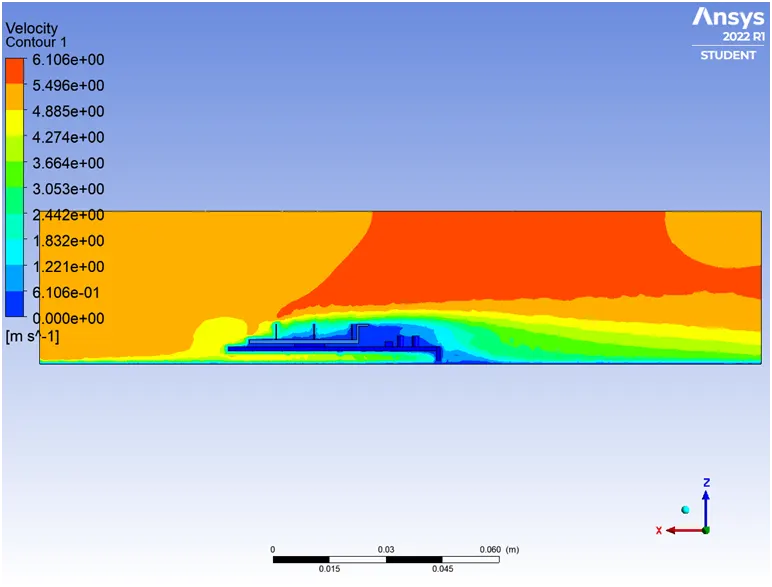
- Velocity Contour
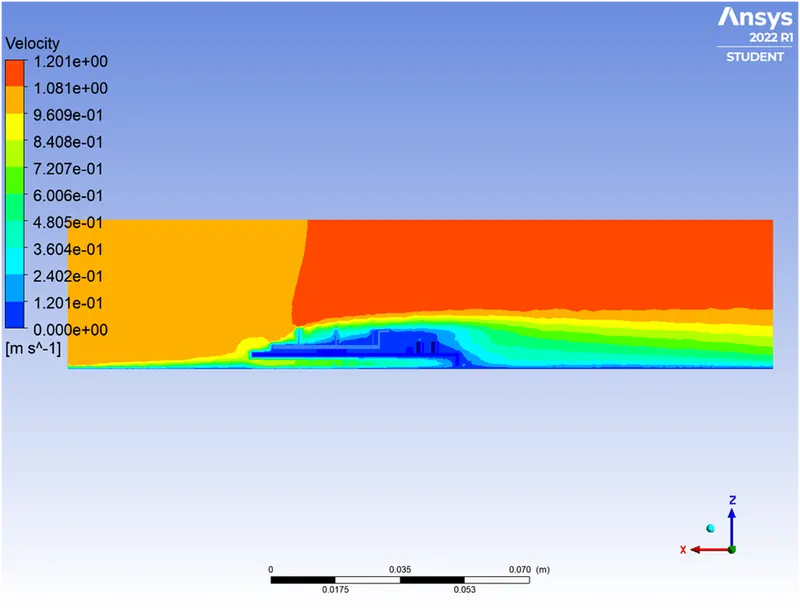
Refined Mesh
- Velocity = 3 m/s
Residual
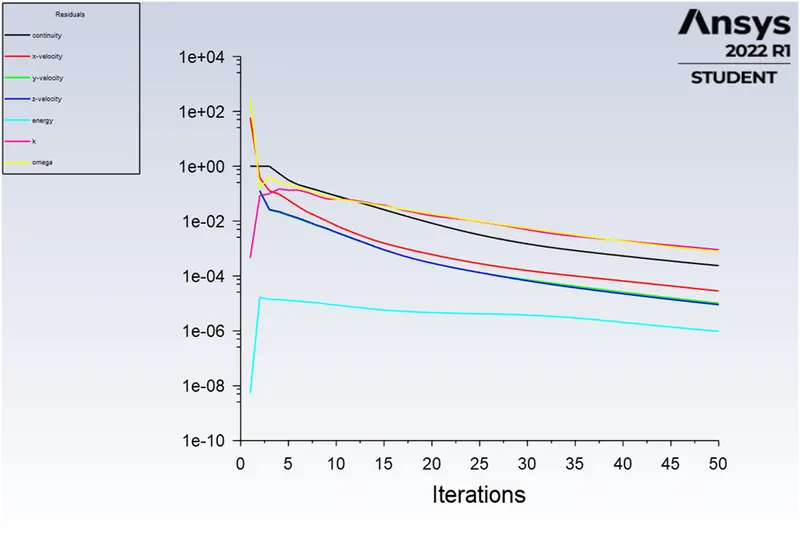
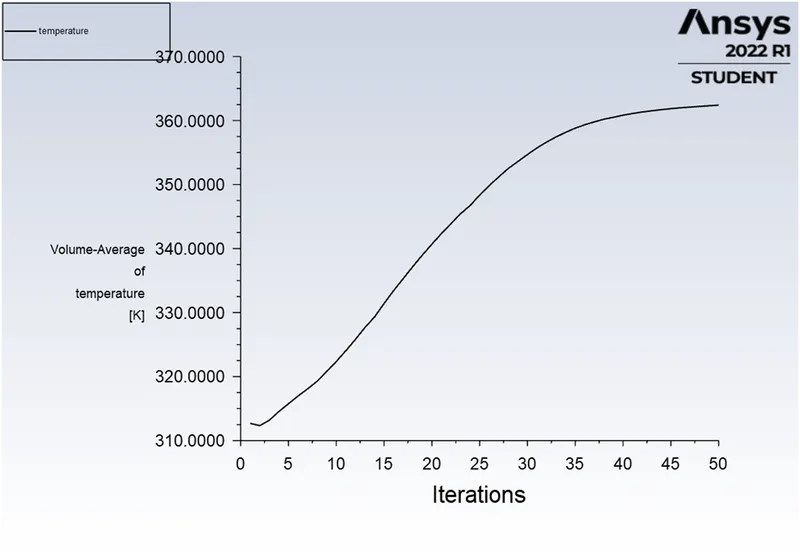
Temperature
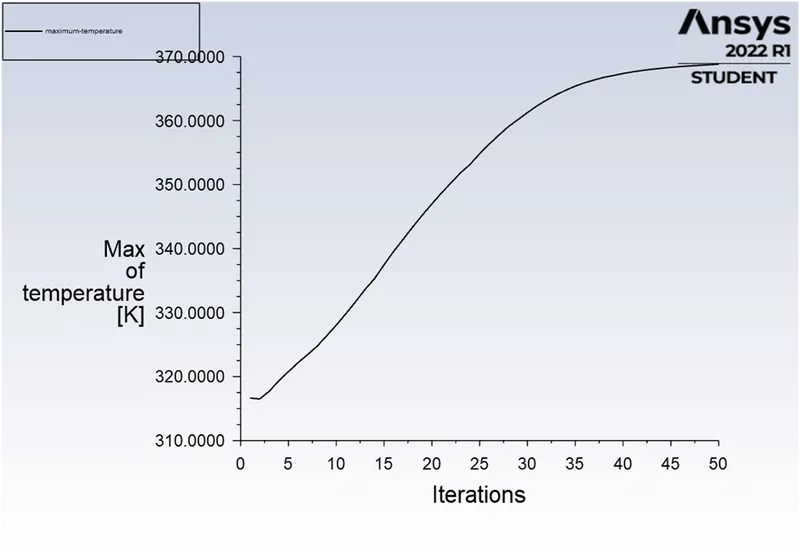
Maximum Temperature
IMPORTANT VALUES
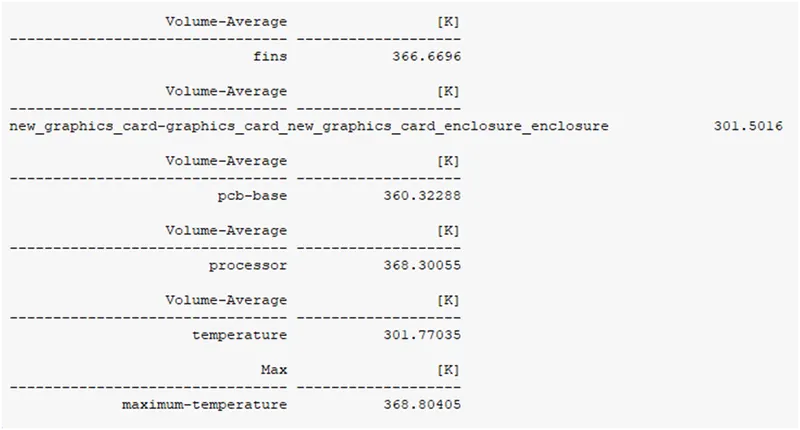
Post-processing
- Global Hotspot Region
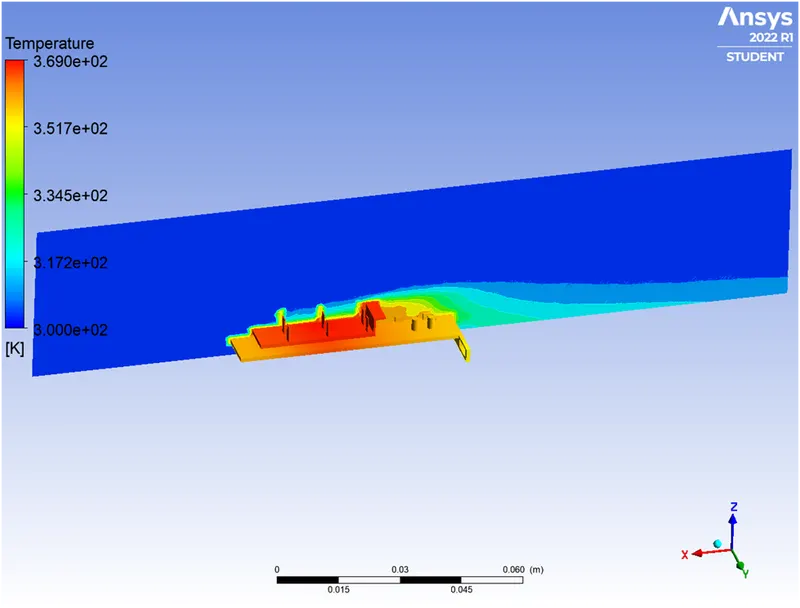
- Hotspot around the Processor
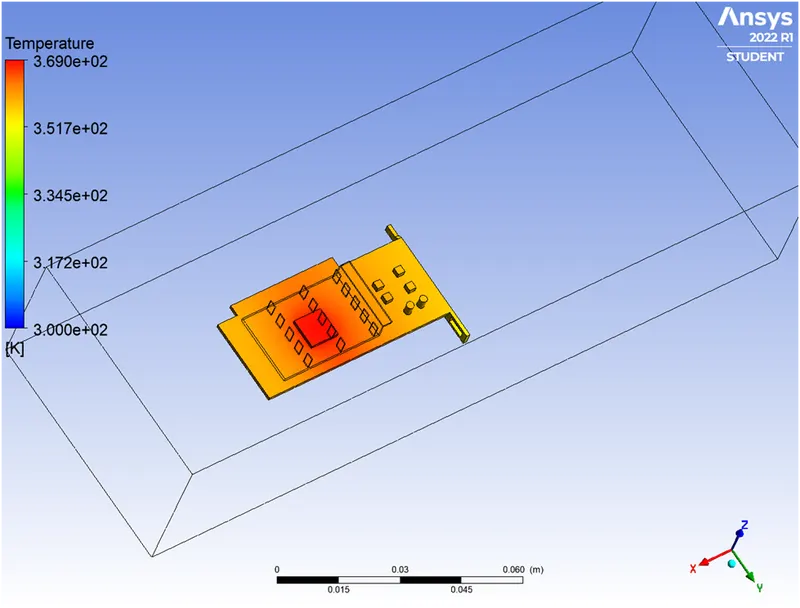
- Wall HTC
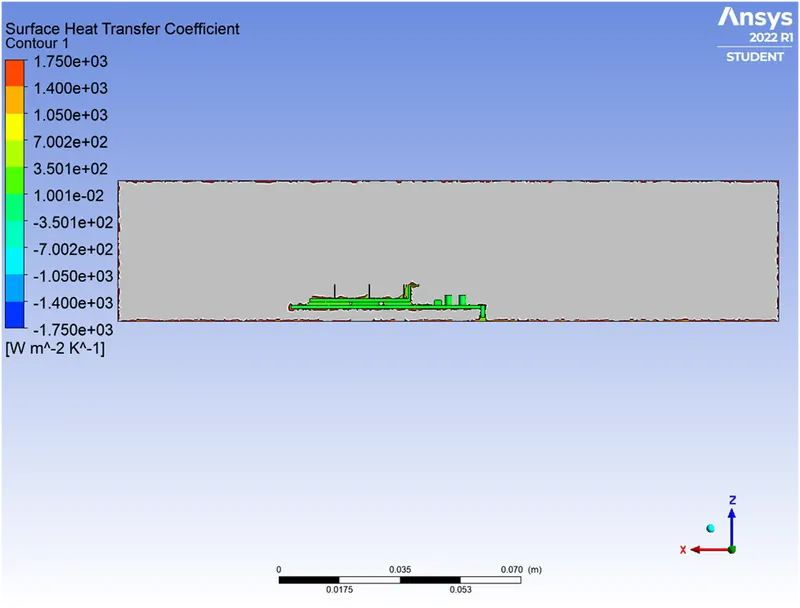
- Velocity Contour
- Velocity = 5 m/s
|
COARSE MESH |
REFINED MESH |
Residual
|
|
|
Temperature
|
|
|
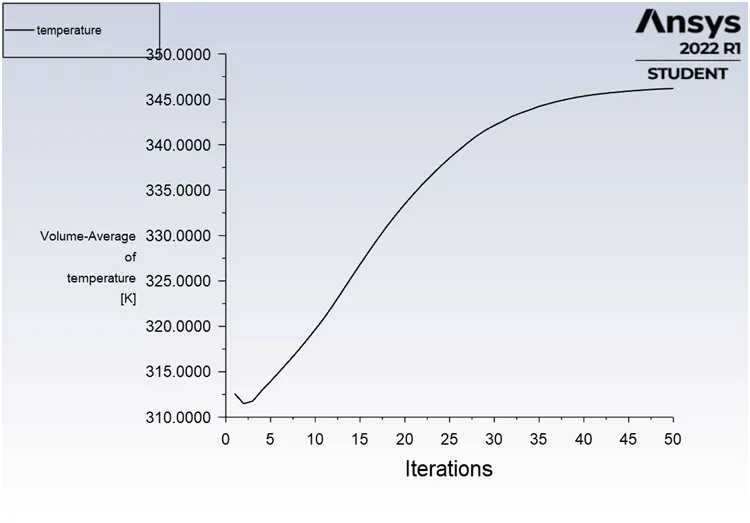
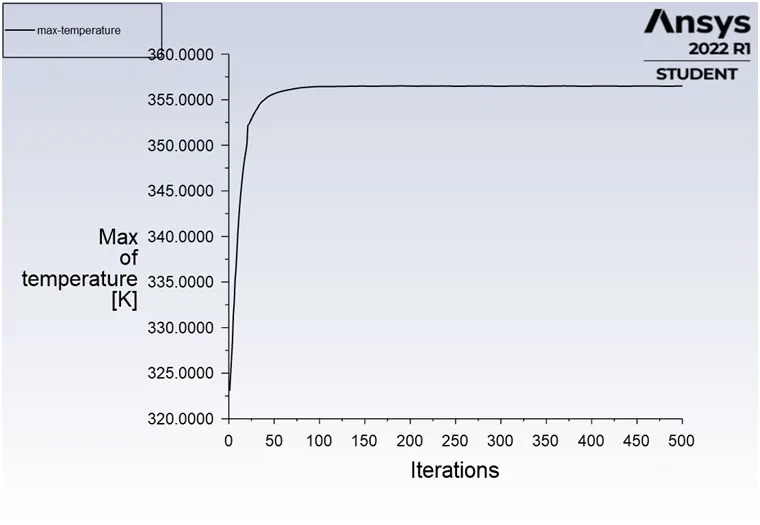
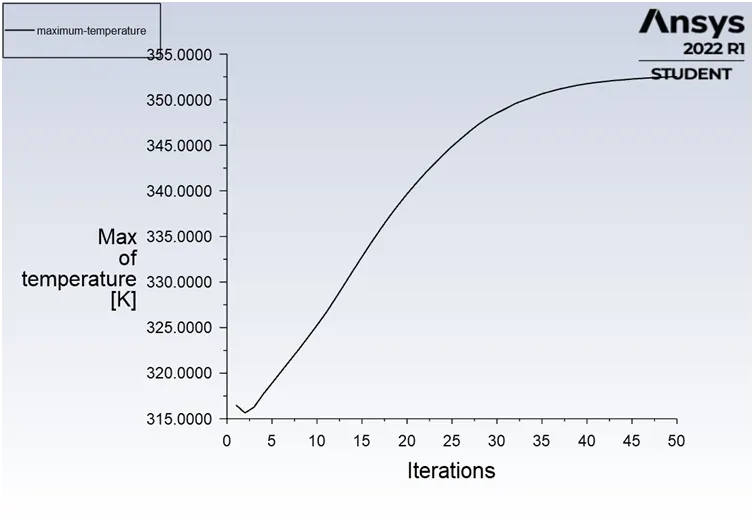
Maximum Temperature
|
|
|
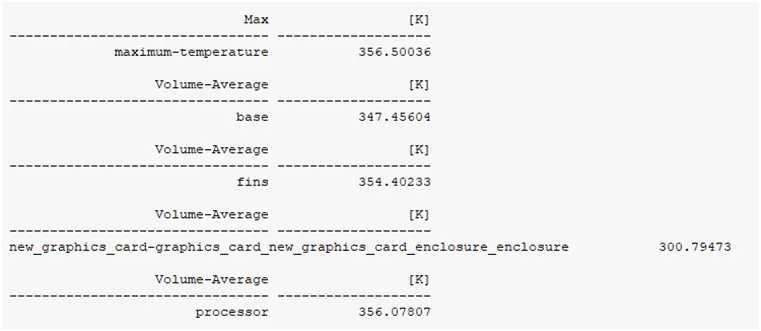
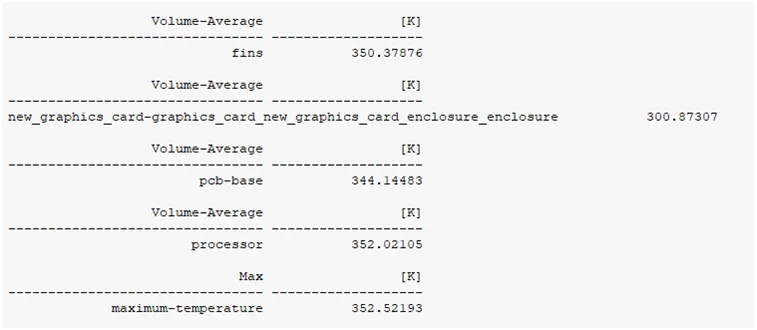
IMPORTANT VALUES
|
|
|
Post-processing
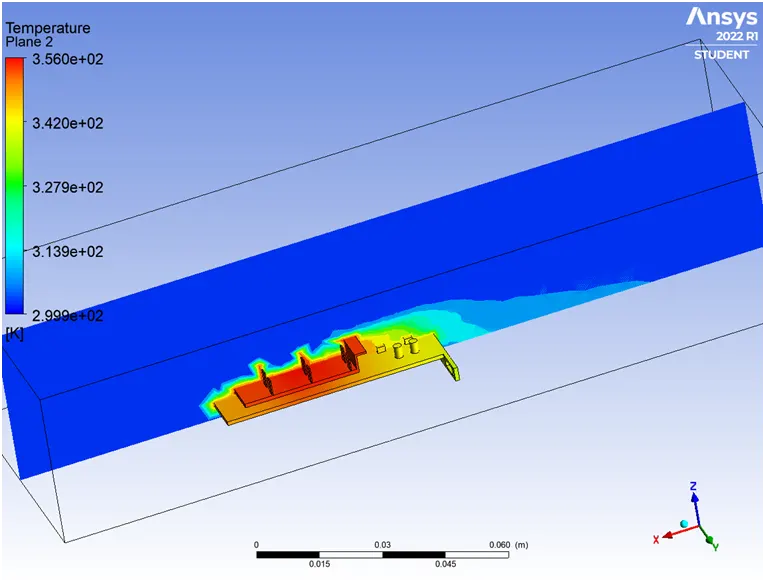
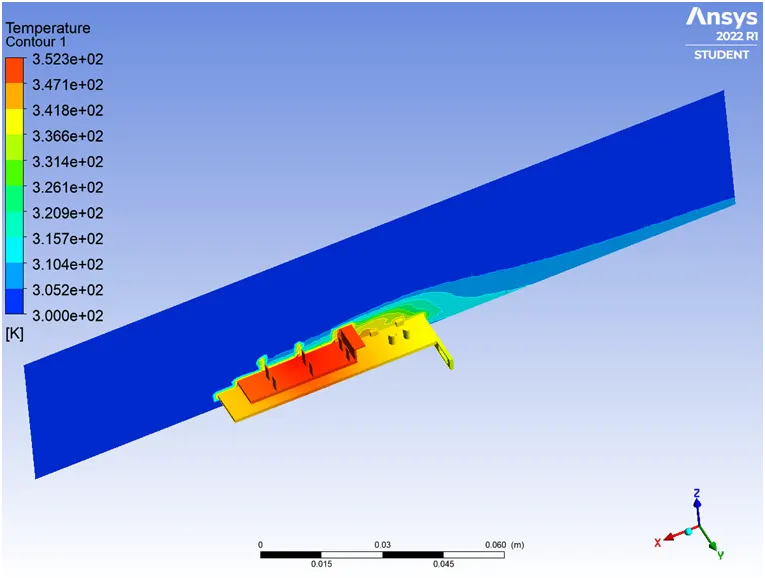
- Global Hotspot Region
|
|
|
- Hotspot around the Processor
|
|
|
- Wall HTC
|
|
|
- Velocity Contour
|
|
|
CONCLUSION
- As the number of elements increases the accurate results of temperature distribution are obtained.
- The net temperature of components of graphic cards decreases with an increase in inlet velocity.
- As the velocity of incoming air increased the maximum temperature reached was decreased. As velocity increases, heat transfer convective coefficient increases so heat transfer to the surrounding increases and temperature attained by the material decreases.
- High inlet velocity provides heat dissipation, lowering the average temperature thus keeping the components safe from damage.
- Meshing is an important step to be taken care of. While refining the mesh it is important to keep in mind the structure and the task of the individual components of the model. This helps in determining the method for meshing and also the characteristics of meshing. Here, the processor being the source needed Hexa dominant mesh.
- In such simulation results provide how the contacted body transfers heat from one body to another body.
REFERENCES