Week-6 Challenge: EV Drivetrain
1. Predominantly used power converter in the BEV/HEV
Inverter (DC to AC):
For BEV, Inverter converts direct current (DC) from the battery to alternating current (AC) to be used by other devices such as the traction motor and coolant pump. The inverter can change the speed at which the motor rotates by adjusting the frequency of the alternating current.
For HEV, mechanical energy from the engine is converter into electrical energy using a generator, which inturn is fed into inverter to converts direct current to alternating current.
DC-DC Converter (DC to DC) for BEV and HEV:
DC-DC converters in an electric vehicle may be classified into unidirectional and bidirectional converters.
Unidirectional DC-DC converters:
Unidirectional DC-DC converters cater to various onboard loads such as sensors, controls, entertainment, utility, and safety equipment. They are also used in DC motor drives and electric traction.
Bidirectional DC-DC Converters:
Bidirectional DC-DC converters find applications in places where battery charging, regenerative braking, and backup power are required. The power flow in a bidirectional converter is usually from a low voltage end such as a battery or a supercapacitor to a high voltage side and is referred to as boost operation. During regenerative braking, the power flows back to the low voltage bus to recharge the battery (buck mode). As a backup power system, the bidirectional DC-DC converter facilitates the safe operation of the vehicle when ICEs or electric drives fail to drive the motor.
AC – DC Converter (On Board Charger):
AC to DC converters are most commonly used in Plug-in Hybrid Electric Vehicles (PHEV) & Plug-in Electric Vehicles (PEV). These vehicles get their propulsion power from an external electricity source (charging stations) which is alternating current. The battery needs to be charged using a direct current source. For this purpose, AC to DC converter is employed in a PHEV & PEV.
2. Motor and Controller Parameters:
Rated Armature voltage= 72 V
Rated armature current= 400 A
Ra= 0.5Ω, KΦ= 0.7 Volt second
Chopper Switching frequency= 400 Hz
Vehicle voltage = 72 * duty cycle (0.7)= 50.4V
The vehicle speed-torque characteristics are given by the below equation
Tv=24.7+(0.0051)w^2 - (1)
Applying the above parameters to the motor characteristics equation
w=V/K-(R/K^2 * T)
T=0.98w+70.56 - (2)
From equation 1 and 2
0.98w+70.56=24.7+(0.0051)w^2
0.0051w^2+0.98w-45.86=0
P=[0.0051 0.98 -45.85];
r=roots(P)
r =
-231.0646
38.9077
steady state speed is 38.91 rad/s
3.
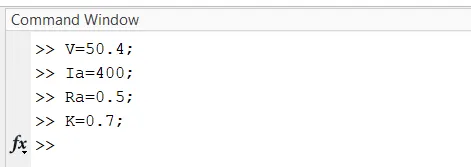
Considering the above parameters and keeping the torque as ramp signal.
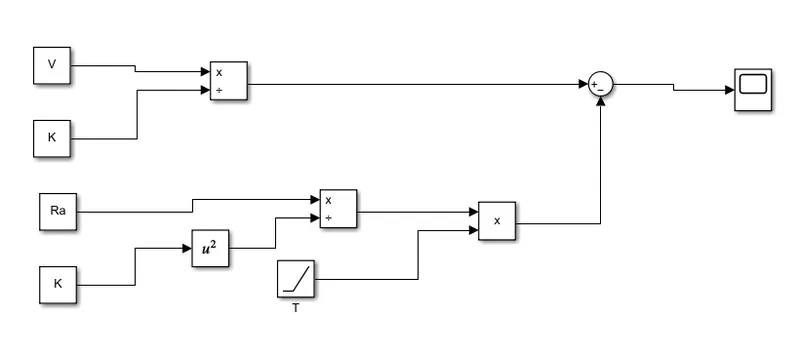
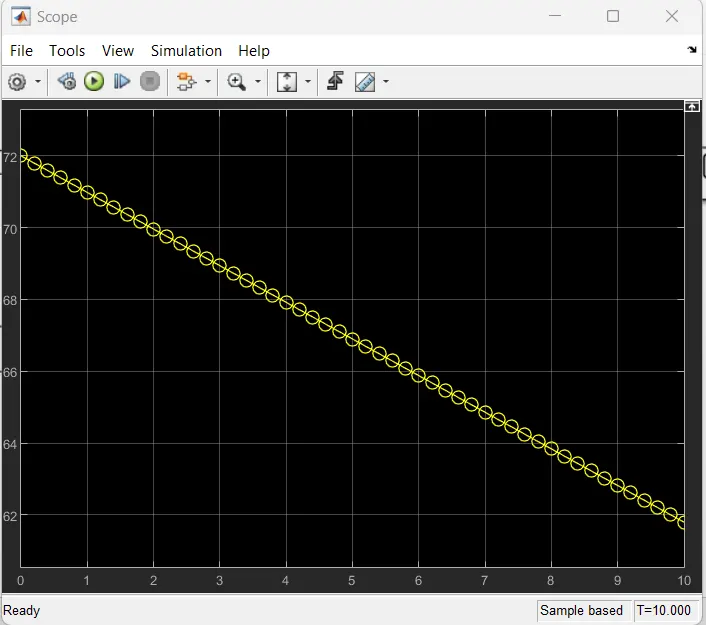
The models gives a DC motor characteristics with the battery voltage of 72V.
4.
- Author has explained by the two predominantly used motors in electric vehicle
- DC brushless motor
- Induction motor
Below are the differences between both the motors as described by the author
|
DC brushless motor |
Induction motor |
|
Field magnets on the stator and rotor is made up of two or more permanent magnet |
Rotor is made of stacked steel laminations with buried peripheral conductors that form a “shorted structure. |
|
Motor does not start at no load, needs a inverter. |
When a 3-phase induction motor is connected to utility type 3-phase power, torque is produced at the outset; the motor has the ability to start under load. No inverter is needed. |
|
Torque performance is high |
Torque performance is low |
|
Controller is required for a fixed speed |
No controller is required for fixed speed, controller is required for variable speed |
|
Changing the magnetic field is difficult in permanent magnet |
Induction machines have no magnets and B fields are “adjustable,” since B is proportionate to V/f |
|
Cost is expensive |
Cost is lower |
|
Achieving stability is easier in DCBM |
Achieving stability over the entire torque-speed range and over temperature is more difficult with induction. This means added development costs, but likely little or no recurring costs. |
DC motors can be adapted easily for small machines, since it has more stability, torque performance is high, and peak efficiency is attained.
Induction motors are suitable for larger machines, efficiency can be optimized, average efficiency will be better.
Authors perspective is both the motor has its own advantages and will be used in a long run depending on the applications.