Week-6 Challenge: EV Drivetrain
1.
Types of power converter circuits
There are 3 types of converters which are widely used in an Electric Vehicles,they are
1.AC -DC Converter
2.DC -DC Converter
3.DC -AC Converter
AC -DC Converter:
AC to DC converters are most commonly used in Hybrid Electric Vehicles (HEV). These vehicles get their propulsion power from an external electricity source (charging stations) which is alternating current. The battery needs to be charged using a direct current source. For this purpose, AC to DC converter is employed.
DC -DC Converter:
DC-DC converters can be used to interface the elements in the electric power train by boosting or chopping the voltage levels. By introducing DC/DC converters one can choose the voltage variation of the devices and the power of each device can be controlled.
DC -AC Converter :
The DC/AC converter converts the dc power to a suitable ac power for the electrical machine. The power output from battery (DC current) is converted using inverter to be used in electric motor.
2.
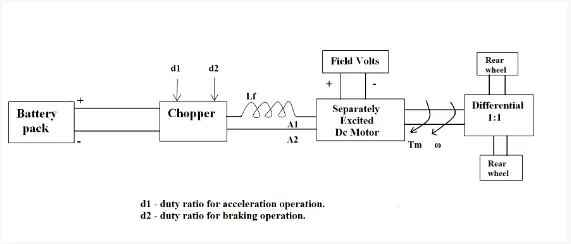
Motor and Controller Parameters:
Rated Armature voltage= 72 V
Rated armature current= 400 A
Ra= 0.5Ω, KΦ= 0.7 Volt second
Chopper Switching frequency= 400 Hz
The vehicle speed-torque characteristics are given by the below equation

solutio:
Vehicle Output Voltage (V) is given by
V= Battery Voltage * Duty Cycle
V= 72 * 0.70
= 50.4V
Now, Equation for Vehicle torque is given by: -
T =((V*K)/Ra) - (((K)^2/R)*w)
Where;
T- Vehicle Torque (N-m)
v - Vehicle voltage (Volts)
w- speed of vehicle (rps)
K- Motor constant
Ra - Armature Resistance
Substituting these values in equation, we get
T= (50.4*0.7/0.5)-(0.7*0.7/0.5)*w
T=70.5-0.98w (1)
Solving these two equations,
70.5-0.98w =24.7+(0.0051)*w*w
We get a quadratic equation:
0.0051w^2+0.98w-45.8=0
Since quadratic equation, we get two values of ;
w= 38.87 rad/s and w = -231.02 rad/s
We take the positive value
Steady state speed of vehicle = = 38.87 rad/s
3.
ω= V/Kϕ -Ra/Kϕ^2*T
simulink model:
n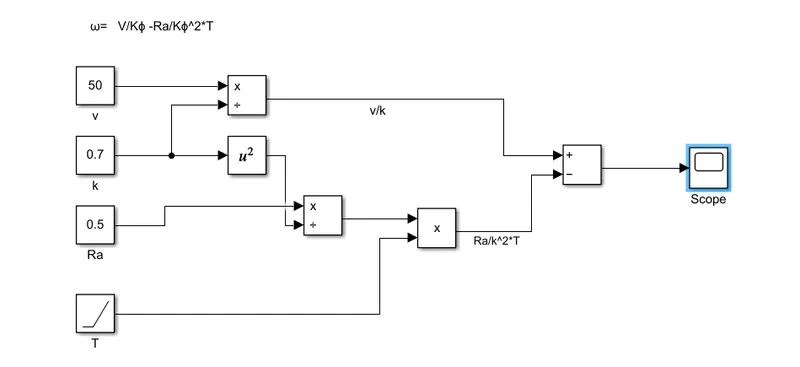
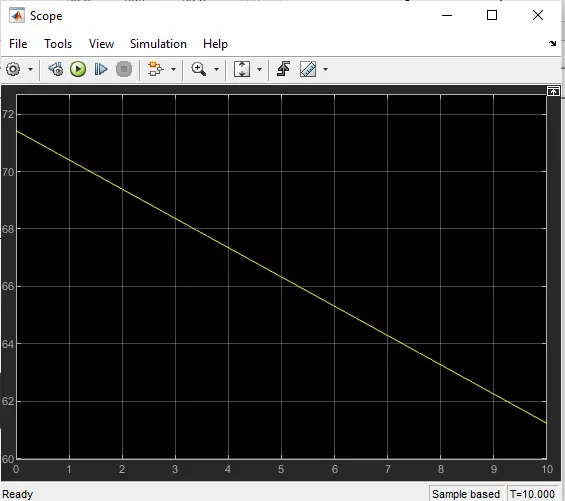
here we have given v-50v,k-0.7,Ra-0.5 and T as a ramp signal.
output:
4.
In the beginning, the author describes the dominance of Internal Combustion Engines(ICE) in the world of automobile industry. He explains that all engines were similar and it was up to the user to select according to their requirement. Next, the author highlights topics related to EV technology especially related to DC Brushless Motor and Induction Motor.
According to him, DC Brush Motors is replaced by either DC Brushless Motor or Induction Motor. Also, the Lead Acid Battery is replaced by lithium-ion batteries for EVs.He also quoted that there will be the future of both the technology (DC Brushless Motor and Induction Motor) depends upon their demands and uses.
The advantage of DC Brushless Motor is that there is low heat generation in the rotor and its cooling capacity is better as compared to Induction Motor. Also, peak point efficiency is generally higher for this drive. The DC brushless drive can also operate at unity power factor, whereas the best power factor for the induction drive is about 85%.
As Machine size grows, the magnetic losses increase proportionately and part load efficiency drops. Permanent magnets are expensive.
The technology behind the induction motor is that it basically uses a 3-phase induction motor which was invented by Nikola Tesla sometime before 1889. Unlike the DC brushless rotor, the induction rotor has no magnets – just stacked steel laminations with buried peripheral conductors that form a “shorted structure.” Currents flowing in the stator windings produce a rotating magnetic field that enters the rotor. In an Induction motor current interacts with the Magnetic field generated by the stator to produce a force which is required for rotor torque.
The induction motor does not have any magnets and in this the B field is adjustable. The motor has the ability to start under load and there is no need of an inverter. In an induction motor B field is proportionate to V/f (Voltage to frequency). This technology is used to reduce the magnetic losses and conduction losses, due to which efficiency will remain at maximum peak. This all leads to increasing the performance, induction motor is very useful and efficient for high performance.
In the end, the author couldn't choose which drive is better than the other but makes it clear that DC Brushless motor drives will likely continue to dominate in the Hybrid and upcoming Plug-in hybrid markets and induction motor drives will likely maintain dominance for the high-performance pure electric.