Week-6 Challenge: EV Drivetrain
Q1.Which types of power converter circuits are employed in electric and hybrid electric vehicle?
Answer :
Introduction- An electric vehicle (EV) is one that operates on an electric motor, instead of an internal-combustion engine that generates power by burning a mix of fuel and gases. Therefore, such as vehicle is seen as a possible replacement for current-generation automobile, in order to address the issue of rising pollution, global warming, depleting natural resources, etc. Though the concept of electric vehicles has been around for a long time, it has drawn a considerable amount of interest in the past decade amid a rising carbon footprint and other environmental impacts of fuel-based vehicles.
HYBRID ELECTRIC VEHICLE
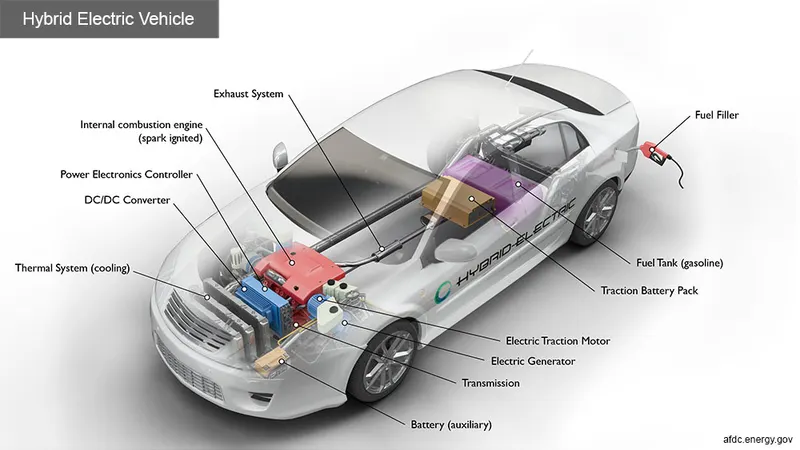
A hybrid electric vehicle is a type of hybrid vehicle that combines a conventional internal combustion engine system with an electric propulsion system. The presence of the electric powertrain is intended to achieve either better fuel economy than a conventional vehicle or better performance.
In a hybrid and other electric vehicles (EVs), two key elements work together to manage power and recharge the circuits.
Power converters circuits for electric and hybrid electric vehicles:
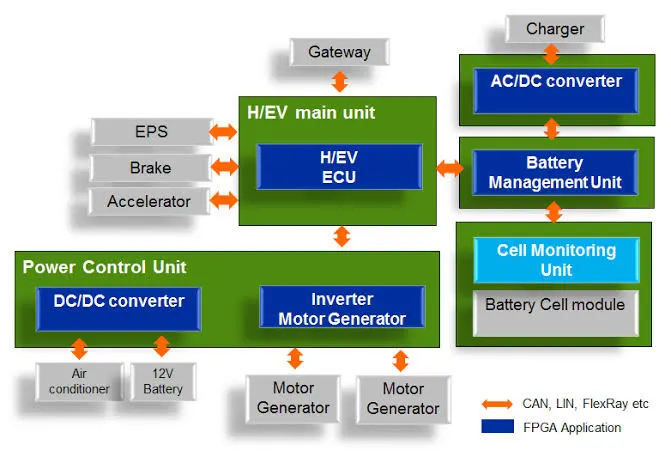
The different configurations of EV power supply show that at least one DC/DC converter is necessary to interface the FC, the Battery or the Supercapacitors module to the DC-link.DC/DC converters can be designed to transfer power in only one direction, from the input to the output. However, almost all DC/DC converter topologies can be made bi-directional. A bi-directional converter can move power in either direction, which is useful in applications requiring regenerative braking.
Power Electronic Converters:
The main components of an Electric Vehicle are a DC-AC inverter, a DC-DC converter, a battery, and an electric motor.
There are two major power electronic units in the general configuration
- DC-DC converter
- DC-AC inverter
Usually, AC motors are used in HEVs or EVs for traction and they are fed by an inverter and it is fed by a DC-DC converter.
An inverter is a device that converts DC power from the battery to AC power in an electric vehicle motor. The inverter can change the speed at which the motor rotates by adjusting the frequency of the alternating current.
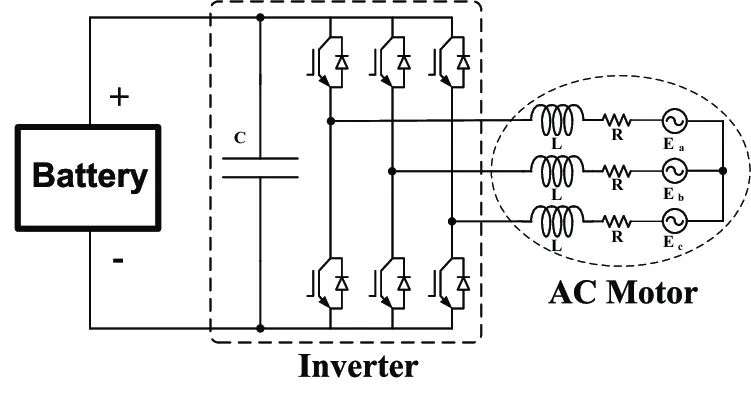
The above Fig shows a typical Traction circuit in a Vehicle based on a 3-Ph Motor and inverter
The Significance of DC/AC Converters
The use of inverters can increase or decrease the power or torque of the motor by adjusting the amplitude of the signal.
It plays a significant role in capturing energy from regenerative braking and feeding it back to the battery. The key component is that it has a direct impact on on-road performance, driving range, and reliability of the vehicle also as a consequence of their weight and size.
The output voltage waveform of ideal inverters should be sinusoidal. However, the waveform of practical inverters is non-sinusoidal and contains certain harmonics.
DC – DC Converter: -
DC-DC converters can be used to interface the elements in the electric power train by boosting or chopping the voltage levels. By introducing DC/DC converters one can choose the voltage variation of the devices and the power of each device can be controlled.
Types
1. Buck Converter
2.Boost Converter
3. Buck Boost Converter
---------------------------------------------------------------------------------
Given: -
The following input parameters are given: -
Battery pack voltage (V) = 72V
Rated armature current = 400 A
Armature Resistance (Ra) = 0.5Ω
Motor constant (KΦ) = 0.7
Chopper Switching frequency= 400 Hz
Duty Cycle = 70%
------------------------------
Solution : See the written Attachment ------------------------------------------------------------
Q3.
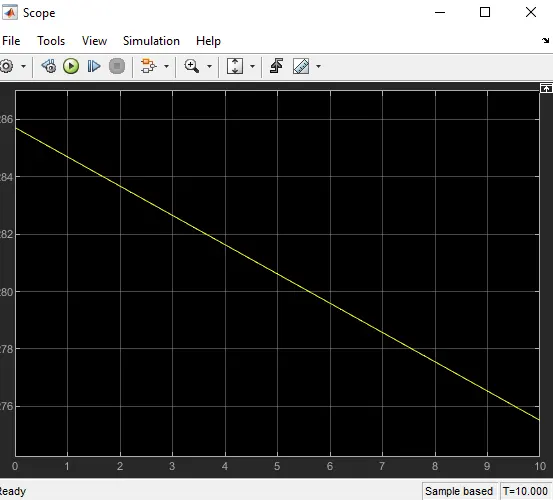
Develop a mathematical model of a DC Motor for the below equation using Simulink.

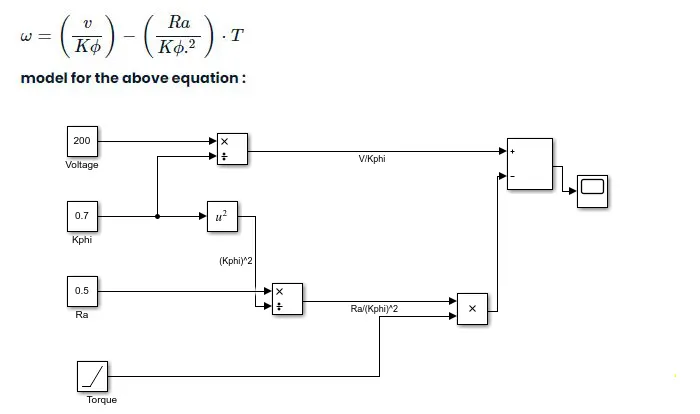
RESULT:
--------------------------------------------------------------
Q4: Refer to the blog on below topic:
Induction Versus DC brushless motors by Wally Rippel, Tesla
Explain in brief about author’s perspective.
Explanation:
The Author Compares the difference at the previous technology on Motors, controller and present technology as below.
He mentions that earlier there were lead acid batteries, DC brush motors, and contactor controllers. Today, none of these remain .Lead has been replaced by lithium and DC by either DC brushless or induction. Contactors, meanwhile, have given way to modulating inverters.
He argues if the Lithium and the present modern technology with respect to EV also become absolete in the future.
Later He explains the Brushless dc machines as
- With brushless machines, the rotor includes two or more permanent magnets that generate a DC magnetic field (as seen from the vantage point of the rotor). In turn, this magnetic field enters the stator core (a core made up of thin, stacked laminations) and interacts with currents flowing within the windings to produce a torque interaction between the rotor and stator. As the rotor rotates, it is necessary that the magnitude and polarity of the stator currents be continuously varied – and in just the right way - such that the torque remains constant and the conversion of electrical to mechanical energy is optimally efficient. The device that provides this current control is called an inverter. Without it, brushless motors are useless motors.
- Induction motor have some advantages like: it has no magnets. The motor has the ability to start under load. No inverter is needed. Some disadvantages of Induction motors are: They cannot operate from DC; AC is a must. Shaft speed is proportionate to line frequency. Hence, when used with utility power, they are constant speed machines. When operated from utility power, they have limited starting torque and somewhat limited running peak torque capabilities, when compared to DC type machines.
- Finally the author is of the opinion that he can't decide which drive is better than the other but makes it clear that DC brushless drives will likely continue to dominate in the hybrid and coming plug-in hybrid markets, and that induction drives will likely maintain dominance for the high-performance pure electrics.
---------------------------------------------------------------------------------------------------------------------