Week-4 Challenge WOT Condition Part-2
Q1) What is the difference between mapped and dynamic model of engine, motor and generator? How can you change model type?
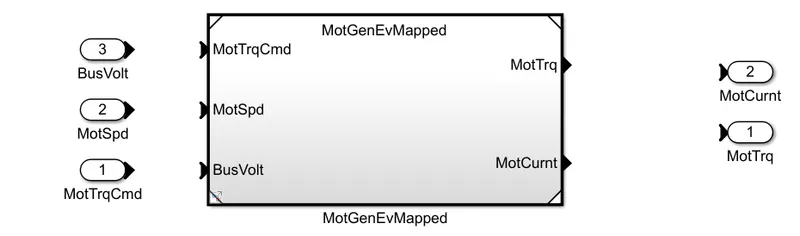
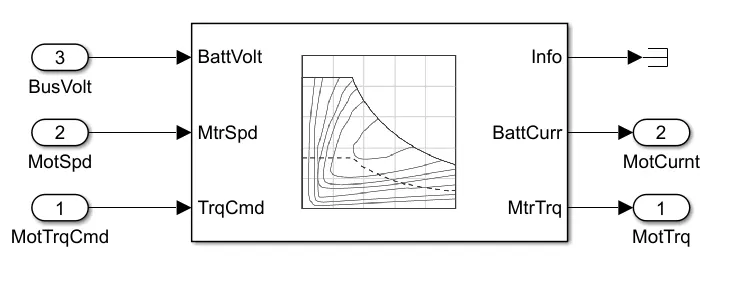
Sol: Mapped Model : It is based on the look up tables and not on actual components. Simulation takes less time due to simpler operation.
Dynamic Model: It is based on actual component model.Each component is modeled separately and simulation takes more time.
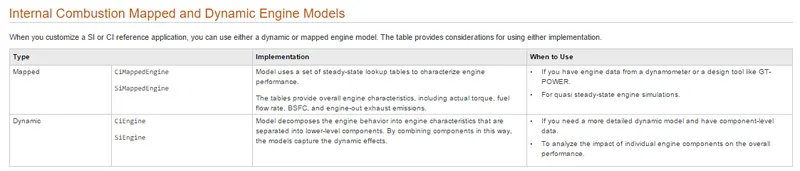
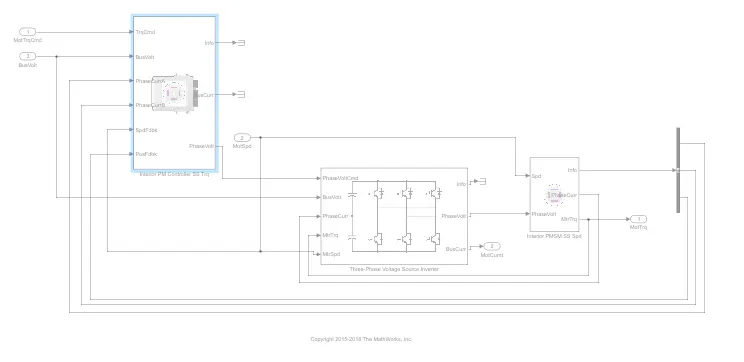
Eg: Mapped Motor
Dynamic model of Generator:
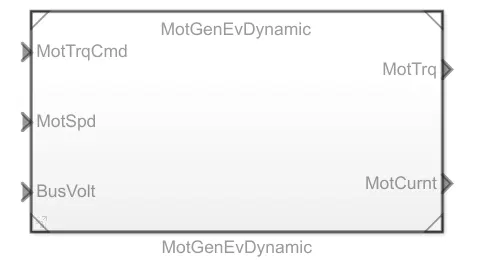
Double click on the above we will get the below fig.
MAPPED MODEL OF SI ENGINE:
The Mapped SI Engine block implements a mapped spark-ignition (SI) engine model using power, air mass flow, fuel flow, exhaust temperature, efficiency, and emission performance lookup tables. You can use the block for:
-
Hardware-in-the-loop (HIL) engine control design
-
Vehicle-level fuel economy and performance simulations
The block enables you to specify lookup tables for these engine characteristics. The lookup tables, developed with the Model-Based Calibration Toolbox™, are functions of commanded torque, Tcmd, brake torque, Tbrake, and engine speed, N. If you select Input engine temperature, the tables are also a function of engine temperature, TempEng.
---------------------------------------------------------------------------------------------------------------------------------------------
Q2) .How does the model calculate miles per gallon? Which factors are considered to model fuel flow?
Answer: Simulink block to calculate Miles/Gallon.
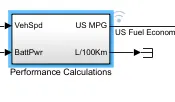
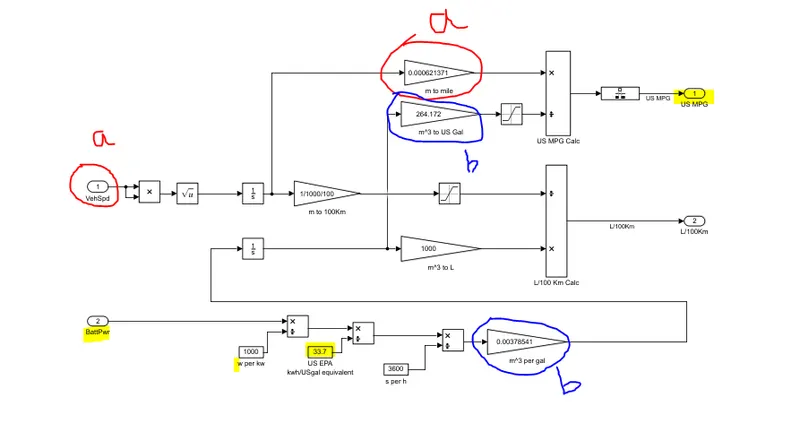
- Double click on the block 'Performance calculations'.
- Vehicle speed data is used to calculate the distance traveled in meters which is then converted to miles (marked as 'a')
- Battery power data is used to find power used in kWh which is then converted to gasoline-equivalent using US EPA value by dividing with 33.7 (marked with yellow)
- As per the US environmental protection agency(EPA) 1 gallon of gasoline is equal to 33.7 kWh
- Dividing distance traveled in miles by the number of gallons, we can get miles per gallon.(marked as 'b')
- For HEV this gallon(gasoline-equivalent of battery power) is added with gallon used by IC engine then miles per gallon is calculated.
----------------------------------------------------------------------------------------------------------------------
Q3:Run the HEV ReferenceApplication with WOT drive cycle. Change the grade and wind velocity in the environment block. Comment on the results.
Answer:
> Open the HEV reference application
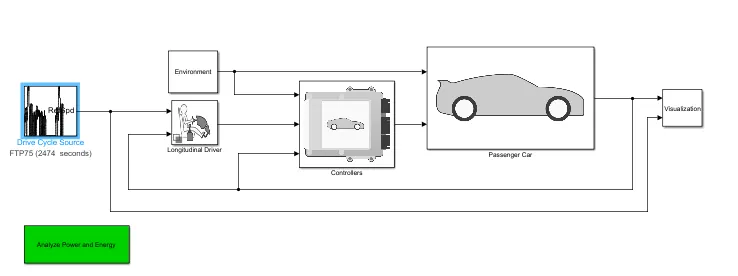
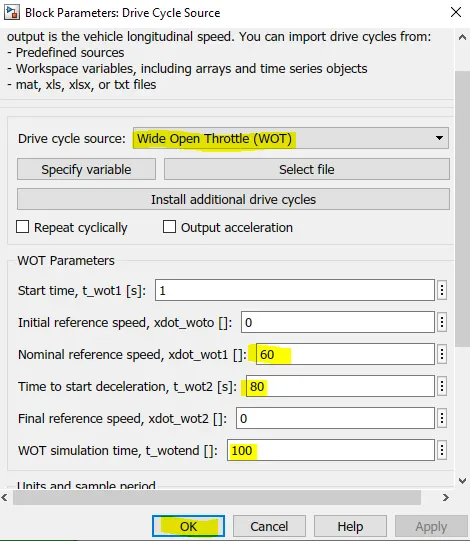
STep2: Click on the Drive cycle source and change the parameters as per our requirement as marked in yellow.
Next Click on the Envuronment block as below:
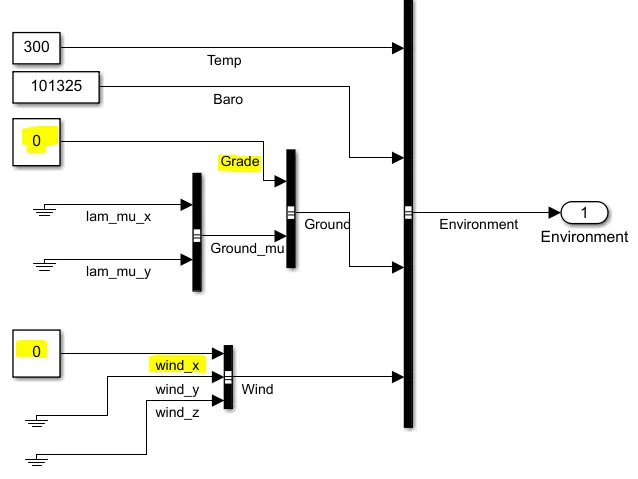
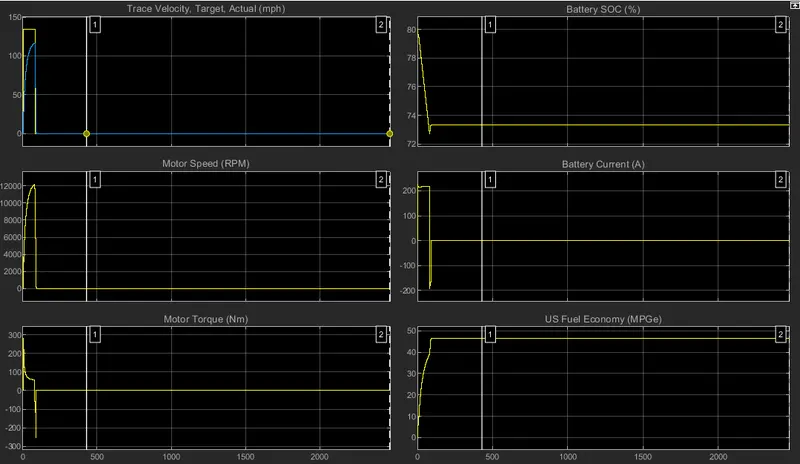
Case 1: Grade - 0, Wind velocity 0 m/s
----------------------------------------------------------------------------------
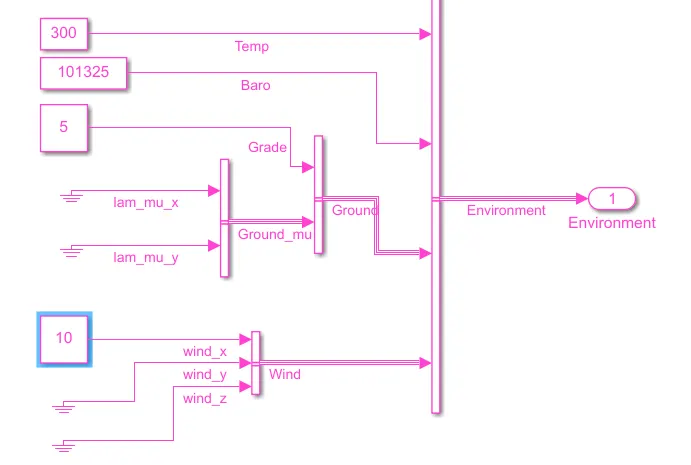
Case 2: Grade - 5, Wind velocity 10 m/s
Results:
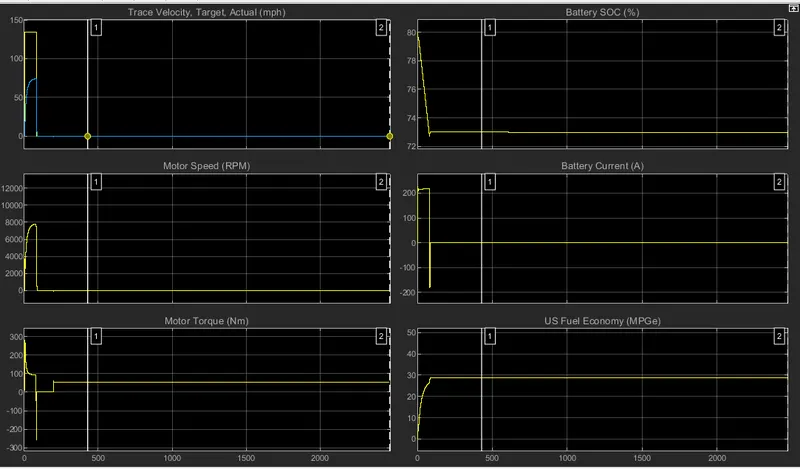
RESULTS:
with the increase in grade and wind velocity,
- Peak velocity achieved is reduced as gradient force and aerodynamic force becomes dominant.
- Fuel economy is also reduced because the distance traveled is reduced due to external forces as seen in image 2 bottom corner.
- Battery SOC at the end of WOT acceleration is similar but during deceleration battery is charged more is the grade and wind velocity is less.
-------------------------------------------------------------------------------------------------------------------
Q4. Keeping all other parameters same, compare the simulated results of hybrid and pure electric powertrains.
Solution:
The Pure electric vehicle model is shown in fig(a).
The drive cycle settings can be altered as per requirement as shown in fig(b).
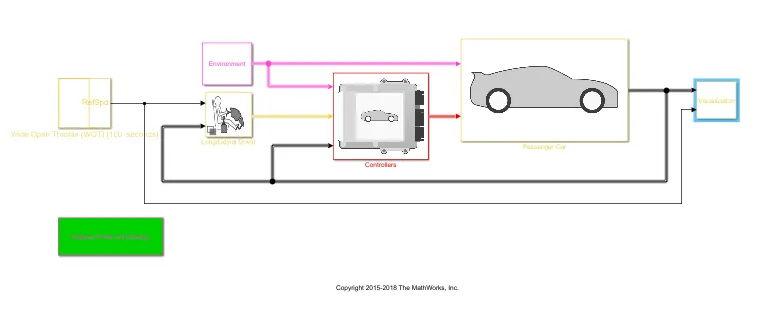
Fig(a)
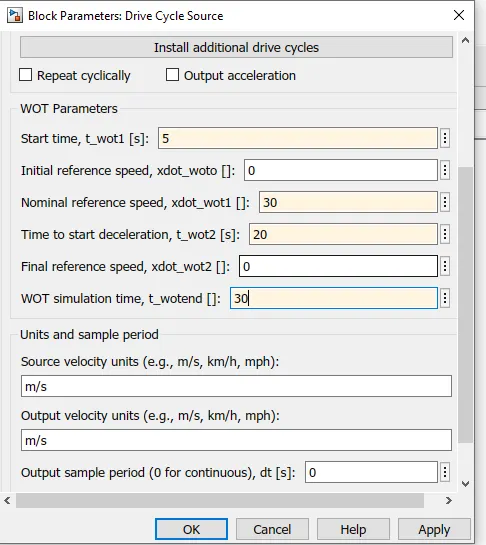
fig(b)
-----------------------------------------------------------------
Results:
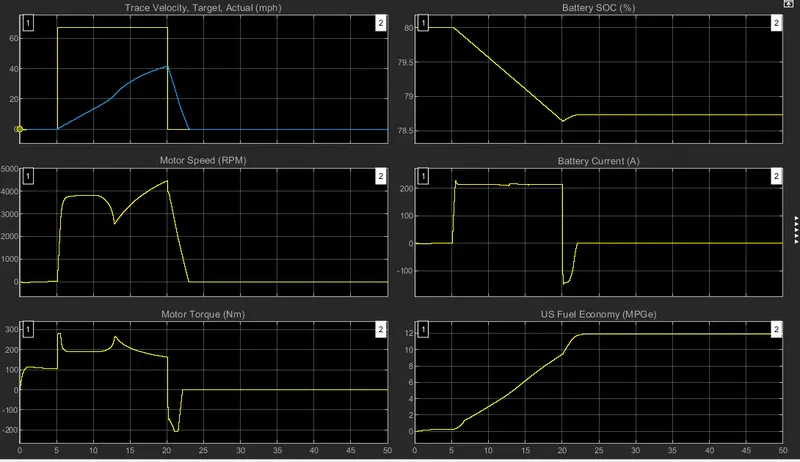
- The Vehicle couldn’t achieve the Target velocity. It attained only 40mile per hour in 20sec.
- Battery State of Charge decreased from 80% to 78.5%.
- Battery supplied its maximum current of 220A
- To Improve WOT performance, Motor has to deliver more torque and Battery should support fast discharging.--------------
- -----------------------------------------------------------------------------------------