Week 4 Session 5
POWER CONVERTERS : There are 4 types of power converters which are commonly used.
- AC to AC Converter (not commonly used in Electric Vehicle)
- AC to DC Converter
- DC to DC Converter
- DC to AC converter
DC to DC Converter
- Converts an unregulated DC input to a regulated DC output
- Non Isolated converters: BUCK, BOOST, Buck boost
A Buck converter, also known as a step-down converter, is used to lower the voltage level of a DC power source. It works by turning the input voltage on and off at high frequencies using a switch and an inductor. The inductor stores energy when the switch is on and releases it when the switch is off, producing a lower output voltage than the input voltage.
A Boost converter, also known as a step-up converter, is used to increase the voltage level of a DC power source. It works by storing energy in an inductor when the switch is on and releasing it to the output when the switch is off, resulting in a higher output voltage than the input voltage.
A Buck-Boost converter combines the functions of a Buck and a Boost converter, and can both increase and decrease the voltage level of a DC power source. It works by switching the input voltage between the inductor and the load, resulting in an output voltage that can be either higher or lower than the input voltage, depending on the duty cycle of the switch.
2. Isolated converters: Flyback, Forward ,half bridge, full bridge.
3. Resonant Converters:Different family of DC DC convrters , used for high power Conversion.
The devices that are designed to provide zero-voltage or zero-current switching are known as Resonant Converters. These converters are basically electric power converters that contain a network of inductors and capacitors that is specifically tuned to resonate at a particular frequency.
In an electric circuit, resonant converters are incorporated to somewhat lessen the chances of switching losses in devices like MOSFET or IGBT. These are regarded as electrical inverters that work on resonant current oscillation.
APPLICATIONS OF POWER CONVERTERS IN ELECTRIC VEHICLE
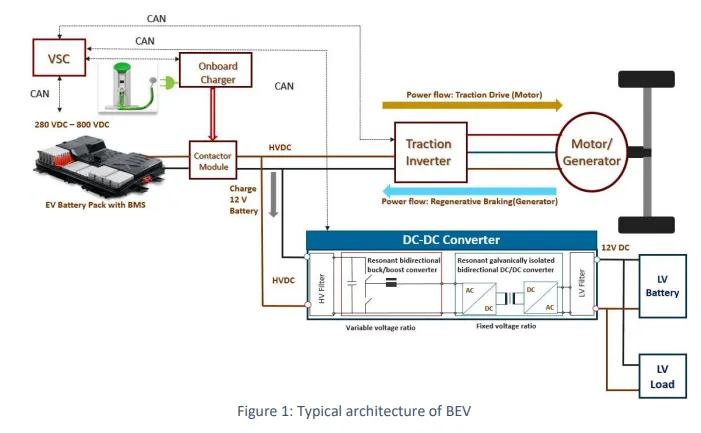
Power Converters play a critical role in electric vehicles, where they are used to manage the flow of electrical power between the battery, motor, and other components of the vehicle. Some of the key applications of power converters in an electric vehicle include:
-
Battery Charging: Power converters are used to convert the AC power from a charging station or home charger into DC power that can be used to charge the vehicle's battery.
-
DC-DC Conversion: Power converters are used to step down the high voltage DC power from the battery to the lower voltage DC power required by the vehicle's electronics and accessories.
-
Motor Control: Power converters are used to control the speed and torque of the electric motor, by adjusting the voltage and frequency of the power supplied to the motor.
-
Regenerative Braking: Power converters are used to convert the kinetic energy of the vehicle during braking into electrical energy that can be stored in the battery for later use.
-
Vehicle-to-Grid (V2G) Integration: Power converters can be used to enable bi-directional power flow between the electric vehicle and the power grid, allowing the vehicle to provide power to the grid during times of peak demand, or to store excess energy from the grid during times of low demand.
Overall, power converters are essential components in electric vehicles that enable efficient and effective management of electrical power throughout the vehicle's systems
EXAMPLE
- To power a horn, a DC-DC converter is used to step down the high voltage of the battery to the required voltage level of less than 10V.
- DC fast chargers are used to charge EV batteries quickly. These chargers use high-power DC-DC converters.
- The power converter used for regenerative braking is called a bidirectional DC-DC converter.
-
Onboard Charger (OBC): An OBC is an AC-DC converter that is used to convert the AC power from the charging station to the DC power that can be stored in the battery of an EV.
------------------------------------------------------------------------------------------------------------------------