Week-6 Challenge: EV Drivetrain
Q1)
To find types of power converter circuits are employed in electric and hybrid electric vehicle.
solution:
Power electronics converters play a crucial role in in electric and hybrid electric vehicle. There different power converter circuits used in electric and hybrid electric vehicles. They are given below.
- AC to DC converter(Rectifiers) -
They are used in onboard charger. Here for charging the battery using external supply, Since battery accept only DC, using a AC to DC converter, external AC supply is converter into DC and it is fed into the battery for charging. They are used mainly used in Plug-in Hybrid electric vehicle(PHEV) and Plug-in electric vehicle(PEV)
- DC to DC converter (choppers)-
This converters can either step-up or step-down of DC voltage. As we know there is an auxilliary battery in EV used for powering the head light, Side mirror and other infotainment system. So here come the use of DC DC converter, it step down the voltage of auxilliary battery and fed it into the systems.
This DC DC converter act a inferface element between battery and DC motor. Which control the speed of motor by varying the voltage applied to it from battery.
- DC to AC Converter( Inverter) -
The power output from battery pack (DC) is converted using inverter to be used in electric motor(AC motor). For induction motor drive Inverter are used.
Q2)
Aim : To find EV steady state speed of given Electric Vehicle's powertrain with 72V battery pack if duty cycle is 70%
Solution:
Given,
Rated Armature voltage, V_rated = 72 V
Rated armature current, Ia = 400 A
Ra= 0.5Ω, KΦ= 0.7 Volt second
Chopper Switching frequency= 400 Hz
We know torque speed relation of motor is
Speed, W = (V/KΦ) - ((Ra*Tm)/(KΦ^2)).---------(1)
Give duty cycle is 70 % so we can write V_actual = 72*70%
V_actual = 50.4 v
Substituting the given values we get
W = (50.4/0.7) - ((0.5*Tm)/(0.7^2))
W = 72 - 1.02*Tm ------(2)
The vehicle speed-torque characteristics are given by the below equation
 ------------(3)
We know steady state speed is the speed at the operating point. At that point, speed-torque characteristics of both vehicle and motor intersect. So we can equate the torque to find the steady state speed.
So from equation (2) and (3) we can write
W = 72 - 1.02*(24.7 + 0.0051*W^2)
=> 0.0052*W^2 + W - 46.8 = 0
by solving this we get steady state speed W_ss = 38.92 rad/sec
Q3)
Aim :
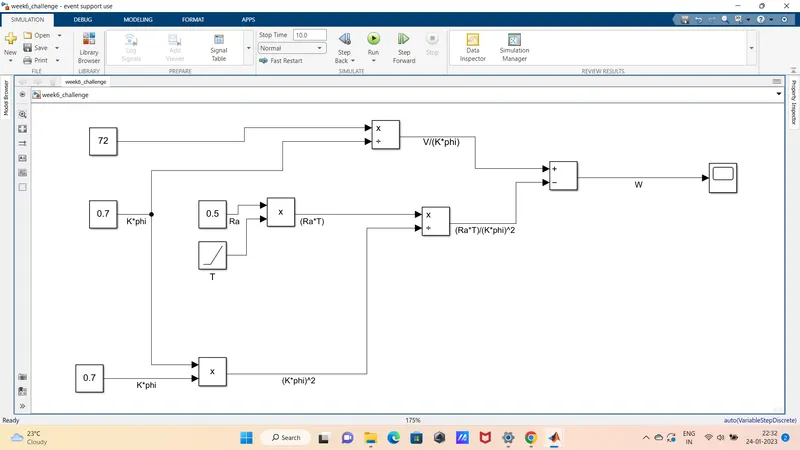
To Develop a mathematical model of a DC Motor for the below equation using Simulink.
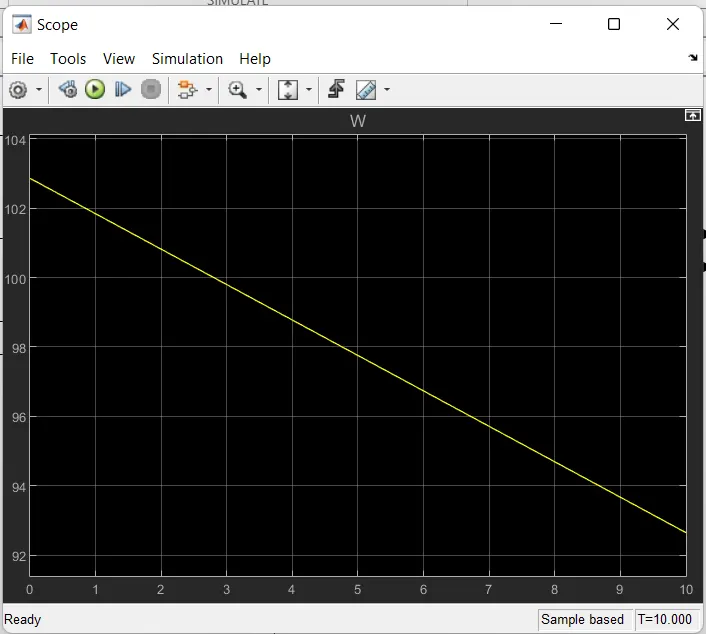
The figure below shows the simulink model
Q4)
The following things can be concluded from the article
- In case of conventional ICE vehicle, we can use different engine. There is no one best engine type, instead there are different types of engines to suit personal requirements, such as price and performance. Same thing applicable in case of electric vehicle motor selection.
- Then the author explained the working of brushless dc motor and three phase induction motor.
- The stators for the 3-phase induction motor and the DC brushless motor are virtually identical. Both have three sets of “distributed windings” that are inserted within the stator core. The essential difference between the two machines is with the rotor.
- The rotor of BLDC motor have permenent magnet but in case of induction there is no permenent magnet in the rotor instead it contain stacked steel laminations with buried peripheral conductors that form a “shorted structure.
- The auther has done as comparison between the two motors saying advantages and disadvantages
- Induction motor - the motor has the ability to start under load. No inverter is needed. induction motors are directly compatible with conventional utility power is the main reason for their success.3-phase induction motors have great utility, they also have some severe limitations. They cannot operate from DC; AC is a must. Shaft speed is proportionate to line frequency. Hence, when used with utility power, they are constant speed machines. Finally, when operated from utility power, they have limited starting torque and somewhat limited running peak torque capabilities, when compared to DC type machines. Induction machines are more difficult to control. The control laws are more complex and difficult to understand
- A brushless DC motor produces no starting torque when directly connected to fixed frequency utility power. Much less rotor heat is generated with the DC brushless drive.Rotor cooling is easier and peak point efficiency is generally higher for this drive. The permenent magnet are expensive.Thus this motor is expensive as compared to IM. Permanent magnet (PM) rotors are also difficult to handle.
- Then auther concluded the article by saying, DC brushless drives will likely continue to dominate in the hybrid and coming plug-in hybrid markets, and that induction drives will likely maintain dominance for the high-performance pure electrics