Project - Position control of mass spring damper system
I have already submitted the project( Speed control of a DC motor) on Nov 20, 2022 and it has been graded. My score was 300/300 in this project. After the site updation, my file is missing from my profile and it shows that I have to resubmit . I have discussed this issue with one of technical engineer and i was told to submit the file here again. Please have a look. I have attached proof showing my project as graded.
Speed control of a DC Motor
The project is to Built a simulink model for the DC(schematic shown in question) Motor and to design a PID controller to maintain a desired speed for the motor.
Applying krichoffs law for the given schematic diagram we get
Vs = Ra*Ia + La*dia/dt +Vb --------------- (1)
Applying newtons's law for the given schematic diagram we get
Kt*Ia = J*d^2theta/dt^2 + B*dtheta/dt -------(2)
Taking Laplase Transform for both equation
Eq(1) => Vs(s) = Ra*Ia(s) + La*s*Ia(s) +Vb(s)
=> Ia(s)*(La*s + Ra) = Vs(s) - Vb(s)
=> Ia(s) = (Vs(s) - Vb(s))/(La*s + Ra) --------------(3)
Eq(2) => Kt*Ia(s) = J*s^2*theta(s) + B*s*theta(s)
=> s*theta(s)(J*s + B) = Kt*Ia(s)
=> s*theta(s) = Kt*Ia(s)/(J*s + B) = w(s) -------(4) since w = dtheta/dt
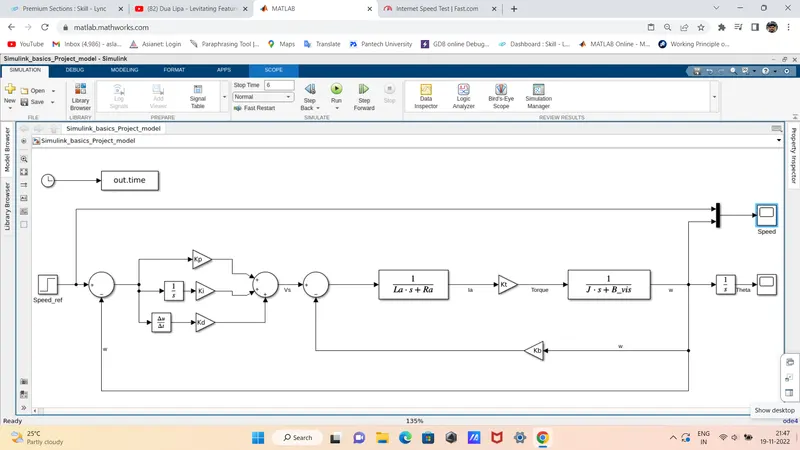
Using Eq (3) and Eq (4) we can built the normal simulation model of Dc motor without PID controller
State space representation
we know
X_dot = A*x + B*u
Y = C*x + D*u
From Eq(2) => J*d^2theta/dt^2 = -B*dtheta/dt + Kt*Ia
we know w = dtheta/dt, substitute in above equation
dw/dt = -(B/J)*w + (Kt/J) = w_theta -------------- (5)
from Eq(1) => La*dIa/dt = -Vb - Ra*Ia + Vs , Vb = Kb*dtheta/dt
=> dIa/dt = -(Kb/La)*dtheta/dt - (Ra/La)*Ia + (1/La)*Vs = Ia_theta---------- (6)
y(t) = w ---------- (7)
From Eq(5), Eq(6) and Eq(7)we will get state space representation of this model
X_dot = [w_theta ; Ia_theta]
x = [w;Ia]
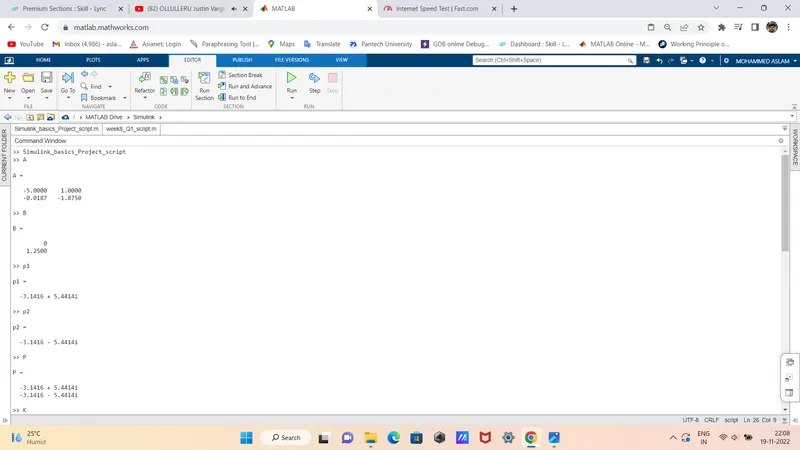
A = [-(B/J) (Kt/J) ;-(Kb/La) -(Ra/La)]
B = [ 0; (1/La)]
C = [1;0]
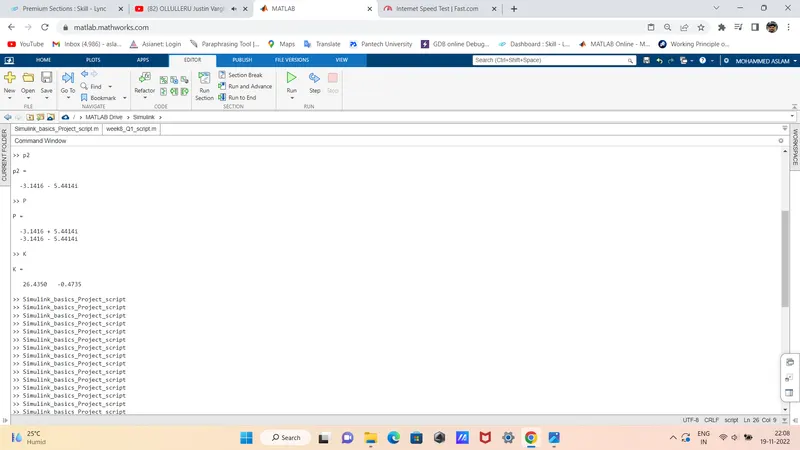
Assuming a value for zeta and by using pole placement technique we will get the value of control gain.
Using above information we can built desired model of dc motor containing PID controller and we can control speed of dc motor to get a desired response.
Here we take zeta = 0.5;
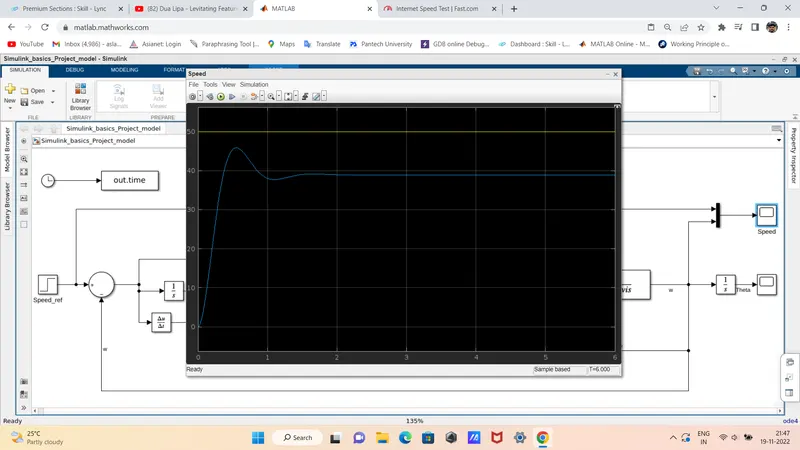
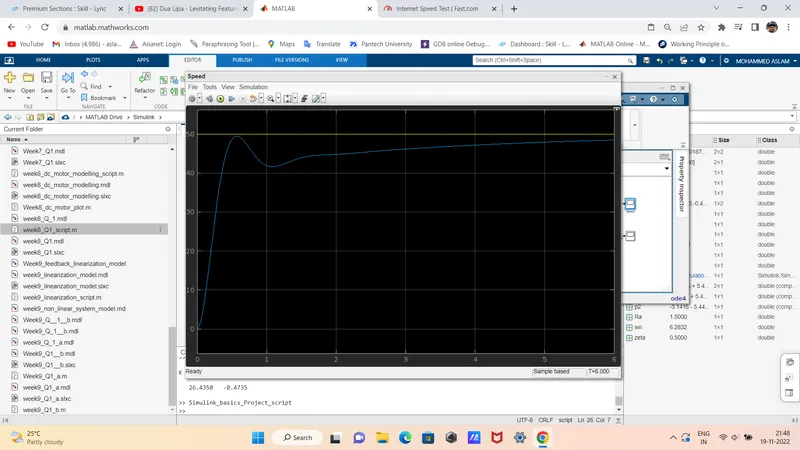
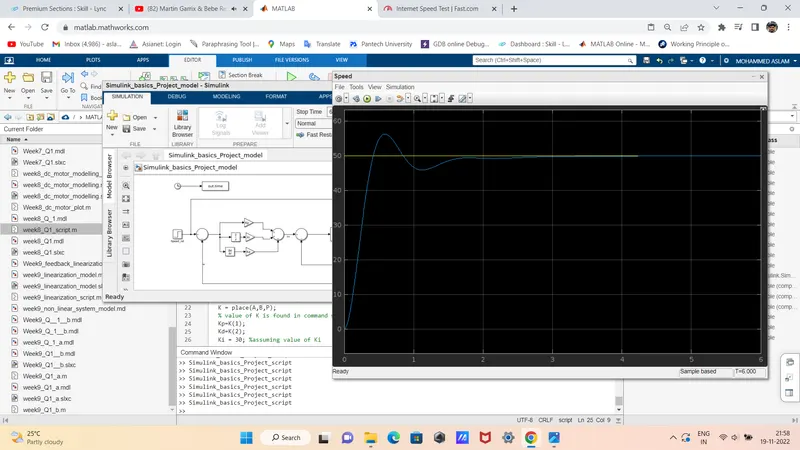
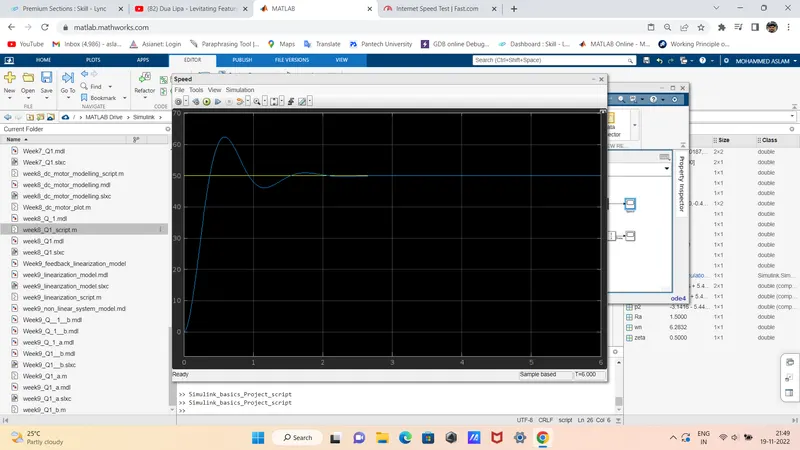
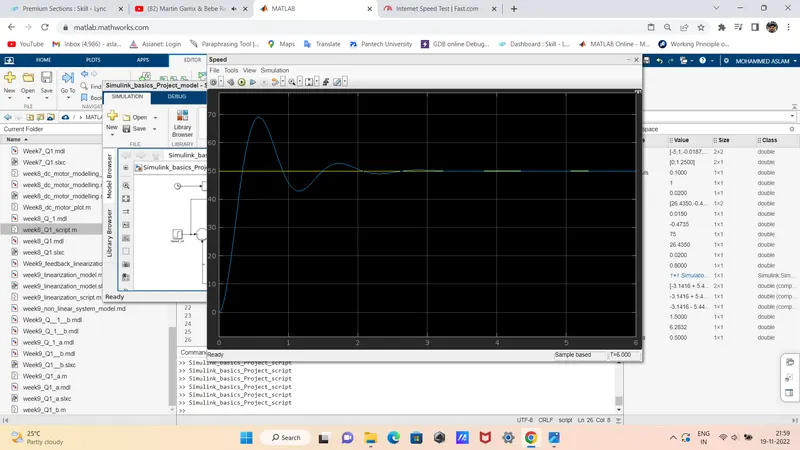
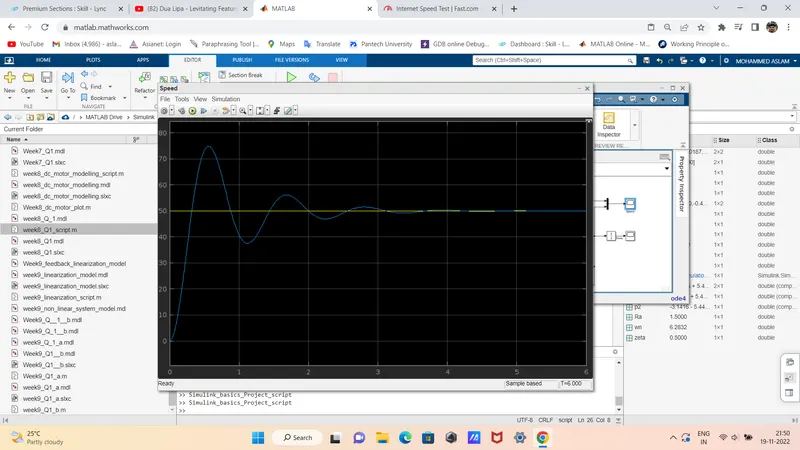
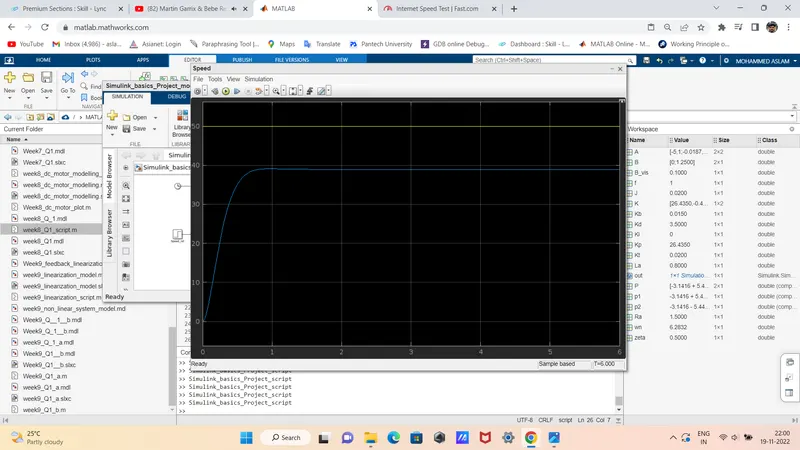
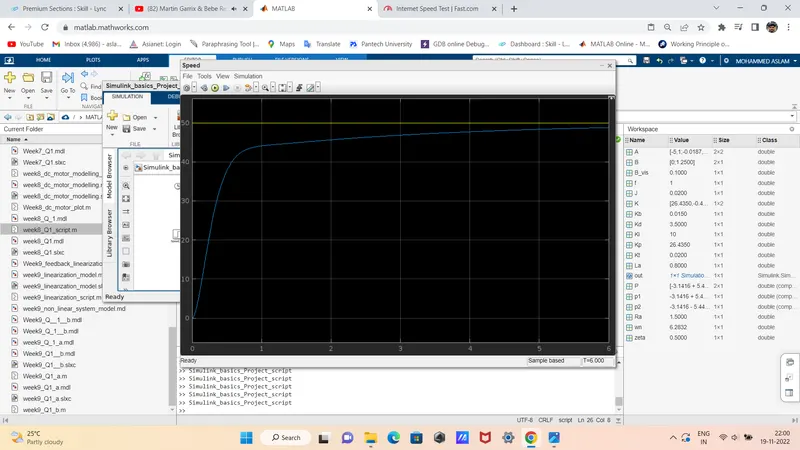
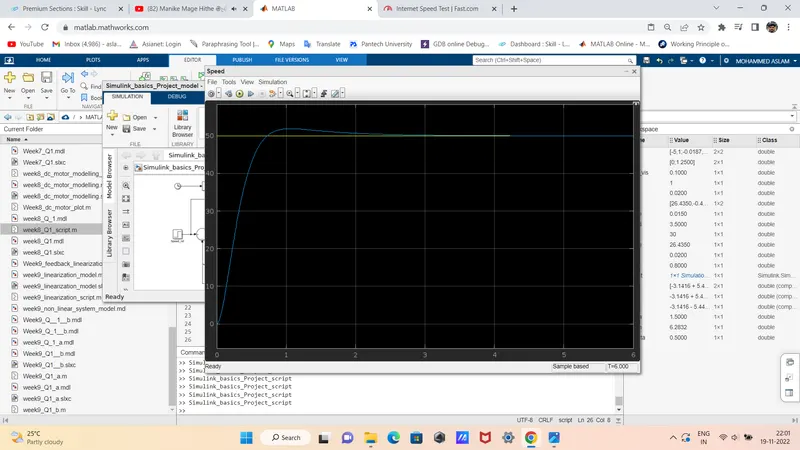
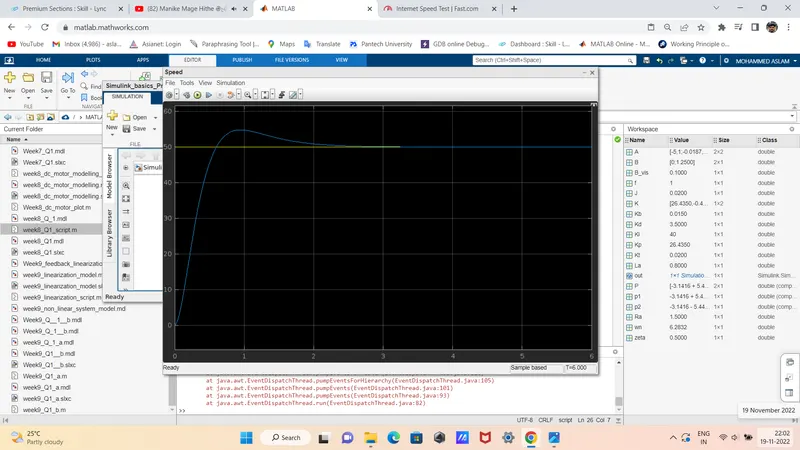
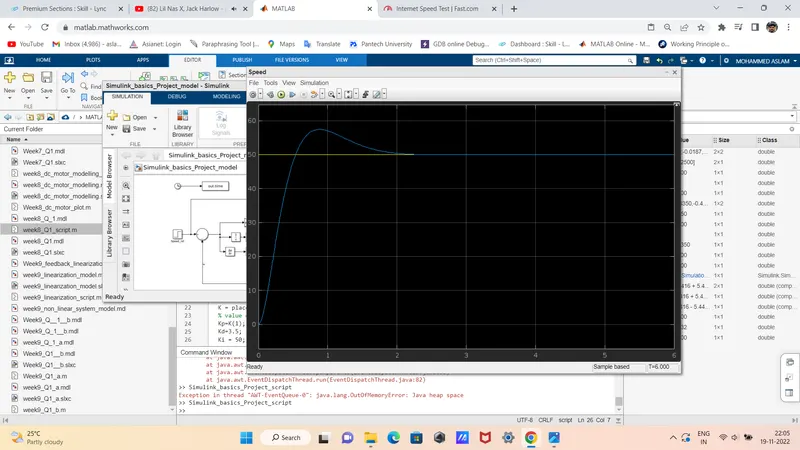
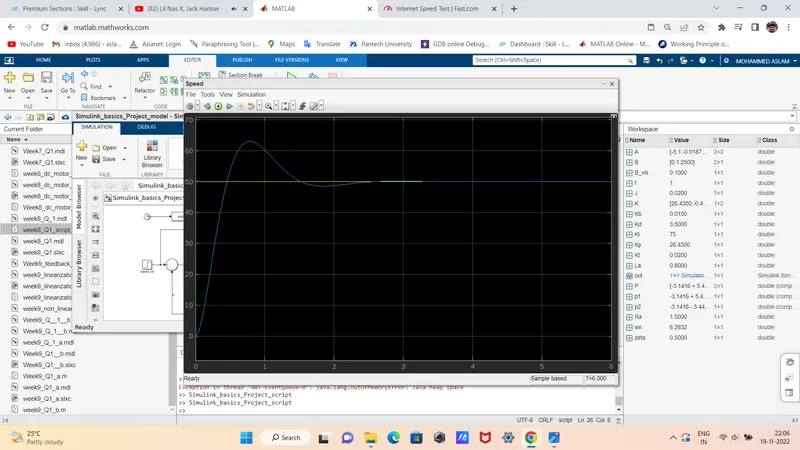
analyzing the response of the system for input reference speed of value 50
that is Reference speed = 50
solver = ode 4, step size=0.01, simulation stop time = 6 sec
Script