Week-6 Challenge: EV Drivetrain
1.
There are several types of power converter circuits that are commonly used in electric and hybrid electric vehicles, including:
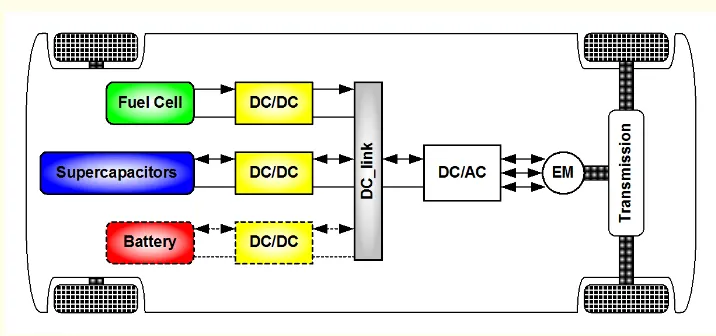
Electric vehicles powertrain
-
DC-DC converters: These are used to convert the high-voltage DC power from the battery pack to a lower voltage DC power that can be used to power the vehicle's electric motor and other electrical systems. This converter typically employs a switching circuit that converts the input DC voltage to a high-frequency AC voltage, which is then converted back to a lower DC voltage output using a transformer.
-
AC-DC converters: These are used to convert the AC power from the grid to DC power that can be used to charge the vehicle's battery pack. This converter typically employs a diode rectifier circuit that converts the input AC voltage to DC voltage.
-
DC-AC inverters: These are used to convert the DC power from the battery pack to AC power that can be used to power the vehicle's electric motor. This converter typically employs a switching circuit that converts the input DC voltage to a high-frequency AC voltage, which is then filtered to produce a clean sine wave output.
-
Battery Management Systems (BMS): These are used to monitor and control the charging and discharging of the vehicle's battery pack. This system typically employs a microcontroller or an integrated circuit to monitor the battery voltage, current, temperature, and other parameters. It also controls the charging and discharging of the battery pack to ensure safe and efficient operation.
2.
Motor and Controller Parameters:
Rated Armature voltage= 72 V
Rated armature current= 400 A
Ra= 0.5Ω, KΦ= 0.7 Volt second
Chopper Switching frequency= 400 Hz
The vehicle speed-torque characteristics: Tv=24.7+(0.0051)ω2">Tv=24.7+(0.0051)ω2Tv=24.7+(0.0051)ω2..........equ.(1)
Duty cycle=70%=0.7,
Actual voltage=0.7*72=50.4V
Torque equation for motor,
T=VkϕRa−((kϕ)2Ra)⋅ω
T=50.4⋅0.70.5−((0.7)20.5)⋅ω
T=70.56-0.98⋅ω">T=70.56−0.98⋅ωT=70.56-0.98⋅ω.......................equ.(2)
solving equation (1)&(2),
comparing both torque of vehicle and torque of motor,
24.7+(0.0051)⋅ω2=70.56−(0.98)⋅ω
0.0051ω2+0.98ω-45.86=0">0.0051ω2+0.98ω−45.86=0
by solving this by quadratic equation
ω=38.915radsec">ω=38.915rad/sec
ω=−231.072rad/sec
EV steady state speed if duty cycle is 70% = 38.915 rad/sec or 371 RPM
3.
In the blog "Induction Versus DC Brushless Motors" by Wally Rippel, the author provides a technical overview of the differences and similarities between induction and DC brushless motors which are commonly used in electric vehicles. Rippel is a long-time proponent of electric vehicles and has worked on the development of EVs for General Motors and on electric vehicle battery research for the Jet Propulsion Laboratory. He is a Principal Power Electronics Engineer at Tesla Motors.
He points out that when he was a student, there were lead acid batteries, DC brush motors, and contactor controllers, but today, none of these remain as lead has been replaced by lithium and DC by either DC brushless or induction. Contactors, meanwhile, have given way to modulating inverters. He predicts that both induction and brushless machines will "duke it out" for many years to come and each will have its loyal proponents and religious detractors.
The author then goes on to explain what these two technologies are and how they work. He starts with DC brushless drives. He explains that with brushless machines, the rotor includes two or more permanent magnets that generate a DC magnetic field as seen from the vantage point of the rotor. In turn, this magnetic field enters the stator core which is a core made up of thin, stacked laminations and interacts with currents flowing within the windings to produce a torque interaction between the rotor and stator. As the rotor rotates, the magnitude and polarity of the stator currents need to be continuously varied such that the torque remains constant and the conversion of electrical to mechanical energy is optimally efficient. The device that provides this current control is called an inverter. Without it, brushless motors are useless motors.
He then moves on to explain induction motor drives. He mentions the 3-phase induction motor was invented by Nikola Tesla sometime before 1889. He points out that the stators for the 3-phase induction motor and the DC brushless motor are virtually identical. Both have three sets of “distributed windings” that are inserted within the stator core. The essential difference between the two machines is with the rotor.
Unlike the DC brushless rotor, the induction rotor has no magnets, just stacked steel laminations with buried peripheral conductors that form a “shorted structure.” Currents flowing in the stator windings produce a rotating magnetic field that enters the rotor. In turn, the frequency of this magnetic field as “seen” by the rotor is equal to the difference between the applied electrical frequency and the rotational “frequency” of the rotor itself. Accordingly, an induced voltage exists across the shorted structure that is proportionate to this speed difference between the rotor and electrical frequency. In response to this voltage, currents are produced within the rotor conductors that are approximately proportionate to the voltage, hence the speed difference. Finally, these currents interact with the original magnetic field to produce forces – a torque that drives the rotor.
In summary, the author presents a technical perspective on the topic of Induction and DC brushless motors, providing a comprehensive overview of the engineering aspects of the technology. He presents the similarities and differences between the two technologies and how they work, he also mentions the advantages and disadvantages of each technology and also mentions that the selection of the right motor type depends on the specific application. He concludes by saying that both induction and brushless machines will continue to coexist in the market as they have their own