Week-6 Challenge: EV Drivetrain
1)
The power electronic converters are thought of as the key components of Electric and Hybrid Electric Vehicles (EV/HEV) that interface their power sources to the drivetrain of the EVs. Advanced DC/DC and DC/AC converters are needed to adapt the output voltage and current levels with excellent power quality in order to design highly efficient converters for the EV's power system.
The three main converter types found in electric vehicles are:
1. AC to DC Converter
This kind of AC-DC converter is used in electric vehicles to convert AC currents to DC during "On-board charging."
Additionally, the battery converter must be isolated for safety reasons in order to create a barrier between the battery and the AC grid.
2. DC to AC Converter
In electric vehicles, the "battery converter" uses an AC-DC type converter to convert DC currents to DC currents.
These converters connect a fixed-input DC supply to a variable-output AC load.
These DC to AC converters are most frequently referred to as inverters. A static device called an inverter changes a fixed DC source voltage into a variable AC voltage.
This battery converter must operate in both directions and may be either isolated or not isolated.
3. DC to DC Converter
A simplified step-down converter might operate by creating a series of on-off pulses and smoothing them out using a combination of inductors and capacitors to create a constant DC signal, whose voltage is determined by the duty cycle (that is, the duration of the "on" states relative to the "off" states), and whose current is constant.
A power conversion device is required since many DC powered applications demand various DC voltage levels from a fixed DC source and EVs and HEVs need variable DC to create variable speed.
2)
3)
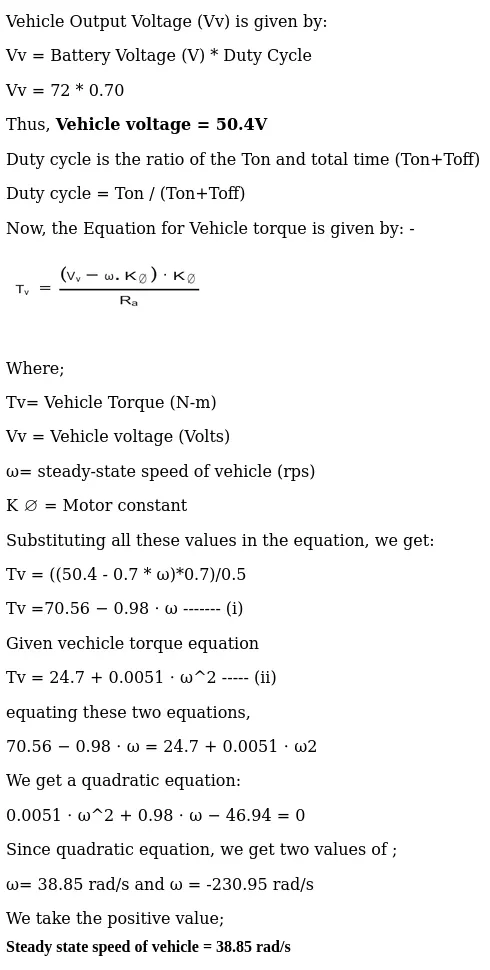
Given equation is
It is modelled in simulink environment as
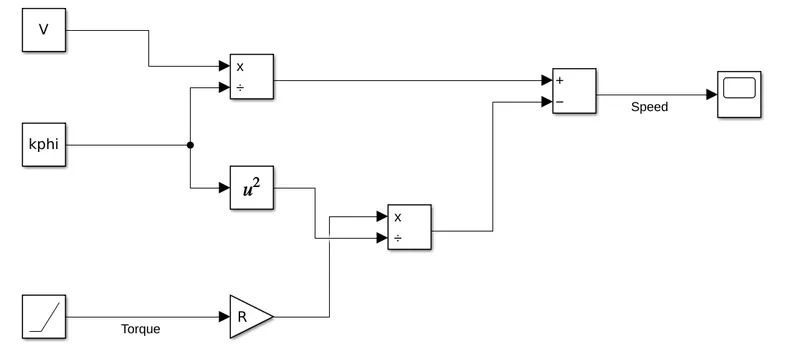
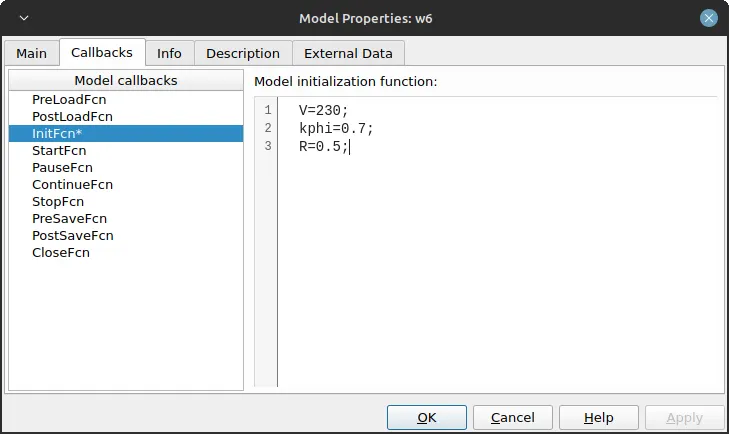
Constant are initialized with the help of init function.
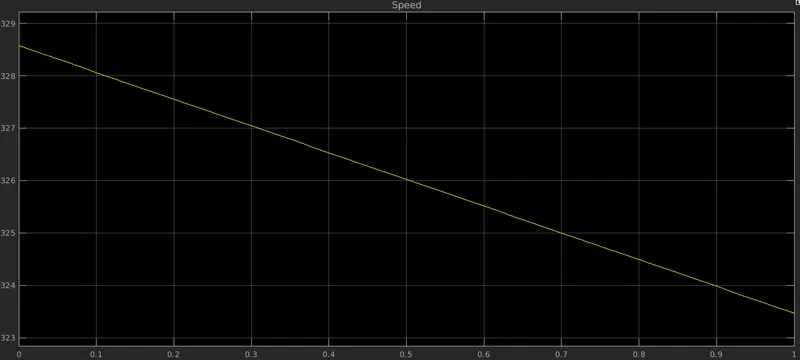
The ouput speed in rad/s is a linear function of Torque and is obtained as
4)
Author is attempting to make the point that the choice of motor for any purpose relies on the nature of the application.
- Nowadays, DC brushless motors are used frequently in HEVs and PHEVs due to their high torque operation and also because speed control methods are simple. However, core losses are a limitation because permanent magnets in the rotor of DC brushless motors prevent the flux from being controlled, which leads to core losses. It is preferred to employ compact size applications because these core losses cannot be avoided when motor size grows. Additionally, the price of the magnetic material is high.
- Induction motors with a three-phase inverter circuit, on the other hand, are also more suited for usage in electric vehicles (EVs) since magnetic flux can be adjusted since no permanent magnet is employed, but torque must be sacrificed.
Induction motor speed control is complicated as well.
According to the author, no motor can be better than another. We cannot always choose one because each has advantages and disadvantages.