Week-6 Challenge: EV Drivetrain
1) Which types of power converter circuits are employed in electric and hybrid electric vehicle?
There are 4 main categories of power converter circuits which are used in electric and hybrid electric vehicles. They are listed and elaborated upon below:
- AC to DC converter
- DC to AC converter
- DC to DC converter
- AC to AC converter
AC TO DC CONVERTER
This type of converter takes an AC power supply and converts it to a DC one. Examples of Ac to DC converters are: phone charger, laptop charger etc. An AC power supply has an alternating waveform which repeatedly reverses direction. An AC to DC converter will prevent the current changing direction, so that it only flows unidirectionally.
In the case of EVs or HEVs, the battery pack which operates with a DC power supply is charged at home or at a charging station both of which are supplied power in AC form from the electric grid. So, the chargers for these vehicles are an example of the AC to DC power converter.
In the case of EVs or HEVs, the battery pack which operates with a DC power supply is charged at home or at a charging station both of which are supplied power in AC form from the electric grid. So, the chargers for these vehicles are an example of the AC to DC power converter.
DC TO AC CONVERTER
This type of converter takes a DC supply and converts it to an AC one. Power which is supplied from a battery or capacitor can have its form changed to the AC type for use in homes or systems which have an AC load. For instance, the power generated by solar panels are stored in batteries in the DC form and this can power a house which uses an AC power supply so that we can utilise this power from the mains. This type of converter is referred to as an \'inverter\' and is widely used in homes and in EV/HEVs.
In the case of EVs and HEVs, the battery pack will supply its power to the inverter. The inverter contains a transformer which consists of a primary and secondary winding. The current from the battery is first supplied to the primary winding where the electronic switches will repeatedly reverse the direction of the current to create an AC waveform. This current will return back the way it came from. The AC current in the primary winding will induce an AC current in the secondary winding which then supplies this current to an AC load e.g. the AC traction motor.
DC TO DC CONVERTER
This type of converter is similar to a transformer in that it can change the voltage from its current level to another level. It can take an input supply of voltage and increase it or do the exact opposite and decrease it similar to a step up or step down transfomer. This kind of a converter is called a 'chopper'. The purpose of using this type of converter is to provide the necessary level of power to a particular component and for the safety of the appliance and the user. If a component if suppled with too little or too much voltage, it won\'t operate due to lack of power or it will get damaged, so it all depends on the load requirement.
There are 2 main types of DC to DC converters which are isolated and non-isolated type. The non-isolated type can be subdivided to 5 types:
- Buck - to step down the voltage
- Boost - to step up the voltage
- Buck/Boost - this can do both step up and step down operations but is mainly used to reverse polarity
- Cuk - similar to the Buck/Boost type
- Charge Pump - to step up/step down the voltage for low power sources
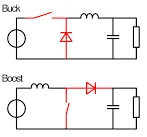
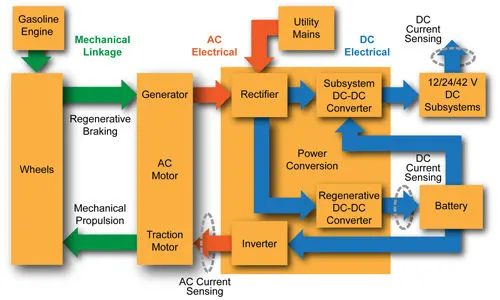
Block diagram of Hybrid Electric vehicle powertrain
The isolated type can be subdivided in to 2 types:
- Flyback converter - similar to the Buck Boost converter except it uses a transformer instead of an inductor to store energy
- Forward converter - this type will use a transformer to send energy between the input and output in a single step
AC to AC converter
This type of converter takes an input AC waveform with a particular voltage and frequency and outputs a different AC waveform with another voltage and frequency. The output voltage and/or freqency can be changed or maintained depending on the application. This converter has many applications in our daily life e.g. lamp dimming, motor speed control. There are 4 main types of AC to AC converters:
- Cycloconverters
- AC to AC convert with DC Link
- Matrix Converter
- Hybrid Matrix Converter
This type is very similar to the matrix converter in that they combine the AC//DC/AC design with the matrix design. It uses unidirectional switches and 2 converter stages, without the DC link to reduce the size and weight of the converter.
2)An Electric Vehicle's powertrain with 72V battery pack in shown in the diagram below.
The duty ratio for acceleration operation is 'd1' and for the braking operation the duty ratio is 'd2'.
Motor and Controller Parameters:
Rated Armature voltage= 72 V
Rated armature current= 400 A
Ra= 0.5Ω, KΦ= 0.7 Volt second
Chopper Switching frequency= 400 Hz
The vehicle speed-torque characteristics are given by the below equation 
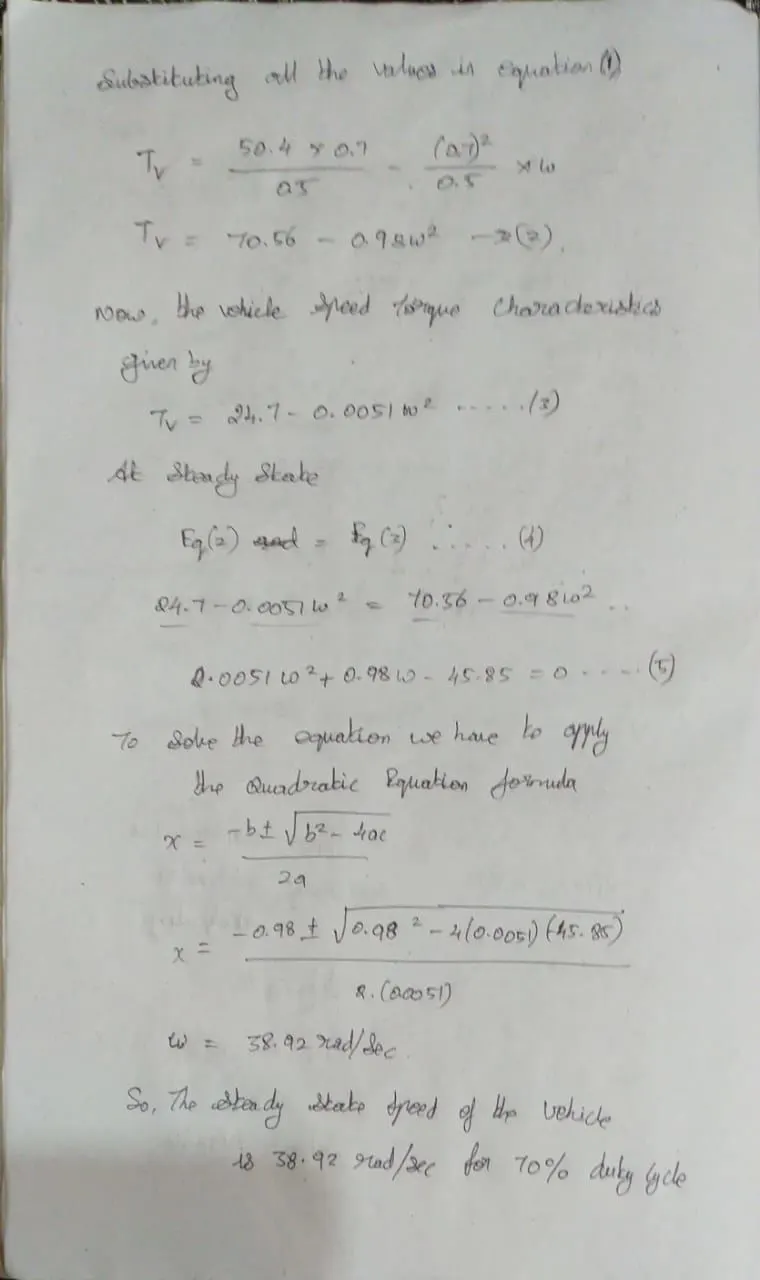
What is EV steady state speed if duty cycle is 70%?
Vehicle Output Voltage() = Battery Voltage(V)*Duty Cycle
= 72 * 0.7 = 50.4 v
Now, Equation for Vehicle torque is :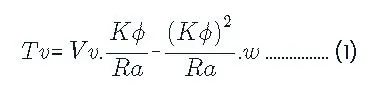
Solved this problem in Notebook
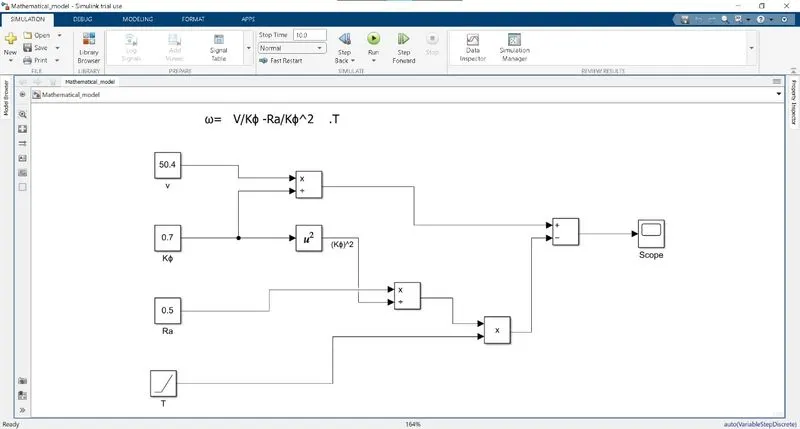
3) Develop a mathematical model of a DC Motor for the below equation using Simulink.
ω= V/Kϕ -Ra/Kϕ^2 .T
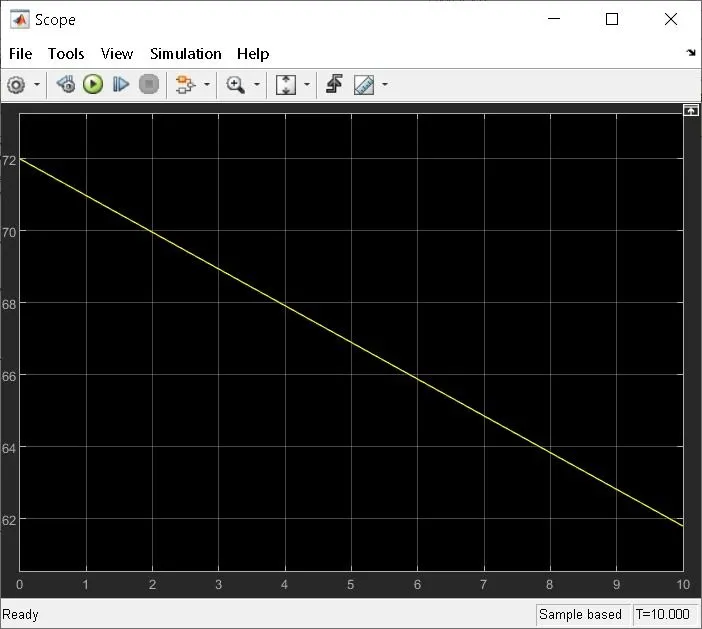
Solving the equation in Matlab simulink
V = 50.4v
Ra = 0.5ohm
Kϕ = 0.7
Simulink model
Scope of the result
4) Explain in brief about author’s perspective.
In the blog, Author Explained Working and performance of both DC brushless and Induction motor. Though Induction motors are old technology and he explained it's significant advantages over the DC brushless motor in pure EV's, at the same he also explained the DC brushless motor significance in Hybrid and Plug-in HEV and it's dominantly used in the current market. Induction motors though lastly found in General Motor EV1, the author suggested that the Induction motor along with DC Brushless motor will be widely used side by side as per Vehicle requirement.
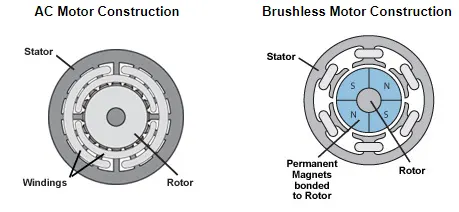
Working Principle of DC Brushless Motor:
1. The Stator is made of thin and stacked laminations. The stator interacts with the current flowing within its windings to produce a torque interaction between the stator and the rotor.
2. The Rotor here includes 2 or more permanent magnets that generate DC magnetic field. As the rotor rotates it is important that the magnitude and the polarity of the stator current be continuously varied so that torque remains constant and also achieving the efficiency.
3. For the functioning of DC brushless motor it is mandatory to have an inverter without which it cannot function.
Pros and Cons of DC Brushless:
Pros
i) Heat generated from the rotor is less, hence rotor cooling is easy and peak point efficiency is higher than the DC Brushless.
cons
i) Inverter (whose phase is maintained in a step with the angular position of the rotor) is mandatory without which DC Brushless motor is useless.
Working Principle of Induction Motor:
A forerunner of the 3-phase induction motor was invented by Nikola Tesla sometime before 1889.
1. The stator is the same as of Induction motor. The only difference is that rotor is different when compared to the DC Brushless. Induction Motor does not have permanent magnets. The Induction motor does not mandatorily require an Inverter to function but with help of a small inverter, the efficiency of the Induction motor will increase.
2. Here the Rotor has stacked steel laminations with buried peripheral conductors that form a shorted structure. Currents flowing in the stator windings produce rotating magnetic fields that enter the rotor.
Pros and Cons of Induction Motor:
Pros
i) No need for Inverter, the motor has the ability to start under load.
ii) Since they do not have any magnets, controlling the Magnetic field here is easy. Hence Magnetic losses (Eddy+Hysterisis+current resistance losses) are minimized and the efficiency is maximized.
My conclusion is that author's perspective of DC brushless drives will likely continue to dominate in the hybrid and coming plug-in hybrid markets, and that induction drives will likely maintain dominance for the high-performance pure electrics. The question is what will happen as hybrids become more electrically intensive and as their performance levels increase? The fact that so much of the hardware is common for both drives could mean that we will see induction and DC brushless live and work side by side during the coming golden era of hybrid and electric vehicles.