Week-6 Challenge: EV Drivetrain
QUESTION 1: (a)-Step-Down or ‘Buck’ Regulators
The ‘step-down’ or ‘buck’ switching regulator (or chopper) . The essential components are an electronic switch with an associated drive circuit, a diode and an inductor. the switch is on, and the current flows through the inductor and the load. The inductor produces a back EMF, making the current gradually rise. The switch is then turned off. The stored energy in the inductor keeps the current flowing through the load, using the diode, The different currents flowing during each part of this on–off cycle . The voltage across the oad can be further smoothed using capacitors if needed.
(b)-Step-Up or ‘Boost’ Switching Regulator
to step-up or boost a DC voltage, regenerative braking being just one example. This can also be done quite simply and efficiently using switching circuits. Voltage boost circuits are also needed for regenerative braking. The circuit is the basis usually used.We start our explanation by assuming some charge is in the capacitor. the switch is on, and an electric current is
building up in the inductor. The load is supplied by the capacitor discharging. The diode prevents the charge from the capacitor flowing back through the switch. the switch is off. The inductor voltage rises sharply, because the current is falling. As
soon as the voltage rises above that of the capacitor (plus about 0.6V for the diode) the current will flow through the diode, and charge up the capacitor and flow through the load. This will continue as long as there is still energy in the inductor. The switch is
then closed again, , and the inductor re-energised while the capacitor supplies the load.
(c)-Single-Phase Inverters
The circuit that produces AC from DC sources such as batteries and fuel cells is known as an inverter.The basic operation of the inverter is quite simple. First switches A and D are turned on, and a current flows to the right through the load. These two switches are then turned off – at this point we see the need for the diodes. The load will probably have some inductance, and so the current will not be able to stop immediately, but will continue to flow in the same direction, through the diodes across switches B and C, back into the supply. The switches B and C are then turned on, and a current flows in the opposite
direction, to the left. When these switches turn off, the current ‘freewheels’ through the diodes in parallel with switches A and D.
QUESTION 2:Rated Armature voltage= 72 V
Rated armature current= 400 A
Ra= 0.5Ω, KΦ= 0.7 Volt second
Chopper Switching frequency= 400 Hz
from above para meters calculate motor torque speed character speed equation
which comes out to be Tm=100.8-0.98w.......eq(1)
as we know the vehicle characteristics Tv=24.7+(0.0051)w^2.......eq(2)
at steady state Tm=Tv hence
equation comes out to be (0.0051)w^2+0.98w-76.1......eq(3)
roots of the eq(3) are -251.4896, 59.3327
hence -ve speed would be neglected
w=59.3327*60/2*pi=566.58555 rpm
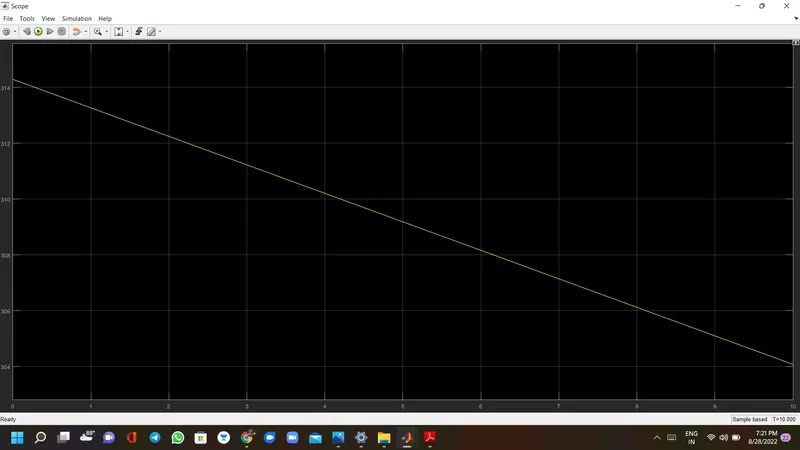
QUESTION 3:SIMULINK MODEL
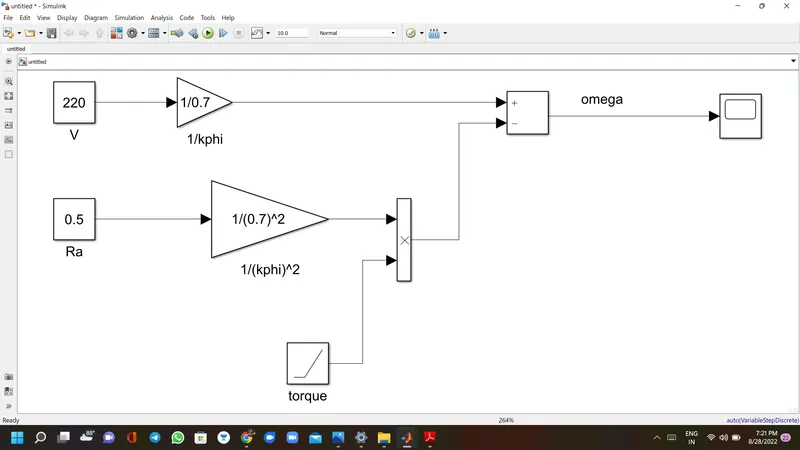
scope
QUESTION 4:
In the starting of the blog he said "One Size Does Not Fit All"
he said in that odious world engines are of the different type . He said one would thought that ,year ago ,some was try to figure out which is best engine and that should be in production but his thought got failed .there is no one is best one .with the different requirement there are different type of engine .such a way he said this true for Brushless DC and Induction Motor. He also said about the evolution of batteries DC bush motor ,and contactor controllers
he said the lead acid battery is replaced by the lithium and brush DC motor with Brushless DC motor or Induction motor.
Next he talks a closer look , he gives some closer look of the brushless DC motor and induction motor there technologies ,there working .
also he speak about what differentiate them ? in that he told about DC brushless machine that rotor generate the magnetic field with two or more permanent magnet and this magnetic field enters the stator core (a core made up of thin, stacked laminations) and interacts with currents flowing within the windings to produce a torque interaction between the rotor and stator. As the rotor rotates, it is necessary that the magnitude and polarity of the stator currents be continuously varied – and in just the right way - such that the torque remains constant and the conversion of electrical to mechanical energy is optimally efficient. The device that provides this current control is called an inverter. He told one thing that Without inverter, brushless motors are useless motors.
Then is told about the induction motor drives. he curiously told that stator of the both DC brushless and induction motor have three sets of “distributed windings” the only difference is in the rotor , induction motor has no magnet it contains steel laminations with buried peripheral conductors.He describes working of induction motor that Currents flowing in the stator windings produce a rotating magnetic field that enters the rotor. In turn, the frequency of this magnetic field as “seen” by the rotor is equal to the difference between the applied electrical frequency and the rotational “frequency” of the rotor itself. Accordingly, an induced voltage exists across the shorted structure that is proportionate to this speed difference between the rotor and electrical frequency. In response to this voltage, currents are produced within the rotor conductors that are approximately proportionate to the voltage, hence the speed difference. Finally, these currents interact with the original magnetic field to produce forces – a component of which is the desired rotor torque.
he said that induction motor not require inverter and the motor has ability to start under the load .
with the fixed utility power dc brushless motor produces no starting torque it needs inverter .
induction motor not operated form the DC source.
Next he is talking with the heading "Brushless or Induction"
He told that back 1990s all EV except one uses the DC brushless drives today all HEV using the DC brushless .Then he gave some comparison between DC brushless and induction motor