Week-6 Challenge: EV Drivetrain
Que.1. Which types of power converter circuits are employed in electric and hybrid electric vehicle?
Ans: EVs use electrical energy to drive the vehicle and for the electrical appliances in the vehicle to function.Nowadays power electronics become an essential part of automobiles. The power converters used based on the application for Electric vehicles and Hybrid Electric vehicle.A motor drive consists of a power electronic converter and the associated controller. The power electronic converter is made of solid-state devices and
handles the flow of bulk power from the source to the motor input terminals. The controller processes the command input and the feedback information to generate the switching signals for the power converter semiconductor switches.
Fig.1:Electrical system of an EVs powertrain.
The most common types of power converters are:
- Inverter(DC-AC)
- Converter(DC-DC)
- Rectifier(AC-DC)
- Regulator(AC-AC)
Fig.2:Power electronics converters used in a series HEV.
1)Inverter(DC-AC):The inverter functions to change the direct current (DC) on the battery into an alternating current (AC) and then this alternating current is used by an electric motor. In addition, the inverter on an electric car also has a function to change the AC current when regenerative braking to DC current and then used to recharge the battery. The type of inverter used in some electric car models is the bi-directional inverter category.The inverter converts DC to AC. The inverter can change the speed at which the motor rotates by adjusting the frequency of the alternating current.Controlling the inverter can control the speed of the vehicle. The multilevel inverter has the highest efficiency.
Fig.3.Schematic representation of boost converter & inverter.
2)Converter(DC-DC):This one of electric car parts that to converts higher-voltage DC power from the traction battery pack to the lower-voltage DC power needed to run vehicle accessories and recharge the auxiliary battery.The function of a DC-DC converter is to change one level of DC voltage to another level of DC voltage.
a)The change might be step-up(Boost) or step down(Buck) or it can be both (Buck-boost).This converter is used to power up monitors, AC, lamb, headlight, etc.
b)Unidirectional converter used for powering sensor, lamb, utilities, safety equipment.
c)Bi-directional converter used for regenerative braking, charging, power backup.
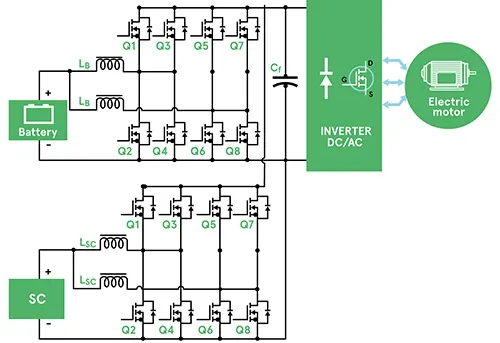
Fig.4.Schematic of a typical (MDIBC)multidevice interleaved bi-directional DC-DC converter.
3)Rectifier(AC-DC):The function of the Rectifier is to converts AC to unipolar (DC) current. Used for slow charging (7KW) with 1 phase, fast charging (11KW) with 3 phase, regenerative action.
Fig.5.Rectifier circuit represntation in Electric vehicle.
4)Regulator/Cycloconverter/Matrix converter(AC-AC):The function of the Regulator converts an AC waveform to another AC waveform, where the output voltage and frequency can be set arbitrarily.The AC input that has a variable magnitude and frequency is processed to provide an AC output that has both regulated magnitude and frequency.
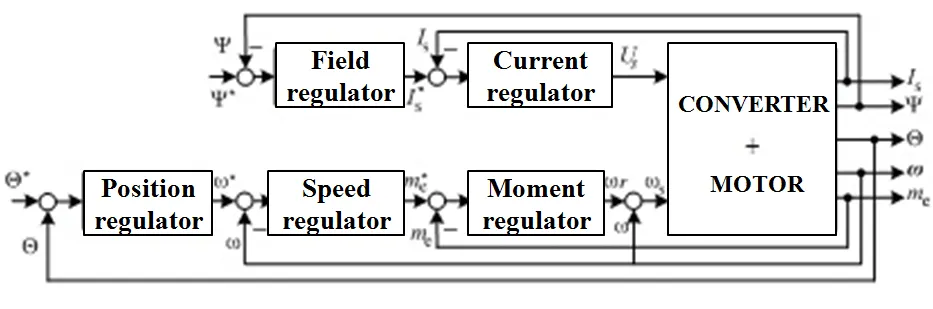
Fig.6.Block diagram of AC motor regulator.
Above block diagram represents block-diagram of regulated drive for AC motor.Depending on use and requirements, some of feedbacks and regulators can be left out. Power block (converter + motor) has two input and five output values. Input (command) parameters are effective polyphase supply voltage Ud and frequency Ws. Output (regulated) values are motor current Is, flux w, position O, rotary frequency w and torque me.Each of those has proper regulator in negative feedback.
Que.2:An Electric Vehicle's powertrain with 72V battery pack in shown in the diagram below. The duty ratio for acceleration operation is 'd1' and for the braking operation the duty ratio is 'd2'.
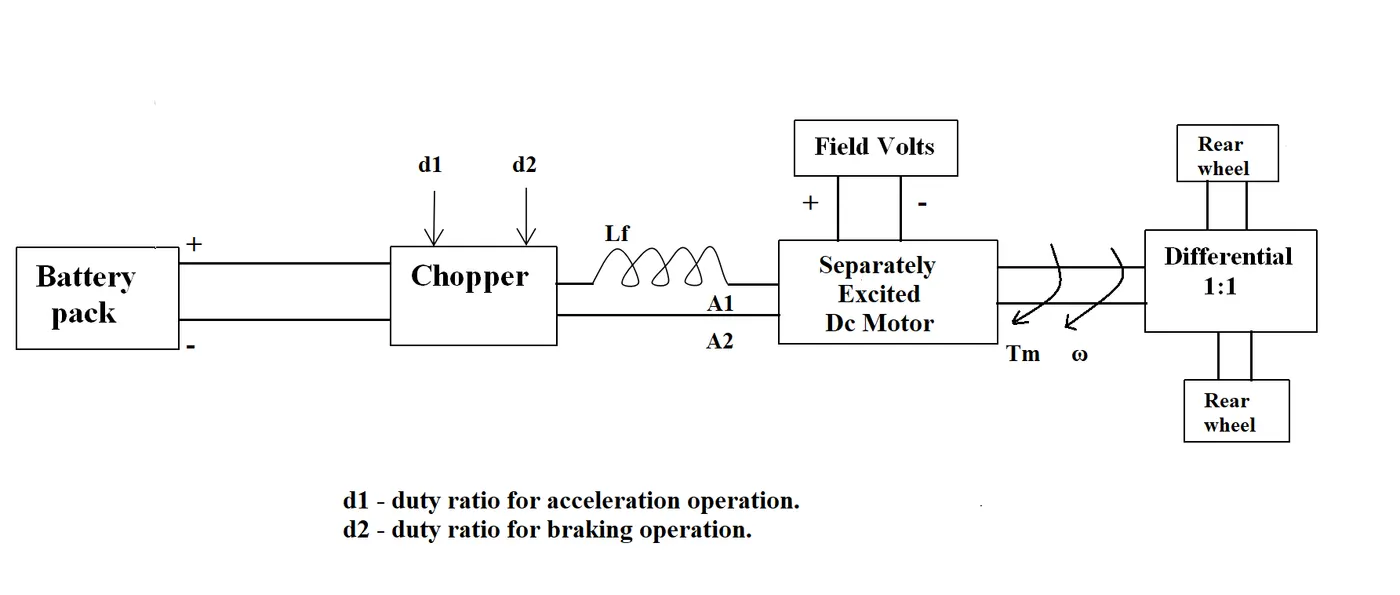
The other parameters of the electric vehicle is given below,
Motor and Controller Parameters:
Rated Armature voltage= 72 V
Rated armature current= 400 A
Ra= 0.5Ω, KΦ= 0.7 Volt second
Chopper Switching frequency= 400 Hz
The vehicle speed-torque characteristics are given by the below equation:

What is EV steady state speed if duty cycle is 70%?
Ans:
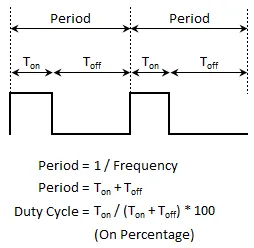
Duty cycle: A duty cycle or power cycle is the fraction of one period in which a signal or system is active.Duty cycle is commonly expressed as a percentage or a ratio. A period is the time it takes for a signal to complete an on-and-off cycle.As a formula, a duty cycle (%) may be expressed as:
Steady State Speed of Vehicle:Equilibrium speed of a motor-load system is obtained when motor torque equals the load/vehicle(traction) torque. Drive will operate in steady-state at this speed, provided it is the speed of stable equilibrium.
Given data:
V=72 V=Rated Armature Voltage.
Ia=400 A=Armature current.
Ra=0.5Ω=Armature Resistance.
KΦ=0.7=Motor Constant.
Chopper Switching frequency= 400 Hz.
The vehicle speed-torque characteristics:
.................(1)
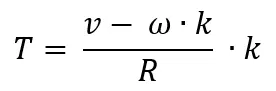
Torque speed characterstic of Separately excied DC motor given as:
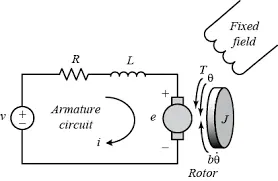
T = Torque of motor
v = Supply voltage
ω = Rotational Speed
k = Motor Constant
R/Ra=Armature Resistance.
For Duty cycle=70%.
∴Actual rated Voltage=72*0.7=50.4V.
Tm=(V(KΦ)/Ra)-(ω(KΦ)^2/Ra)
Tm=[(50.4*0.7)/0.5]-[(ω*(0.7)^2)/0.5]
∴Tm=70.56-0.98ω..........(2)
∴Tv=24.7+(0.0051)W^2
At equilibrium Tm=Tv:
∴from equation 1 & 2:
24.7+(0.0051)ω^2=70.56-0.98ω
∴0.0051ω^2+0.98ω-45.86=0
ω=38.82 rad/sec.
∴ω=38.82*60 = 2331.6rpm.
it is required steady state speed of a vehicle.
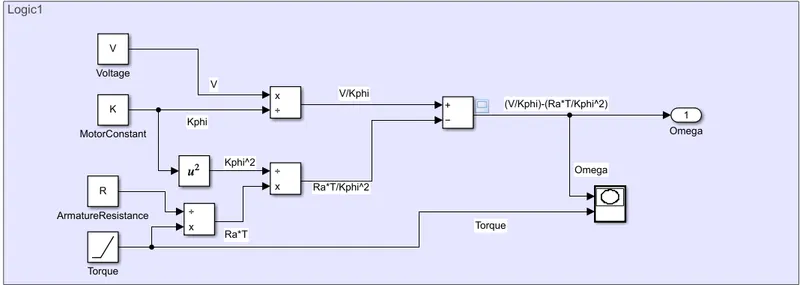
Que.3: Develop a mathematical model of a DC Motor for the below equation using Simulink.
ω">ω=V/Kϕ">ϕ-Ra*T/Kϕ">ϕ^2.
Ans:
Simulink model:

M-Script File:
clear
close
clc
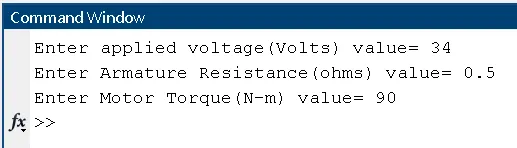
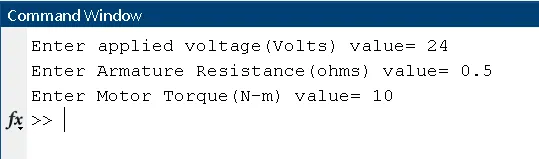
V=input('Enter applied voltage(Volts) value= ');
K=0.7; % Motor constant.
R=input('Enter Armature Resistance(ohms) value= ');
T=input('Enter Motor Torque(N-m) value= ');
Cammand Window Input:
For Logic 1:
For logic 2:
Observation/Result:
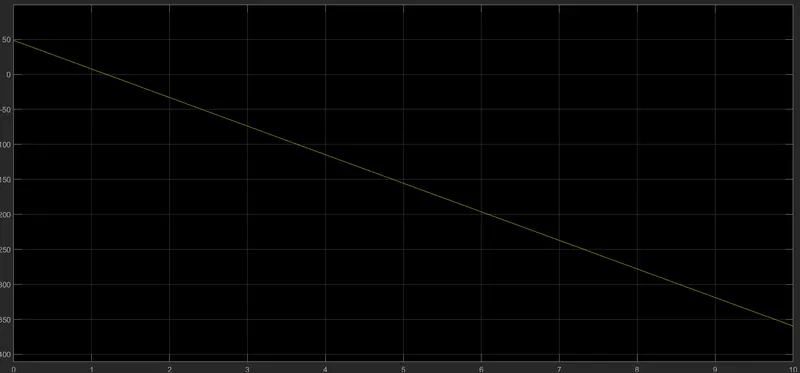
A)For Logic 1:
1)Motor speed plot:
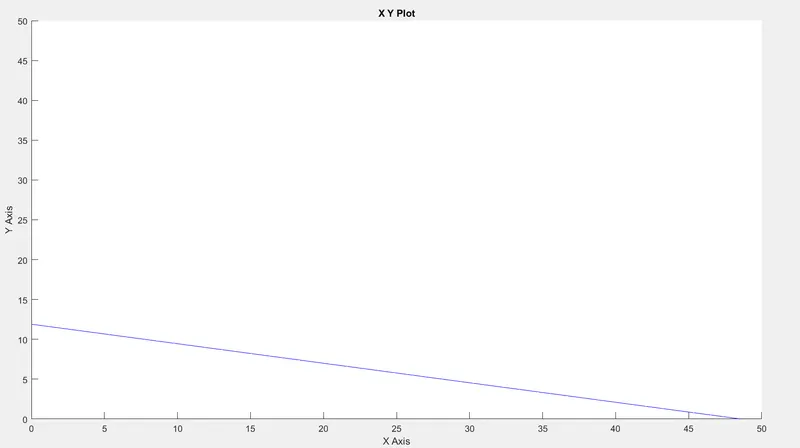
2)Torque-Speed Characterstic:
X-axis= Speed of motor.
Y-axis= Torque of motor.
2)For Logic 2:
Motor speed Plot:
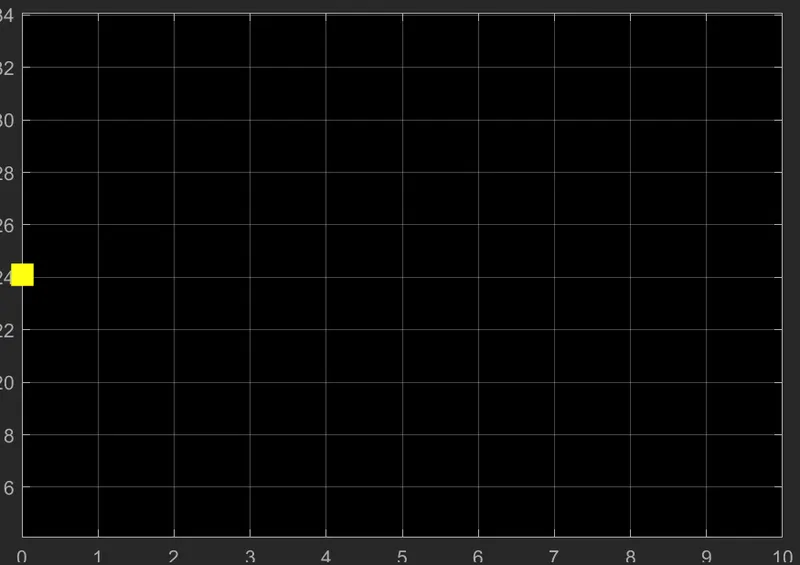
Conclusion: From above plot both the logic it is observe that higher the torque lesser the angular speed of the motor & Vice versa. So the Torque-Speed characterstics of a motor are inversely proportion to each other.
Que.4:Refer to the blog on below topic:
Induction Versus DC brushless motors by Wally Rippel, Tesla
Explain in brief about author’s perspective.
Ans:Wally Rippel,an author writing this blog, has wide experience in electric vehicle development & also works for automobile giants likes the General Motors, Jet Propulsion Laboratory, Tesla etc. In this blog, he is putting light on most important aspect of EV/HEV development i.e. motor selection, where he concludes that ''there is no best motor for all EV/HEV applications''. He starts with the construction and working of DC brushless motor, induction motor also & put light on the benefit's/advantage & drawbacks/downside of it.
Before comparing both the motor author convey analogy between gas powered conventional IC engine & Electric vehicle drives. And later convey the merits & demerits of DC motor brushless & induction motor/drives based on their applications. The Merits & Demerits Of both the drive's are:
DC Brushless drives:These motors operate on DC supply.
Merits:
- Electrical to mechanical energy conversion is optimal.
- Can operate at unity power factor.
- Rotor cooling is easy & and peak point efficiency is higher.
- Less rotor heat is generated.
- Torque performance is high compared to induction motor.
- Higher starting and running torque compared to induction machine.
- Control is comparatively easy.
Demerits:
- Torque remains constant .
- Without an inverter the brushless DC motor are useless motor.
- Rotor includes permanent magnets.
- Permanent magnets are expensive.
- No starting torque when connected to the fixed frequency.
- Not easy to change magnetic field with permanent magnet.
- Efficiency is less.
- As machine size grows magnetic losses increases,load efficiency drops.
Induction drives:These motors operate on AC supply.
Merits:
- No permanent magnets.
- Has the ability to start under load when directly connected to the fixed frequency.
- Desired torque can be achieved.
- The motor has the ability to start under load, no inverter is needed.
- Efficiency is maximum over dc brushless motor when operated with smart inverter.
- The magnetic field can be adjustable.
- As machine size grows, losses are not necessary to grow.
- Cost Advantage over PM machine.
Demerits:
- Stabilization of torque, speed, temperature is difficult.
- Torque performance is low compared to DC motor.
- Limited starting and limited running torque when compared to DC motor.
- The control laws are more difficult and complex to understand.
- The best power factor is about 85%.
Conclusion:After analyzing the merits and demerits of both the motor, Wally Rippel's concludes that DC brushless drives are best suited for in the HEV's and coming p-HEV's(Plug in hybrid), and induction drives are best suited for the high-performance pure electric vehicles, some of them are the General Motors EV-1;the AC Propulsion vehicles, including the tzero; and the Tesla Roadster.The selection of motors is mostly based on the application.