Week -2
Question no. 1:-
Aim:- To make a simulink model of Doorbell using solenoid block where the switch is closed for 2 seconds & then released. Observe the physical movement of the plunger.
Apparatus:- Matlab-Simulink Software.
Objective 1:-
Theory:- a)Doorbell:-Electric doorbell is a device works with the principal of "working of electromagnetism".It is low voltage device ,when we press a doorbell switch, we complete an electric circuit that allows electricity to flow through the doorbell's internal electromagnet. The magnetic fied generated by the electromagnet then used to power a mechanism that creates the doorbell sound.
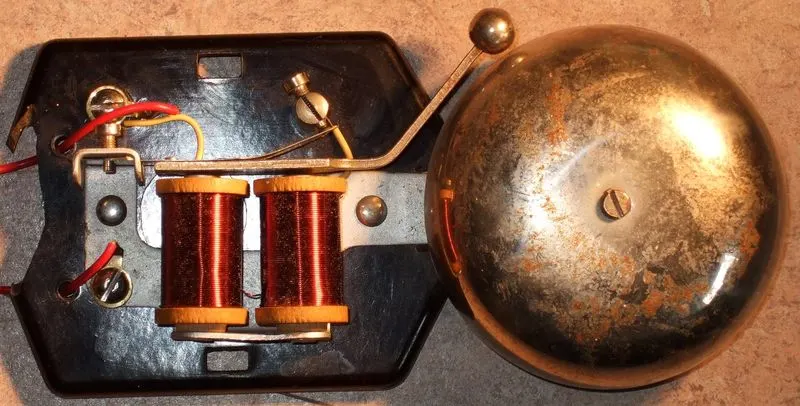
Fig.a. Traditional Electric Doorbell.
b)Solenoid:-The solenoid simply works on the principal of 'Electromagnetism'.When current flow through the coil magnetic field generated in it, if we place a conductor/metal core inside coil the magnetic flux is concentrated on the core which increases the induction of coil as compare to air core. More simply it converts electrical energy into linear mechanical motion. Since coil wire has large application, people often assume solenoid to be an electromagnet.solenoid commonly used as a switch or valves which are entirely automated. The magnetic field of solenoid also has a south & north pole like other magnets. In solenoid , the electromagnetic field causes movement of piston forward & backward direction; this is how motion is created by solenoid. It has very limited application because of short stroke, usually of an inch.
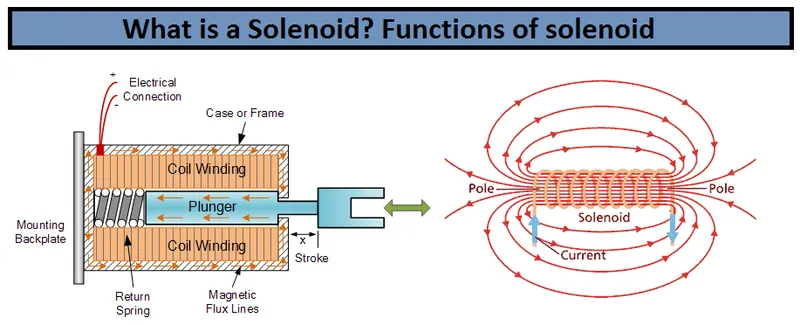
Fig. b. Solenoid.
Objective 2:-
Model Explaination:-
Simulink Model of Doorbell using solenoid block.
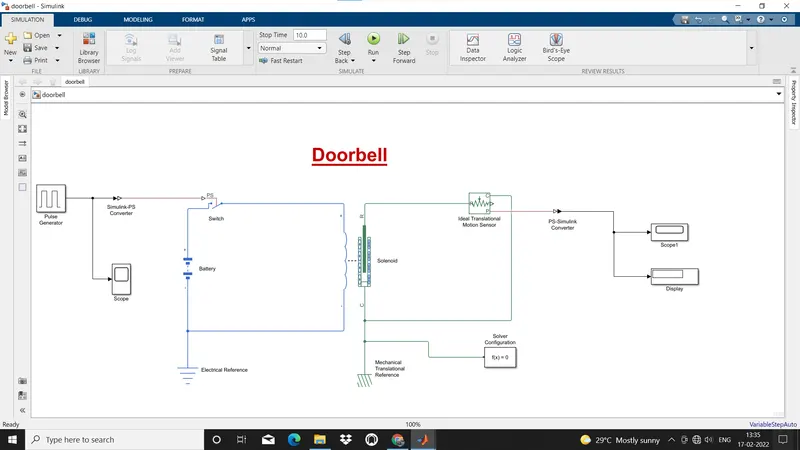
The block used in above model are:-
1) Pulse Generator:- It generates square wave pulses at regular intervals. The block has waveform parameter amplitude, pulse width, period & phase delay which detrmines shape of waveform.
2)Simulink-PS converter :- It converts unitless simulink input signal to physical signal.
3)Scope:- It display signals generated during simulation.
4)Switch:- It controlled by an external physical signal.
5)Battery:- It represents a simple battery model.
6)Solenoid:- This block implements electrical & mechanical characterstics of solenoid.
7)Ideal Translational Motion Sensor:-This block measures velocity or displacement in a mechanical translational network. The sensor is ideal since it does not account for inertia, friction, delays, energy consumption, and so on.
8)Mechanical translational Reference:-This block represents a mechanical translational reference point, that is, a frame or a ground. Use it to connect mechanical translational ports that are rigidly affixed to the frame (ground).
9)Electrical Reference:-Electrical reference port. A model must contain at least one electrical reference port (electrical ground).
10)Solver Configuration:-It defines solver settings to use for simulation.
11)PS-Simulink Converter:- It converts the input Physical Signal to a Simulink output signal.
12)Display:-It display input values. If the incoming signal is of type string, the 'Numeric display format' parameter selection does not affect the display of the string.
13)PS-Simulink converter:-This block converts the input Physical Signal to a Simulink output signal.
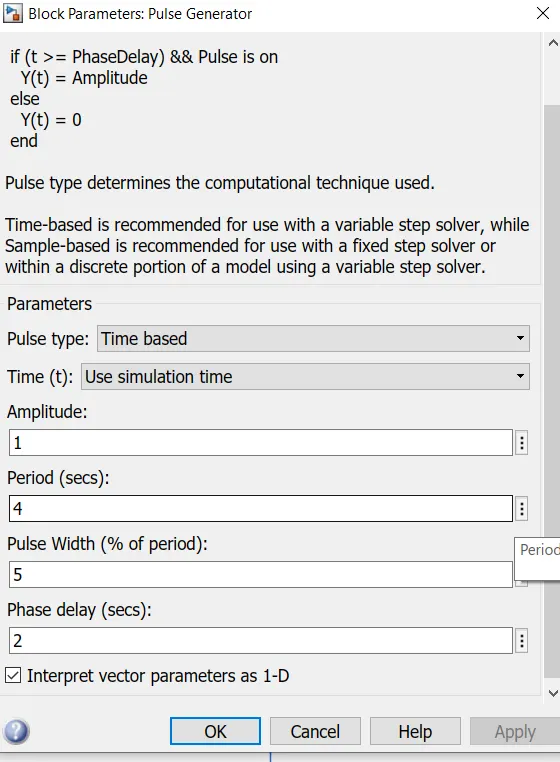
Fig. c. Block parameter of Pulse Generator.
Observation & Result:-
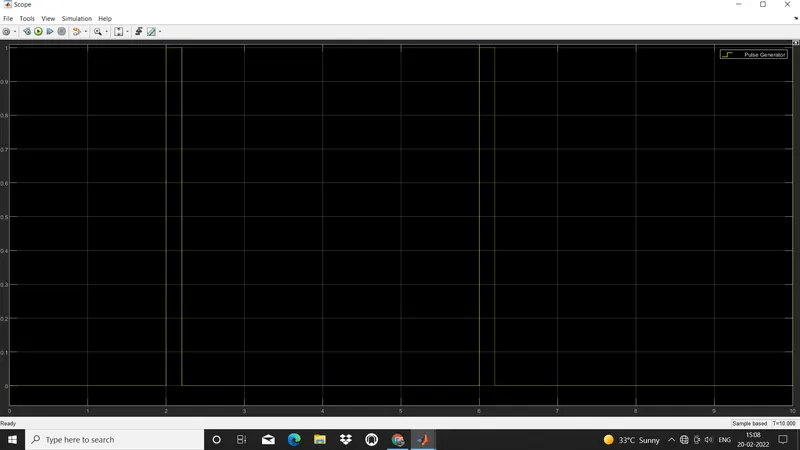
Fig.c. Pulse Generator input waveform.
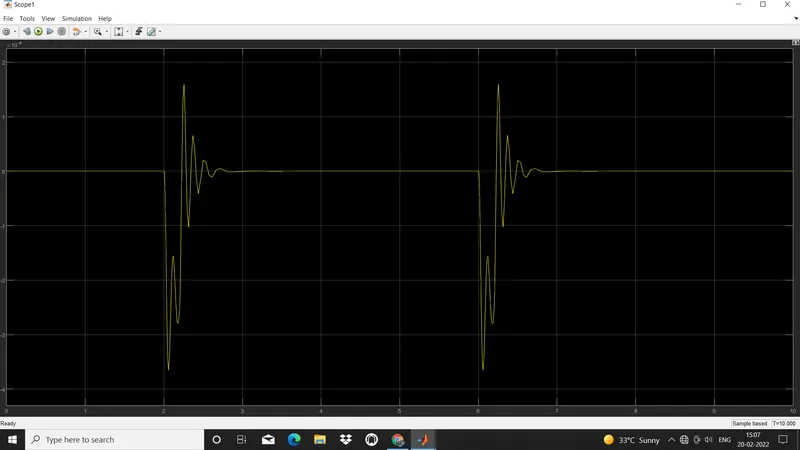
Fig.d. Output waveform.
Result:- The simulink model pf doorbell using solenoid has been created & simulated successfully
Question No.:-2.
Aim:-Use a thermistor to sense the temperature of a heater & turn on or turn off the fan as per the below conditions:
Temperature source: 20 °C from 0 to 10 seconds, 27 °C from 10 to 30 seconds, 23 °C from 30 to 50 seconds
Fan conditions: ON if the temperature above 25 °C, OFF otherwise.
Apparatus:- MATLAB-Simulink Software.
Theory:-A thermistor is a resistance thermometer, or a resistor whose resistance is dependent on temperature. The term is a combination of 'thermal' and 'resistor'. It is made of metallic oxides, pressed into a bead, disk, or cylindrical shape and then encapsulated with an impermeable material such as epoxy or glass.There are two types of thermistors: Negative Temperature Coefficient (NTC) and Positive Temperature Coefficient (PTC). With an NTC thermistor, when the temperature increases, resistance decreases. Conversely, when temperature decreases, resistance increases. This type of thermistor is used the most.A PTC thermistor works a little differently. When temperature increases, the resistance increases, and when temperature decreases, resistance decreases. This type of thermistor is generally used as a fuse.Typically, a thermistor achieves high precision within a limited temperature range of about 50ºC around the target temperature. This range is dependent on the base resistance.
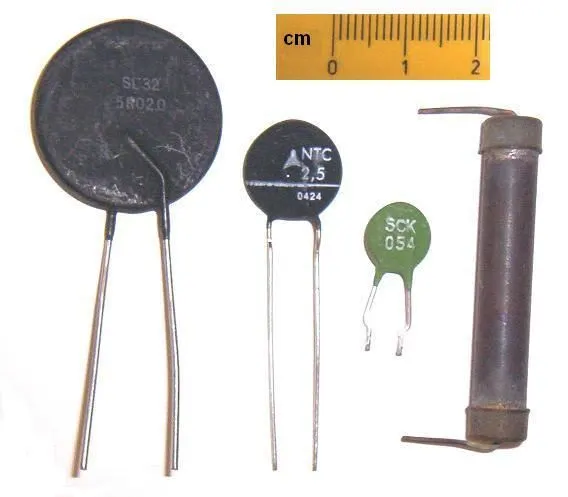
Fig.a. Thermistor.
Simulink Model:-
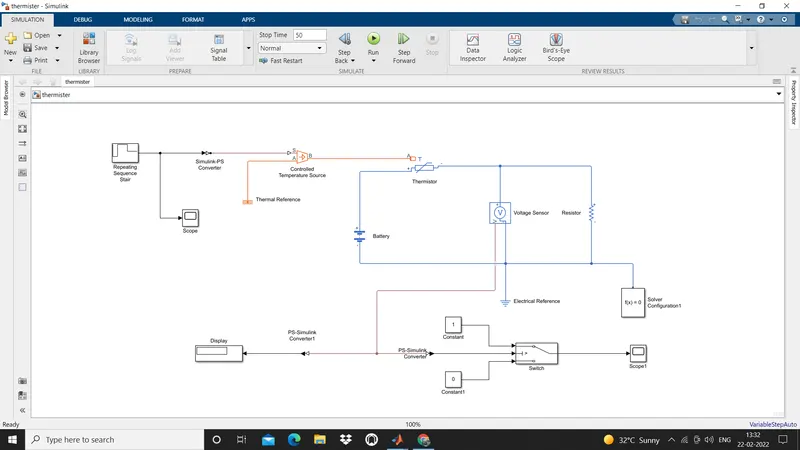
The blocks used in above model are:-
1)Repeating sequence stair:-Discrete time sequence is output, then repeated.Here we give 5 temperature(in kelvin) inputs at every 10 sec. each i.e. 50 sec. in total Run time.
2)Simulink-PS converter :- It converts unitless simulink input signal to physical signal.
3)Controlled temperature source:-This block represents an ideal energy source in a thermal network that can maintain a controlled temperature difference regardless of the heat flow rate.
4)Thermal Reference:-This block represents a reference point in a thermal network where the temperature is equal to absolute zero.
5)Thermistor:-This block represent NTC type thermistor.
6)Voltage Sensor:-The block represents an ideal voltage sensor, that is, a device that converts voltage measured between any electrical connections into a physical signal proportional to the voltage.
7)Battery:- It represents a simple battery model.
8)Resistor:-This block represent a resistor which is based on ohm's law.
9)Electrical Reference:- This block represent a electric ground.
10)Switch:- It controlled by an external physical signal.
11)Scope:- It display signals generated during simulation.
12)Solver Configuration:-It defines solver settings to use for simulation.
13)Display:-It display input values. If the incoming signal is of type string, the 'Numeric display format' parameter selection does not affect the display of the string.
14)PS-Simulink converter:-This block converts the input Physical Signal to a Simulink output signal.
Observation & Calculation:- 0°C=273.15 K,
Kelvin = (Celsius + 273.15) & Celsius = (Kelvin - 273.15).
20°C=293.15 K,
27°C=300.15 K,
23°C=296.15 K.
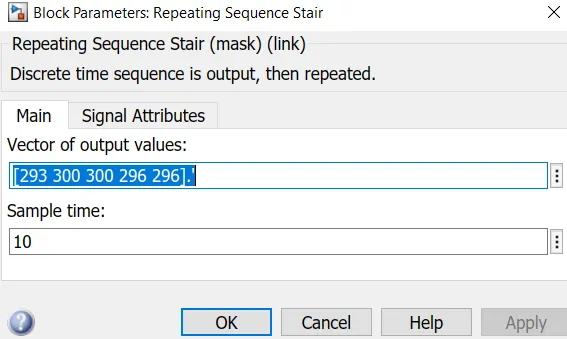
Fig.a. Input parameter.
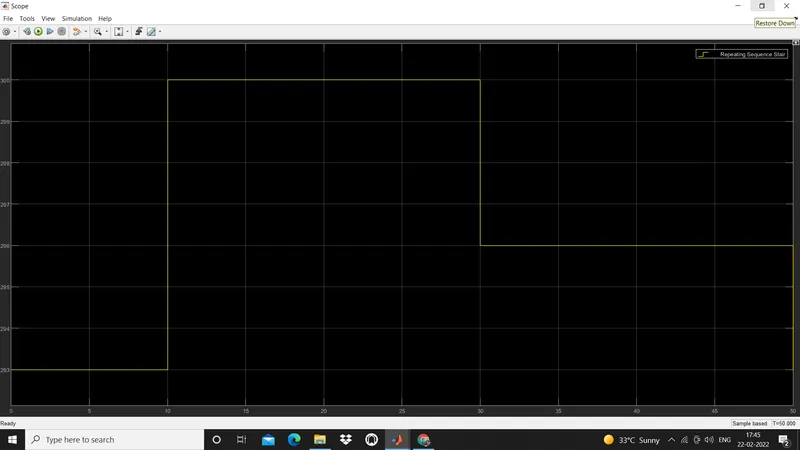
Fig. b. Repeating sequence stair(input) waveform.
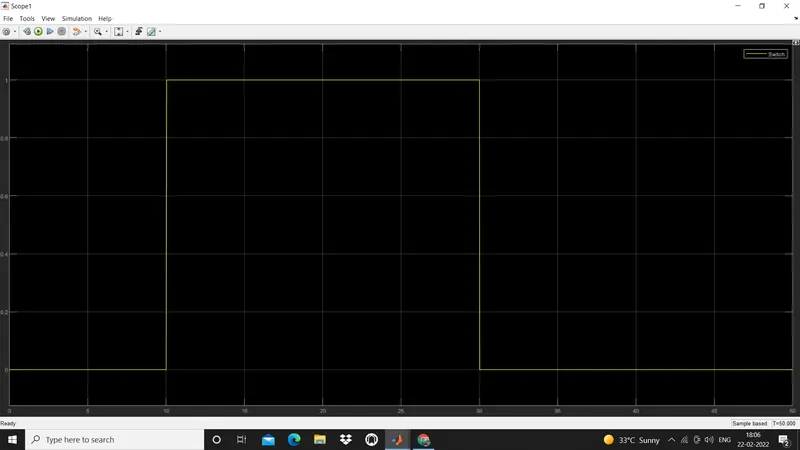
Fig.c. Switch(Output) Waveform.
Result:-The Simulink model of thermistor to sense the temperature of a heater & turn on or turn off the fan with given condition has been created & simulated successfully.