Week-6 Challenge: EV Drivetrain
QUE 1 ANS - Power converter circuits for electric and hybrid electric vehicle:
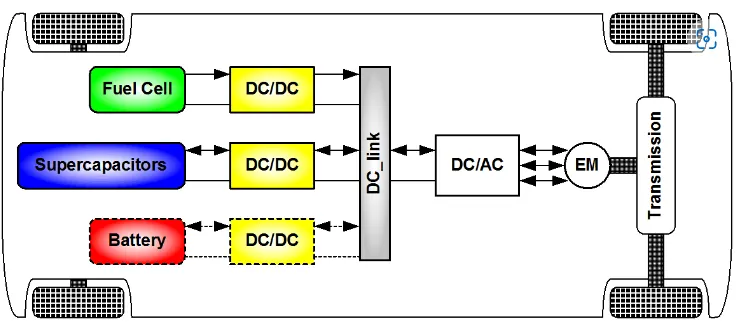
The different configuration of EV power supply show that at least one DC/DC converter is necessory to interface the FC, the battery or the Supercapacitor modules to the DC-link DC/DC converters can be designed to transfer power in only one direction, from the input to the output. However, almost all DC/DC converter topologies can be made bi directional. A bi-directional converter can move power in either direction, which is useful in application requiring regenerative braking.
Non-isolated converters -
The non isloated converters type is generally used where the voltage needs to be stepped up or down by a relatively small ratio and when there is no problem with the output and input having no dielectric isolation. There are five main types of converter in this non isolated group, usually called the buck, boost, cuk and charge pump converters. The buck boost converter is used for step down voltage, while the boost converter is used for voltage step up. The buck boost and cuk converters can be used for either step down or step up. The charge pump converter is used for either voltage step up or voltage inversion, but only in relatively low power application.
Isolated converters -
Usually, in this type of converters a high frequency transformer is used. In the application where the output needs to be completely isolated from the input, an isolated converter is necessary. There are many types of converters in this group such as Half-Bridge, Full-Bridge, Fly-back, Forward and Push-Pull DC/DC converters. All of these converters can be used as bi-directional converters and the ratio of stepping down or step up the voltage is high.
QUE 2 ANS -
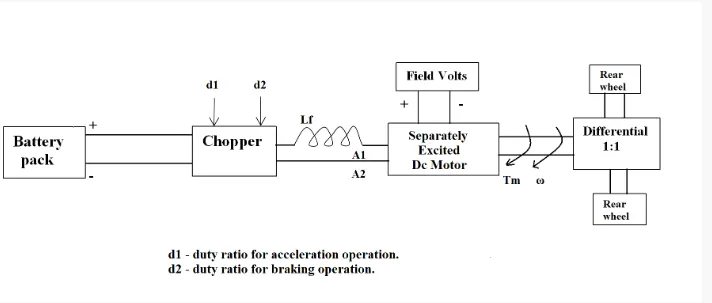
Motor and Controller Parameters:
Rated Armature voltage = 72 V
Rated armature current = 400 A
Ra= 0.5ohm, Kϕ=0.7 Volt second
Chopper switching frequency = 400 Hz
The vehicle speed-torque characteristics are given by the below equations:
 ....equation 1
solution :
Duty cycle=70%=0.7
Actual voltage=0.7*72=50.4V
We have torque equation of motor,
`T= Vkϕ/Ra - ((kϕ)^2/Ra)*w
T = 50.4*0.7/0.5 - ((0.7^2)/0.5) * w
T = 70.56 - 0.98 w ....... equation 2
solving equation 1 & 2
comparing both torque of vehicle and torque of motor.
24.7 + (0.0051) w^2 = 70.56 - (0.98) w
0.0051w^2 + 0.98w - 45.86 = 0
by solving this by quadratic equation we get,
we get two values as
w = 38.915 rad/sec and w= 231.072 rad/sec
so, the EV steady state speed if duty cycle is 70% = 38.915 rad/sec or 371 RPM.
QUE 3 ANS -
Develop a mathematical model of a DC Motor for the below equation using Simulink.
ω= V/Kϕ -Ra/Kϕ^2 .T
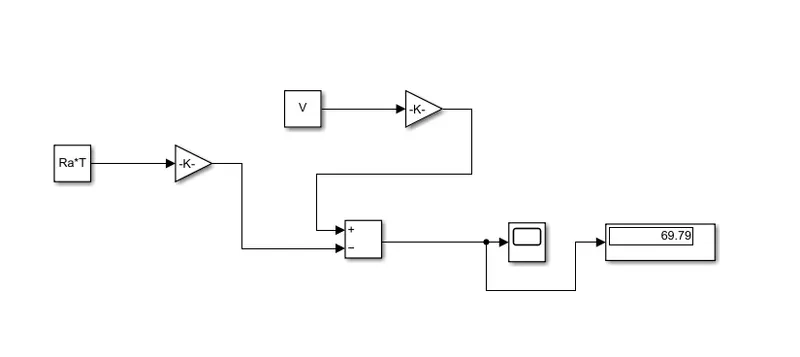
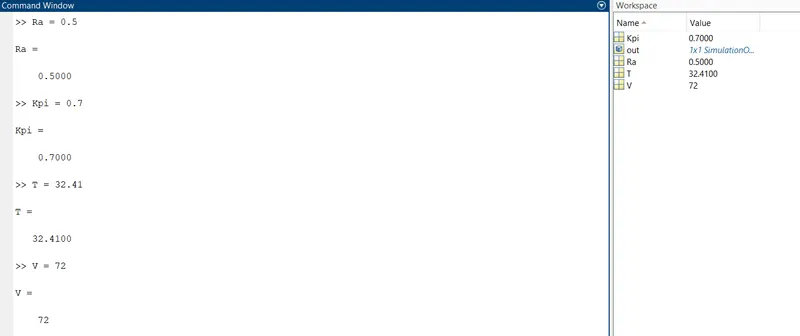
Values - Ra = 0.5, V = 72 V, Kpi = 0.7, T = 32.41.
So from this values i get the speed of mathematical model is 69.79.
QUE 4 ANS - Induction versue DC brushless motor
1. According to author perspective, Firstly he gave the discription of DC brushless motor about its parts and specification and what is called and next description about induction motor about is component and working of induction motor. Then he compare the DC brushless and induction which is mentioned that 3 phase induction motor can produce output torque and also have an ability to start under the load without any inverter, as of DC brushless motor produces no starting torque when directlly connected to fixed frequency utility power and also inverter is needed to start under load. Then he discussed about the limitation of the 3 phase induction motor they cannot operate from DC;AC is a must. Shaft speed is proportionate to line frequency. Hence, when used with utility power, they are constant speed machines. Finally, When operated from utility powert they have limited starting torque and somewhat limited running peak torque capabilities, when compared to DC type machines inverter can be added to 3 phase induction so that we can supply power from DC source or Battery and also we can get variable speeds and can adjust the frequencies.
2. Then he discussed as the only main difference between DC Brushless and induction motor is of control code and also the rotor of DC brushless gets less heated at peak torque as that of induction motor rotor.
3. Then he discussed about the loses when the motor runs which is the induction machines when operated with a smart inverter has an advantage over a DC brushless machines. magnetic and conduction losses can be traded such that efficiency is optimized. This advantage becomes increasingly important as performance is increased. with DC brushless as machine size grows the magnetic losses increase proportionaly and part load efficiency drops. With induction, as machine size grows losses do not necessarily grow.