Q1. the three main types of convertors which are widely used in a electric vehicles are:
1. AC- DC convertor (on board charger):
AC to DC converters are most commonly used in Plug-in Hybrid Electric Vehicles (PHEV) & Plug-in Electric Vehicles (PEV). These vehicles get their propulsion power from an external electricity source (charging stations) which is alternating current. The battery needs to be charged using a direct current source. For this purpose, AC to DC converter is employed in a PHEV and PEV.
2. DC- DC convertor
DC-DC converters can be used to interface the elements in the electric power train by boosting or chopping the voltage levels. By introducing DC/DC converters one can choose the voltage variation of the devices and the power of each device can be controlled. The power of the DC/DC converter depends on the characteristics of the vehicle such as top speed, acceleration time from 0 to 100 Km/h, weight, maximum torque, and power profile (peak power, continuous power).
3. DC- AC convertor
The DC/AC converter is required to convert the dc power to a suitable ac power for the electrical machine. The power output from battery pack (DC current) is converted using inverter to be used in electric motor (AC current).
Q2.
Vehicle Output Voltage (V) is given by:
V = Battery Voltage (V) *Duty Cycle
V₁ = 72* 0.70
Vehicle voltage = 50.4V
Now, Equation for Vehicle torque is given by: -
Tv=(Vv-w. Kphi) Kphi/Ra
Where;
Tv= Vehicle Torque (N-m)
Vv = Vehicle voltage (Voits)
w steady state speed of vehicle (rps)
Kphi= Motor constant
Ra= Armature Resistance
Substituting all these values in equation, we get:
Tv=(50.04- 0.7.w)-0.7 /0.5
Tv=70.56 - 0.98.w
Tv= 24.7+0.0051.w^2
Solving these two equations,
70.56-0.98.w= 24.7+0.0051.w^2
We get a quadratic equation:
0.0051w^2 +0.98.w -46.91=0
Since quadratic equation, we get two values of;
w=38.85 rad/s and w=-230.95 rad/s
We take the positive value;
Steady state speed of vehicle = = 38.85 rad/s
3.a mathematical model of a DC Motor for the below equation using Simulink.
ω=(v/Kφ)-(Ra/Kφ2)T
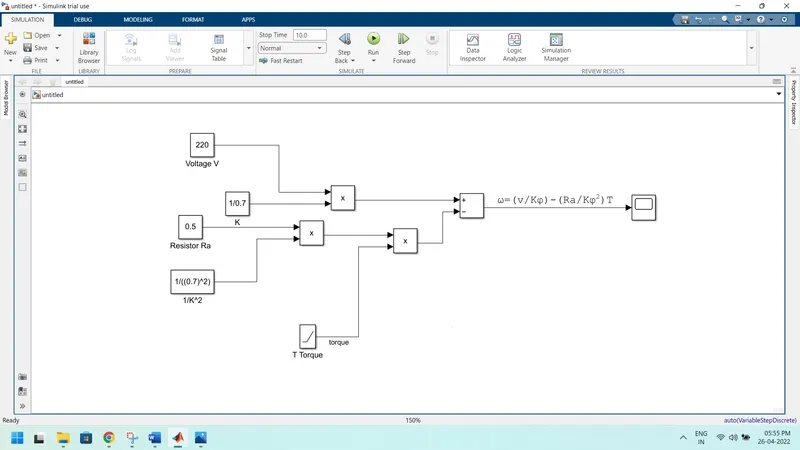
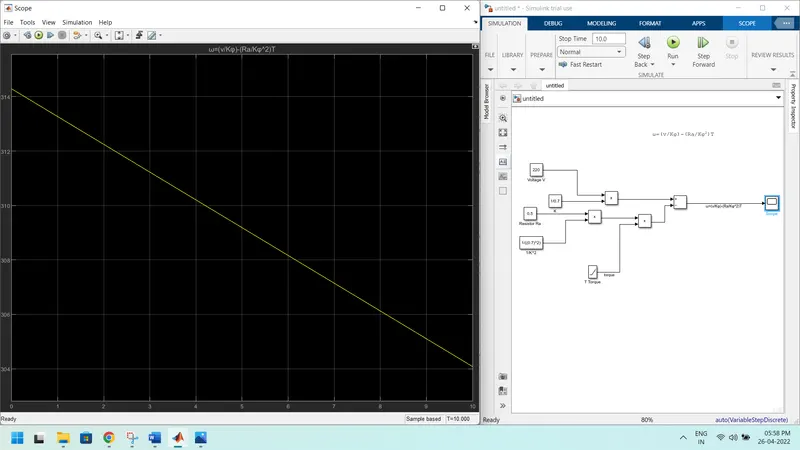
This result show torque speed curve for DC motor.
4)A brief about author’s perspective
According to
Wally Rippel , the description of DC brushless motor about its parts and specifications and what is called and next description about Induction motor about is component and working of Induction motor and he compared the DC brushless and induction Then he discussed about the limitations of the 3-Phase induction motor they cannot operate from DC; AC cannot be neglected . Shaft speed is proportionate to line frequency. Hence, when used with utility power, they are constant speed machines. Finally, when operated from utility power, they have limited starting torque and somewhat limited running peak torque capabilities, when compared to DC type machines Inverter can be added to 3-Phase induction so that we can supply power from DC source or Battery and also we can get variable speeds and can adjust the frequencies.
As stated the only difference between DC brushless and Induction motor is of control code and also the rotor of DC brushless gets less heated at peak torque as that of Induction motor rotor.
And the loses when the motor runs which is the induction machine when operated with a smart inverter has an advantage over a DC brushless machine - magnetic and conduction losses can be traded such that efficiency is optimized. This advantage becomes increasingly important as performance is increased. With DC brushless, as machine size grows, the magnetic losses increase proportionately and part load efficiency drops. With induction, as machine size grows, losses do not necessarily grow. Thus, induction drives may be the favored approach where high-performance is desired, peak efficiency will be a little less than with DC brushless, but average efficiency may actually be better.
Concluded by Still No Winner, DC brushless drives will likely continue to dominate in the hybrid and coming plug-in hybrid markets, and that induction drives will likely maintain dominance for the high-performance pure electrics.