Week-6 Challenge: EV Drivetrain
Q1) which type of power converters used for HEV & EV vehicles
A motor drive consists of a power converter and the controller. the power electronic converter handles the flow of bulk power from the sores to the motor input terminals.
- DC-DC converters: The power converter can be a DC drive supplying a CD motor or an AC drive supplying an AC motor. A DC/DC converter in the basic form converts unregulated DC input voltage into regulated at very high conversion efficiency. These are operated at very high frequency. the switches are turned ON & OFF by pulse width modulation.
- A bettery pack delivers fixed voltage but the requirement of the different auxiliaries in the EV would vary. the DC-DC converter helps to step down and distribute power to different systems.this applications include subway cars, DC traction systems, control of large DC motors, battery operated vehicles, trolley buuses etc.
- AC-AC converters: this converters the AC voltage at one level to the other by varying its magnitude as well as frequency of the supply voltage. These are used in different types of application including uninterrupted power supplies, high power Ac to AC transmission, adjustable speed drives, renewable energy conversion systems and aircraft converter systems.
- DC-AC converters: this converter also known as inverter. That converts fixed DC supply voltage to variable AC voltage. The fixed voltage obtained from batteries or by dc link. this can be single phase or three phase inverter depending on the supply voltage.
aplications
plays a significant role in capturing energy from the regenerative braking and feeding it back to the battery
used in DC motor drivers and electric trction
- AC to DC converters: it converters converts AC supply into DC supply for the load. that contains various components like transformer, switching unit, filters and control block.
applictions
Charging the battery of the vehicle from an external supply. The input is AC the output is an DC to input to battery.
Various onboard loads such as sensors, controls, entertainment, utility and safety equipments.
Q2)
Rated armature voltage (Vbatt)=72V
Rated armature current(Ia)=400 A
Armature resistance (R)=0.5ohm Kϕ=0.7v/s
chopper switching frequency =400Hz
the vehicle speed-torque characteristics are given by the equation
Tv=24.7 +(0.0051)ω^2
if duty cycle is 70%,what is the stedy-stateval
as the torque formula is given , we need to find the speed in rad/sec
T=(V.K/R)-(K^2*W/R)
T-torque
V-armature voltage
R-resistance
W-speed rad/sec
comare the two equation;
24.7+0.0051*W^2=(V*K/R)-(K^2*W/R)
24.7+0.0051*W^2=(72*0.7*0.7)/0.5-(0.7^2*W/0.5)=24.7+0.0051*W^2
W^2+192.15*W-8992.15=0
inorder to find the roots use following formula
for quatratic equation ax^2+bx+c=0
X1,2=(-b±√(b2-4ac)/(2a)
put all valus in abowe equation
as the speed valu cannot be nagative
so,W=38.95 rad/sec
Q3)
simulink model
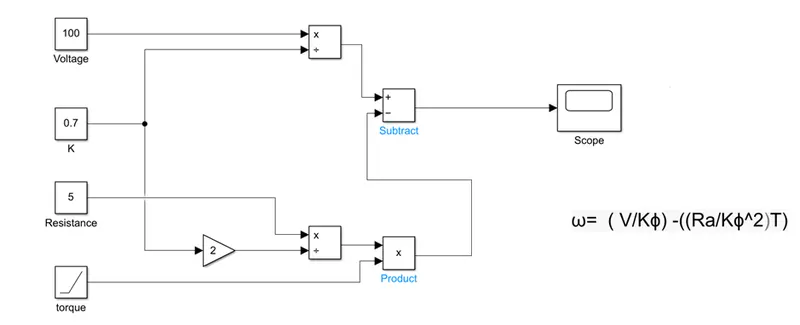
https://drive.google.com/file/d/1_1YM4UA2kqVzTkCw5GtYf1I2LF-PFPJH/view?usp=sharing
output
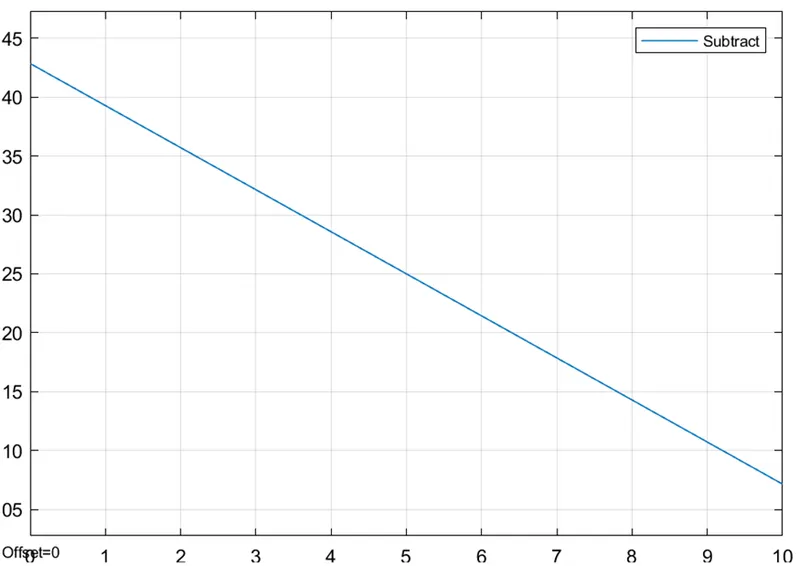
Q4)
In the blog of induction and DC brushless motor the author has mentioned about positives and negative side of both the induction and DC motor. In the blog the basic construction of both the induction and DC brushless motor is explained
In case of DC brushless motor permanent magnets are used which are used which produce a rotating magnetic field. This magnetic field when induces a current in the conductor this current results in force generation in the rotor and results in rotation of the rotor.
One of the main differences is that much less rotor heat is generated with the DC brushless drive. rotor cooling is easier and peak point efficiency is generally higher for this drive.it mentioned that the DC brushless can drive at unity power factor, whereas the best power factor for the induction drive is about 85%
In case of brushless motor, the strength of the magnetic field is adjustable. When at low speed the maximum torque is required magnetic field should be maximum
A machine size grows , magnetic losses increases proportionally and load efficiency drops.in case of induction motor as machine size grows losses do not necessarily grows. however thought he speed variation of induction motor depends upon the frequency input it is difficult to control
The control laws are more complex and difficult to understand. torque performance of IMs are low as compared to DC machines. induction machine cannot operate from DC, AC is must and shaft speed is proportional to line frequency.