Project
AIM
To study and analyze the BAJA ALL Terrain vehicle (ATV) model using Simulink,
SYSTEM SPECIFICATION
- Operating System-windows 8
- RAM-4GB
PLATFORMS USED
- Software-Simulik (MATLAB)
- Version-R2021a
OBJECTIVIOES
To prepare a technical report of BAJA ATV model with and without Lookup Table
THEORY
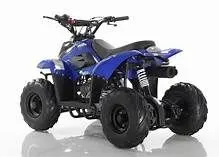
ALL TERRAIN VEHICLE
An all-terrain vehicle (ATV) ,also known as a quad (cycle) three-wheeler, four-wheeler as defined as defined by the American National Standard Institute(ANSI)is a vehicle that travel on low -pressure tire , with a seat that is straddled by the operator ,along with handlebars for steering control. It is designed to handle a wired variety of terrain than most other vehicles
BAJA SAE Series is an even for the undergraduate engineering student, organized globally by the society of automotive engineering, USA. the event originated in the name of mini -BAJA,IN the year 1976 at University of Carolina. Since the event has spanned across six countries -USA Mexico, South Africa,Korea,Brazil and india.
CVT
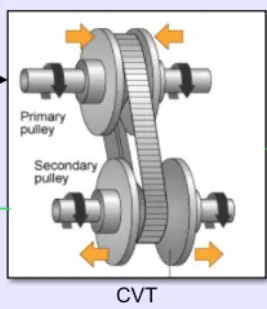
A CVT or continuously Variable Transmission is an automatic, single – speed ,and gearless transmission that can shift through an infinite number of gear rations. A continuously Variable Transmission tat operates on an ingenious pulley system that automatically varies the transmission ratio, allowing an infinity variability between highest and lowest gear with no discrete steps or shifts
SOLUTION
1)BAJA ATV MODEL without Lookup Table
A Simulink model for the BAJA ATV Model is shown bellow
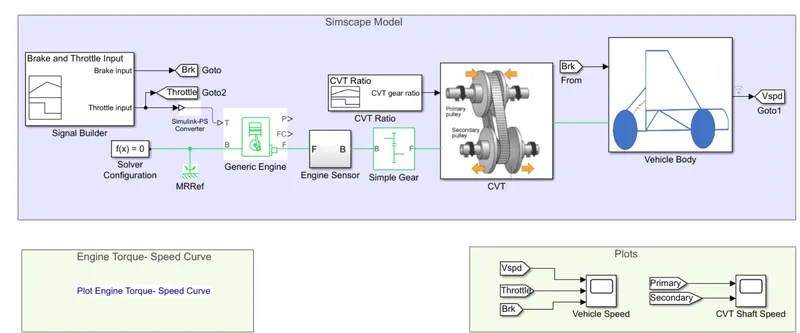
The models consist of common block as follows
Signal builder; The signal builder block allows you to create interchange able groups of piecewise linear signal source and use them in model. you can quickly switch the signal groups into and out a model to facilitate testing
Generic Engine; Represents a system-level model of spark-ignition and diesel engines suitable for use at initial stages of modelling when only the basic parameters are available. Optional ideal speed and red line controllers are included
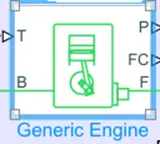
The throttle input signal T lies between zero and specifies the torque demanded from the engine as a fraction of the maximum possible torque.If the engine speed falls below the Stall speed , the engine torque is blended to zero. If the engine speed exceeds the maximum speed, the simulation and error message.
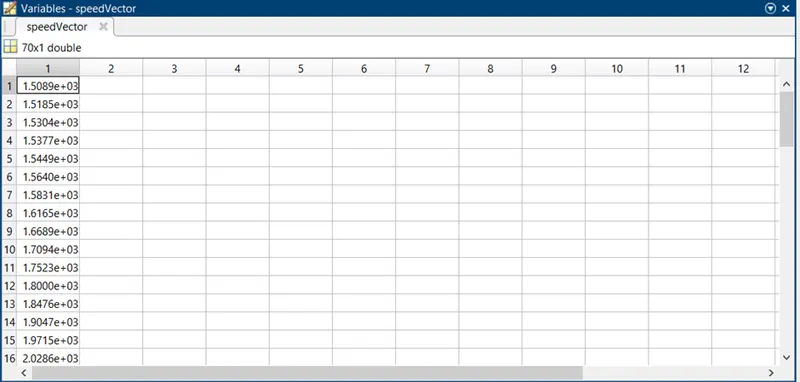
Speed vector
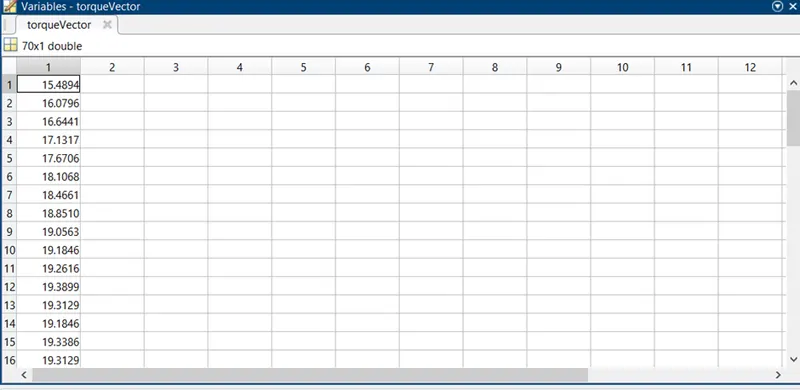
Torque vector
Engine Sensor
Ideal Rotational Motion Sensor: The block represents an ideal mechanical rotational motion sensor, that is a device that converts an across variable measured between two mechanical rotational nodes into a control signal proportional to angular velocity or angle connection R and C are mechanical rotational conserving ports and connections W and A are physical output ports for velocity and angular displacement respectively.
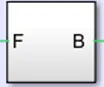
Simple Gear: Represents a fixed – ratio gear or gear box. no inertia or compliance is modelled in this block. You can optionally include gear meshing and viscous bearing losses.

Connection B(base) and F(follower) are mechanical rotational conserving ports. Specify the relation base and follower rotation direction with the Output shaft rotates parameter. optionally include thermal effects and expose thermal conserving port H by right-clicking on variants.
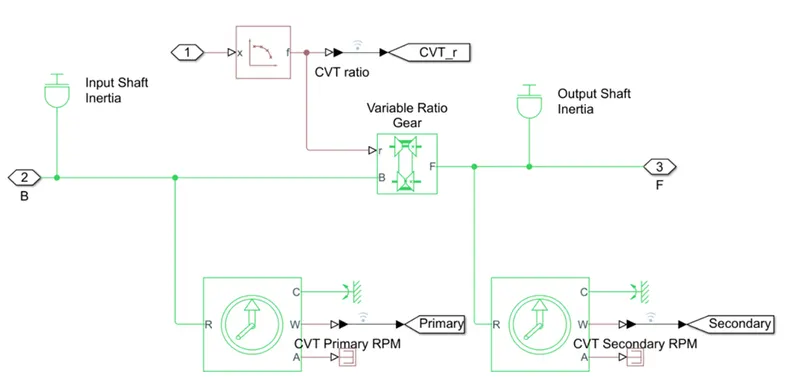
CVT Subsystem
The CVT subsystem consists of the following blocks
Inertia: the block represents an ideal mechanical rotational inertia .the block has one mechanical conserving port . the block positive direction is from its port to the reference point
Variable Ratio Transmission: Represents a variable ratio gear box such as implemented by mechanical belt CVT, electric, or hydraulic transmission. The physical signal input to output angular shaft velocities.
Vehicle Body subsystem
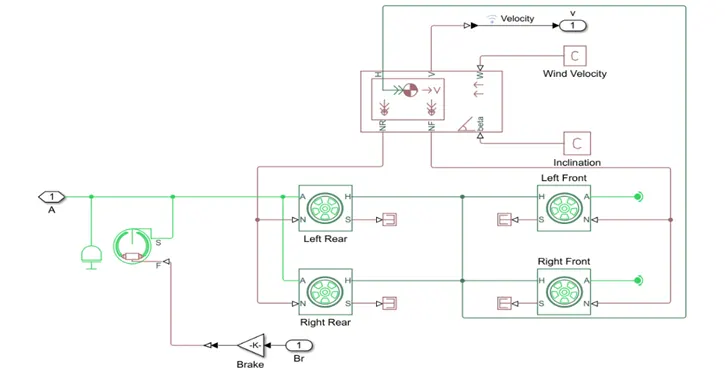
The vehicle body subsystem consists of the following blocks
Vehicle Body: Represents a two-axile vehicle body in longitudinal motion. The block accounts for body mass, aerodynamic drag, road, incline and weight distribution between axles due to acceleration and road profile.
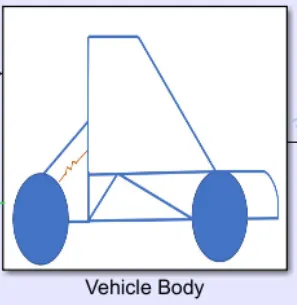
Mass:250kg
Number of Wheels per axle:2
Horizontal distance from CG to front axle:1m
Horizontal distance from CG to rear axle:0.35m
CG height above ground :0.7
Gravitational acceleration:9.81m/s^2
Double Shoe Break; The double-shoe break block represents a frictional break with two pivoted rigid shoes that press against a rotating drum to produce a breaking action
Drum radius:150
Pin location radious:125mm
Pin location angle :15deg
Actuator location radius:100mm
Shoe beginning angle:120deg
Tire:
The vehicle body is connected to 4 tire each per axle to move the vehicle according to the power input to the axile.
Parameterize by constant magic formula coefficients
Magic formula B coefficient:10
Magic formula C coefficient:1.9
Magic formula D coefficient:1
Magic formula E coefficient:0.97
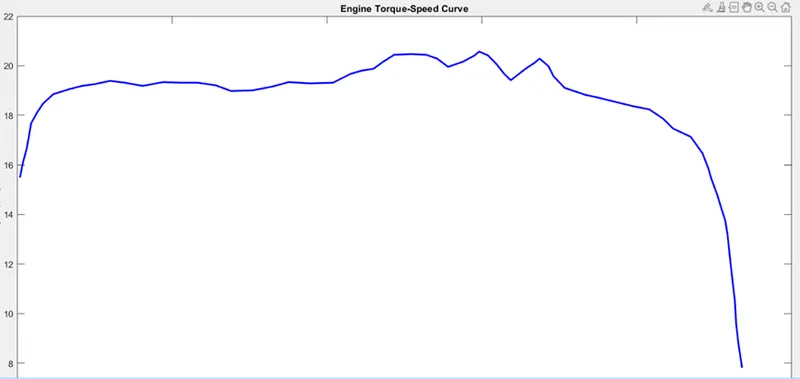
Torque vs Speed characteristics
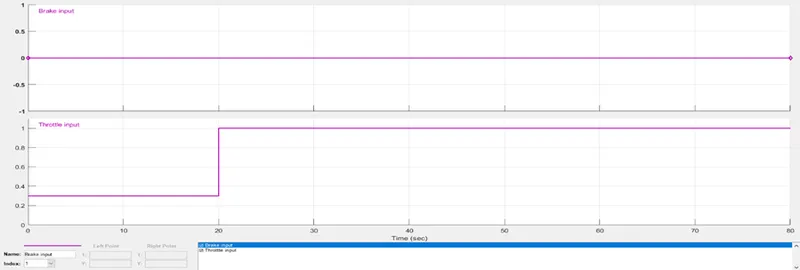
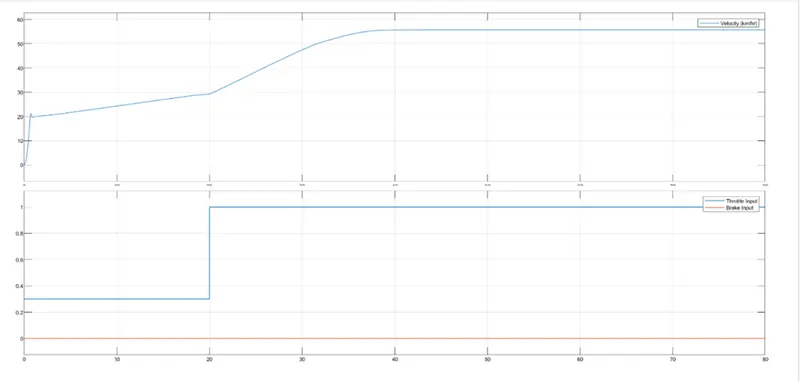
Brake and Throttle input
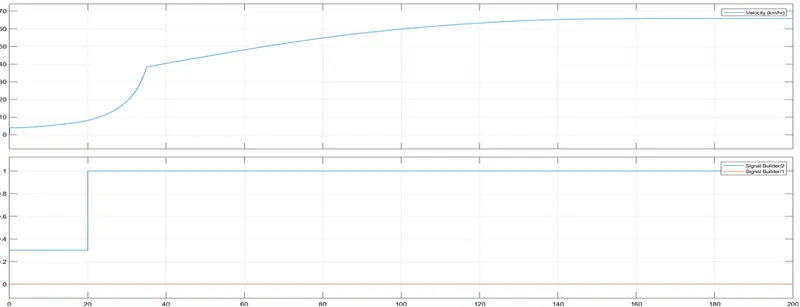
Brake input is constant i.e zero throughout the time of 80 sec. Throttle input is 0.3 for first 20sec, accelerates to 1 at the same and remains constant throughout the remaining time till 80 sec
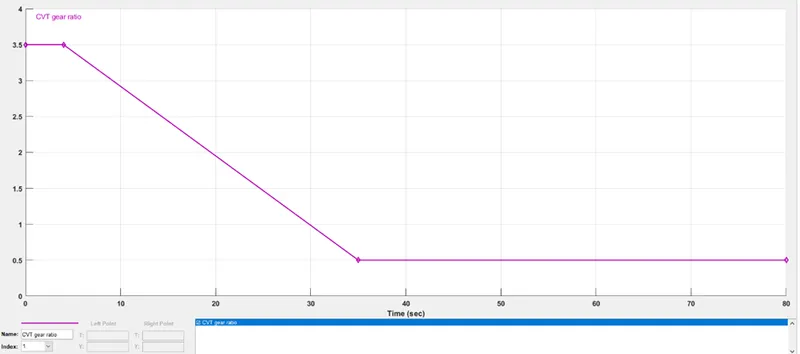
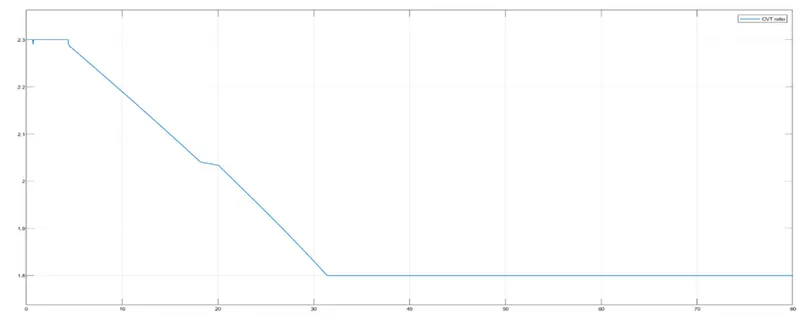
CVT Ratio
The CVT gear ratio 2.3 for the first 4 sec, then drops down to 1.8 till 35 sec and remains constant thereafter rill 80sec
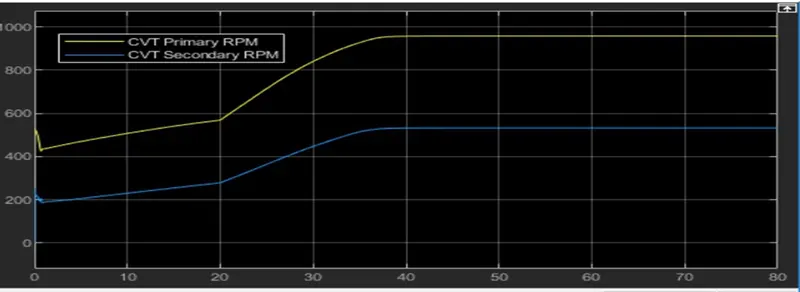
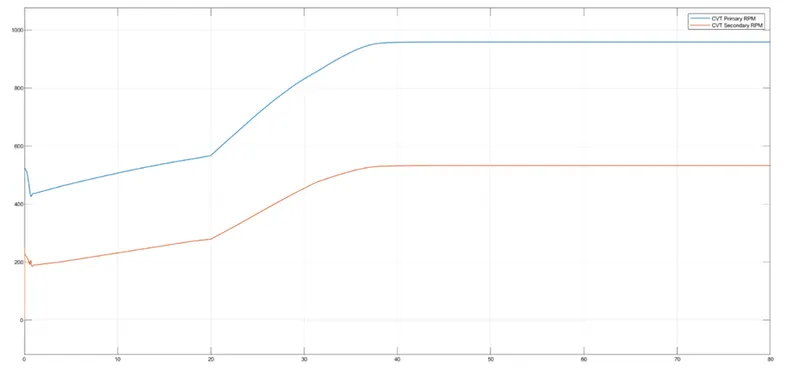
CVT Shaft Speed:
Velocity
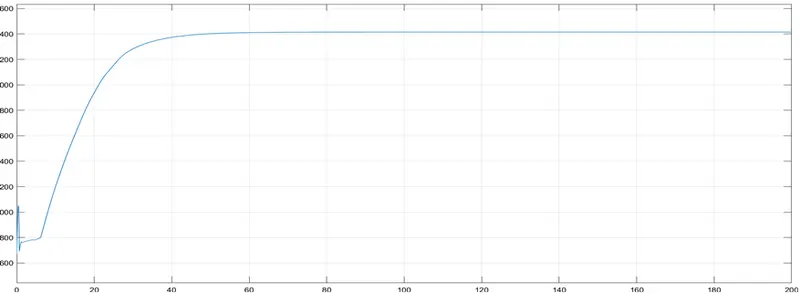
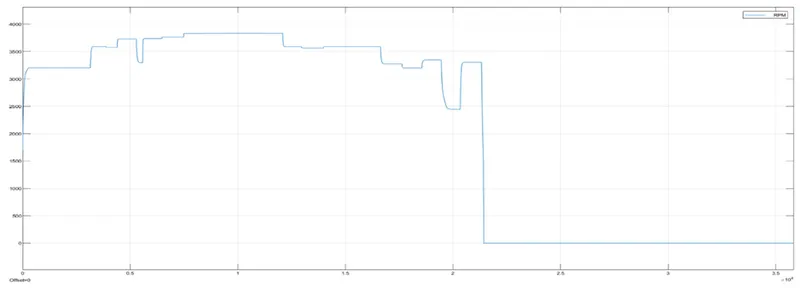
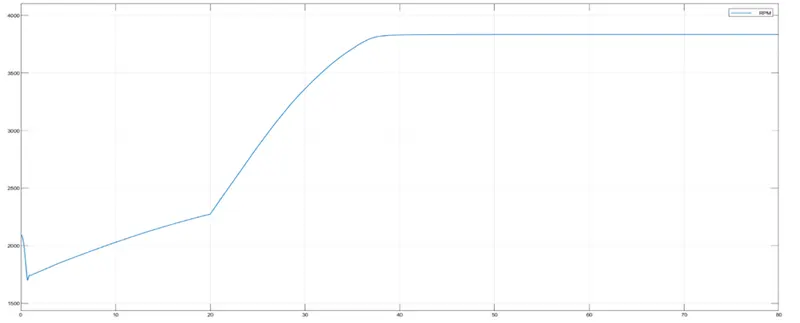
Engine Speed
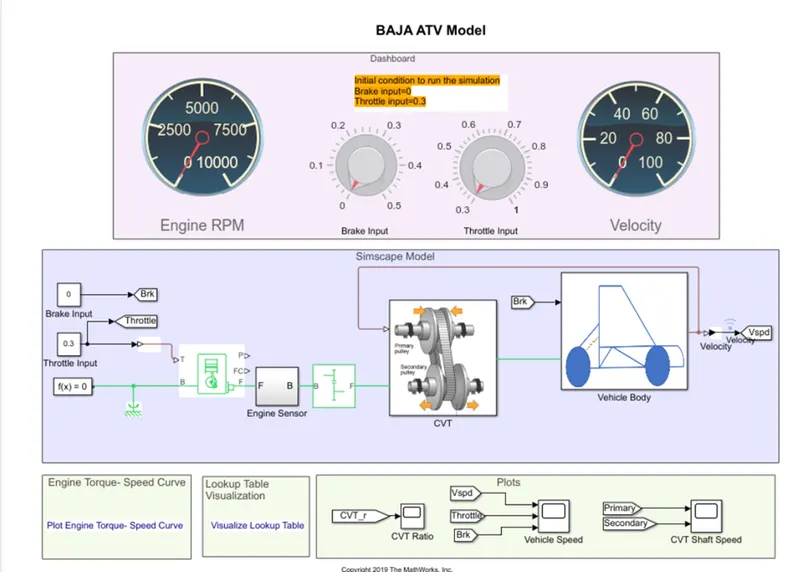
2)With Dashboard
A dashboard is a control panel usually located directly ahead of a vehicle driver, display instrumentation and controls for the vehicles option
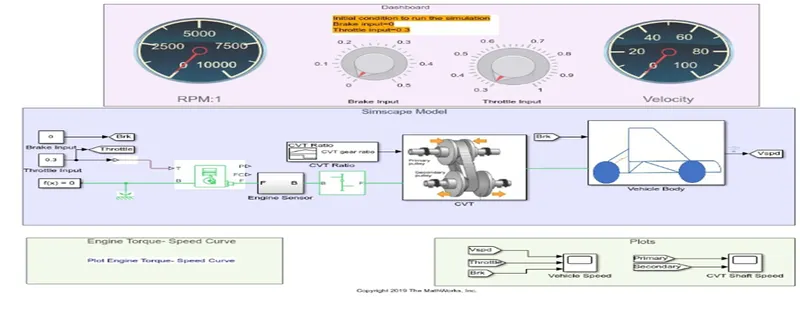
A Simulink model for the BAJA ATV Model including the dashboard is shown below .the reset of the parts and subsystem are common in the above part 1.1
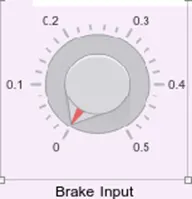
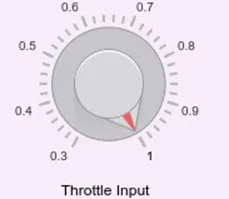
Dashboard: A dashboard instrument panel is a control panel usually located directly ahead Of a vehicles driver, displaying instrumentation and controls for the vehicles operation .the initial conditions are as follows
Brake input=0, throttle=0.3
Input1.2
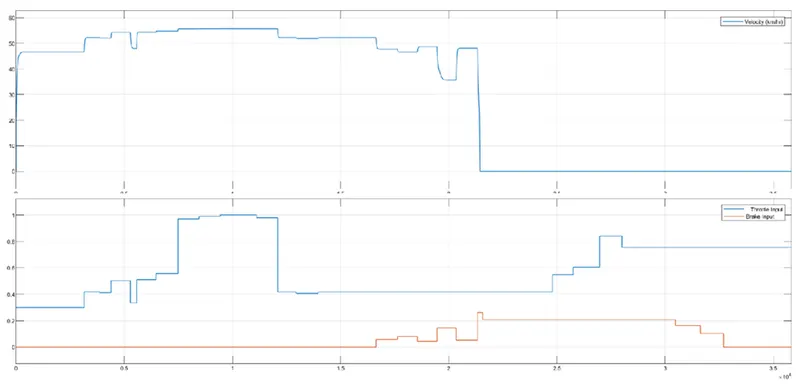
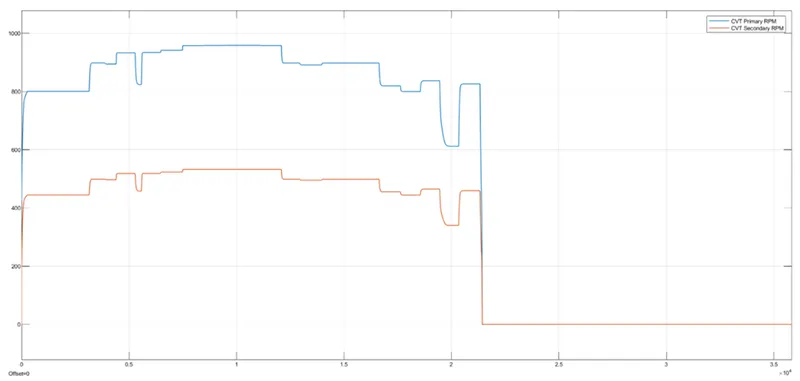
It comprises a throttle and break input through a knob which can be varied unlike the signal builder in the previous model with Dashboard. The engine RPM gauge and velocity gauge displays the change done by the respective knobs
Output1.2;
Velocity
CVT Shaft Speed
Engine Speed
BAJA CTV using Lookup Table
2.1Without Dashboard
A Simulink model for the BAJA ATV model including the lookup table is shown below
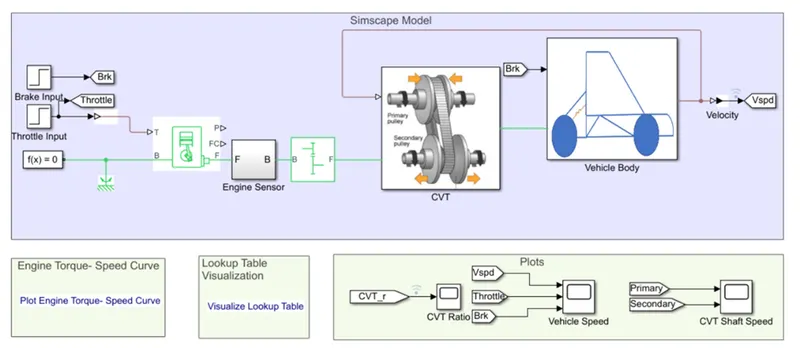
Lookup Table: A lookup table is an array of data that maps input values to output values, thereby approximating a mathematical function. Give a set of input values, a lookup operation retrieves the corresponding output values from the table. if the lookup table does not explicitly define the input value using interpolation, extrapolation, or rounding where.
A lookup table block uses an array of the data to map the input values to output values, approximating a mathematical function. Given input values, Simulink performs a ‘lookup’ operation to retrieve the corresponding output values from the table.
In place of CVT ratio input, a lookup table is assigned in the models below. it needs to be name as “lookup table”
- Interpolation is a process for estimating values that lies between know data points.
- Rounding is a process for approximating a value by altering its digits according to a known rule
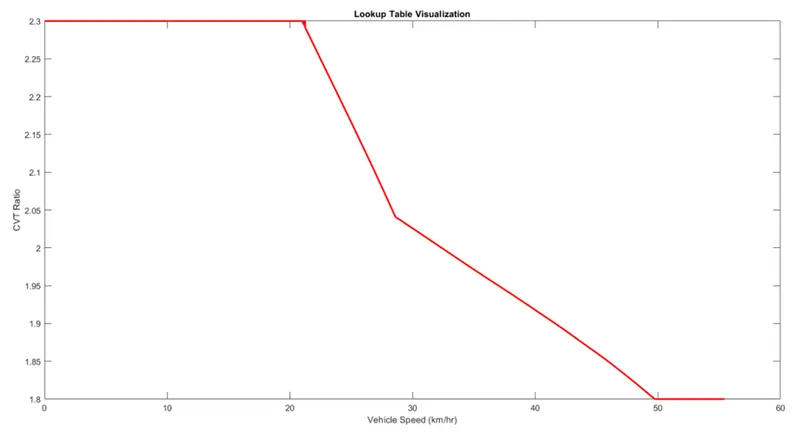
CVT Ratio vs Vehicle Speed
0 to 20km/hr, the CVT ratio is constant at 2.3
20 to 30km/hr,the CVT ratio drops down to 2.03
30 to 50km/hr,the Cvt ratio is drops down to 1.8
50km/hr onwards, the CVT ratio is constant at 1.8
Input 2.1
They are given in steps using the step block parameters are:
Brake input
Step time:35
Initial value:0
Final valu:0
Sample time:0
Throttle input
Step time:20
Initial value:0.3
Final valu:1
Sample time:0
Output 2.1
CVT Ratio
Velocity
CVT Shaft Speed
Engine Speed
2.2 With Dashboard
A Simulink model for the BAJA ATV model including the dashboard and the Lookup table is shown below
Ouput2.2
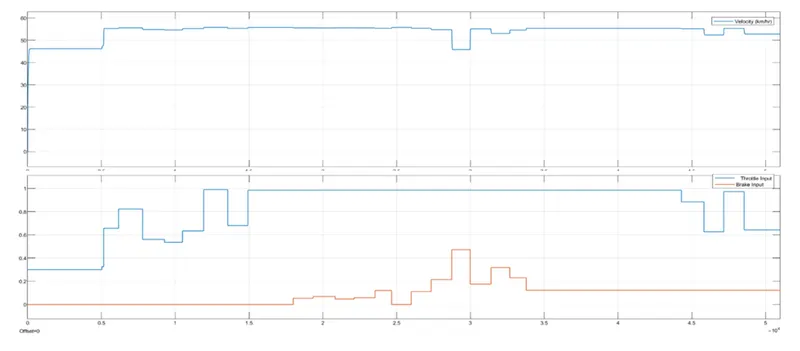
Velocity
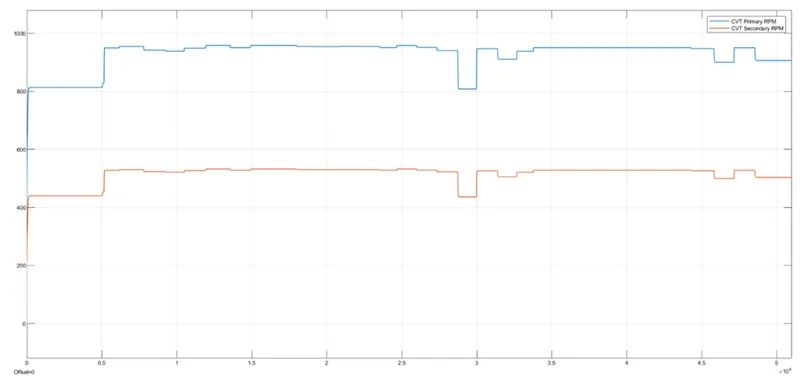
CVT Shaft Speed
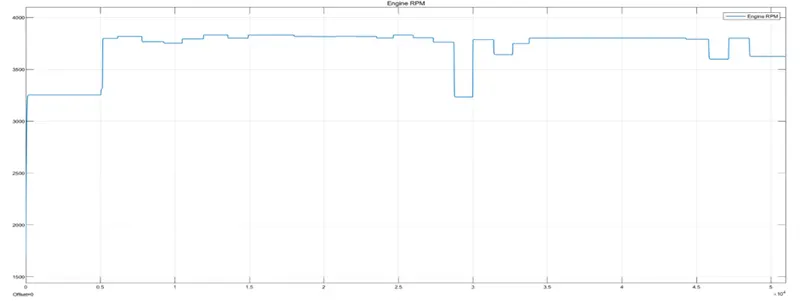
Engine Speed
RESULT
Hence the given BAJA ATV model was simulated successfully.
- Velocity, CVT shaft Speed and Engine speed are directly proportional to Throttle input and inversely proportional to the Brake input
- CVT primary speed is greater than CVT secondary speed. they are directly proportional to the throttle input
- CVT primary speed is greater than CVT secondary speed as they are directly proportional to their shaft diameter
REFERENCE
- BAJA ATV Model file
https://www.mathworks.com/matlabcentral/fileexchange/70576-baja-all-terrain-vehicle-atv-model