Week-6 Challenge: EV Drivetrain
Q1) Which type of power converter circuits are employed in electric and hybrid electric vehicle?
BOTH AC and DC motor can be used for EV and HEV . but widely, DC motor is used ( brushless dc motor).Non-isolating high gain bidirectional dc- dc converter
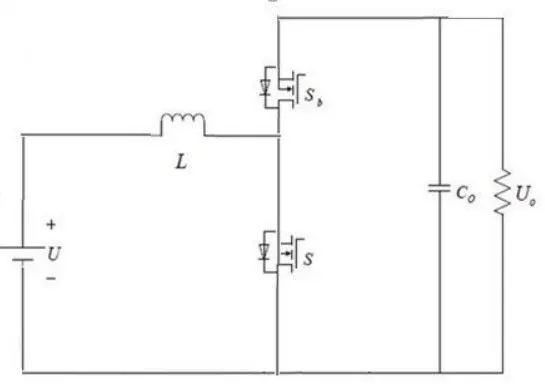
a) The bidirectional dc-dc converter along with energy storage has become a promising option for many power related systems, including hybrid vehicle, fuel cell vehicle, renewable energy system and so forth. It not only reduces the cost and improves efficiency, but also improves the performance of the system.
b) In the electric vehicle applications, an auxiliary energy storage battery absorbs the regenerated energy fed back by the electric machine. In addition, bidirectional dc-dc converter shown is also required to draw power from the auxiliary battery to boost the high-voltage bus during vehicle starting, accelerate and hill climbing . With its ability to reverse the direction of the current flow, and thereby power, the bidirectional dc-dc converters are being increasingly used to achieve power transfer between two dc power sources in either direction.
C) DC-DC converters are electronic devices used whenever we want to change DC electrical power efficiently from one voltage level to another. They are needed because unlike AC, DC can.t simply be stepped up or down using a transformer. In many ways, a DC-DC converter is the DC equivalent of a transformer. DC-DC converters have a wide range of uses today and are becoming increasingly more important in every day use. Dc power supplies are probably the largest use of
the converters and are much more compact and efficient than the old method of conversion with transformers.
These converters can have an output of any range; for instance, one can run logic gates or large dc motor drives with a simple converter. FOR AC motor DC to AC converter (1phase or three phase sin pwm inverter)& AC TO DC CONVERTER
step-down transformer is used to convert the high voltage AC to the low voltage AC. The transformer is PCB mounted and it is a 1-ampere 13-volt transformer.
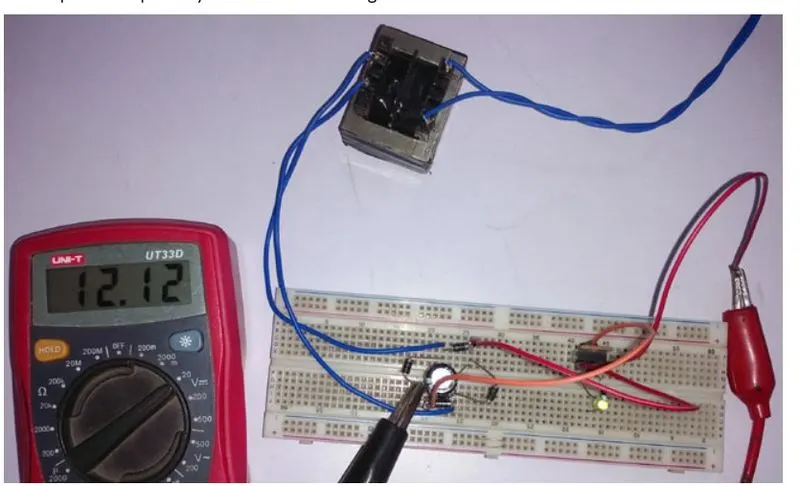
However, during the load, the transformer voltage drops approximately 12.5-12.7 volt
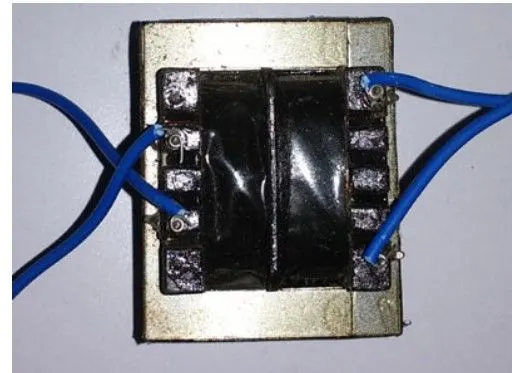
The essential part of the circuit is a diode bridge which consists of four diodes. The diode is an electronic semiconductor device which converts the alternating current to direct current.
The flow of current inside the diode bridge can be seen in the below image
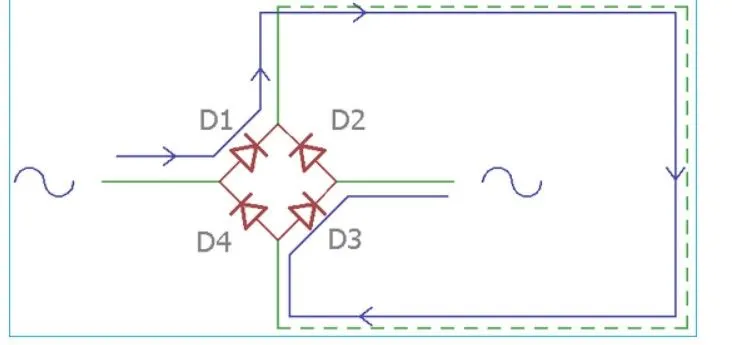
Here two diodes D2 and D4 block the negative peak of the alternating current and make the current flow into the one direction. This is a full bridge rectifier that means the diode bridge rectify both the positive and negative peak of the AC signal.
The large capacitor C1 gets charged during the conversion and smooth out the output voltage. But at the end result, this is not a regulated voltage output. Here the voltage regulation is done by the LDO, LM2940, which is IC1 in the schematic.
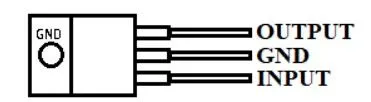
The LDO, LM2940 is a 3 pin device into TO220 package. LDO stands for low dropout voltage. The pin diagram can be shown in the below image.
The output can be perfectly seen in the below image
Limitations of Transformer based AC-DC Converter Circuit
Transformer-based AC to DC conversion is a common choice where DC is required but it has certain drawbacks.
1.Any situations where the input AC voltage has possibilities to fluctuate or if the AC voltage drops significantly, the output AC voltage across the transformer
also gets dropped. So a 230V AC to 12V DC converter cannot be powered in 110V AC line. To address this isse, an additional setting is provided for different
input voltage levels
2.Despite not having a universal input voltage range, it is a costly choice, as the transformer itself costs more than 60% of the total manufacturing cost of the converter circuit.
3.Another limitation is low conversion efficiency. The transformer gets heat up and the waste unnecessary energy.
4.The Transformer is heavy stuff which unnecessarily increases the weight of the product.
5.Due to the transformer, the bigger space is required inside the product to fit the converter circuit or at least the transformer.
To overcome these limitations, SMPS or switch mode power supply is a preferable choice
Q2) An Electric Vehicle's powertrain with 72V battery pack in shown in the diagram . The duty ratio for acceleration operation is 'd1' and for the braking operation the duty ratio is 'd2'.
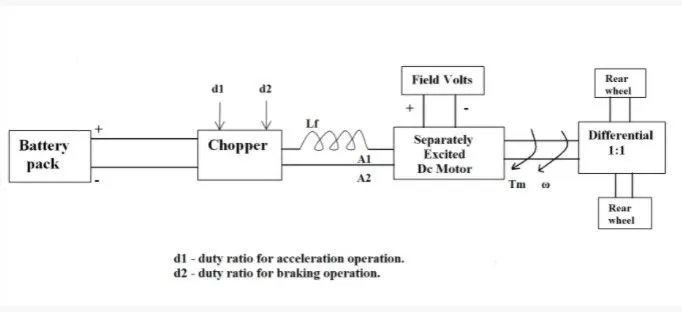
DATA:
Rated voltage =72V
Armature current=400A
Armature Resistance=0.5 ohm
motor constant= 0.7 v
chopper frequency=400 hertz
T_v=24.7+0.0051 w_m^2
Duty cycle=70%=0.7
sol : Torque calculation
T_m=((V*K)/R_a)-((w_m)(k^2)/R_a
V = 72 * duty cycle = 72* 0.7 =50.4v
T_m = ((50.4 *0.7)/0.5 - ((w_m)(0.7)^2/0.5)
T_m = 70.56-0.98w_m
vehicle Torque speed characteristic given as belwo equation
T_v = 24.7 + 0.0051w_m^2
the above two equation are plotted in graph using excel which was attached below
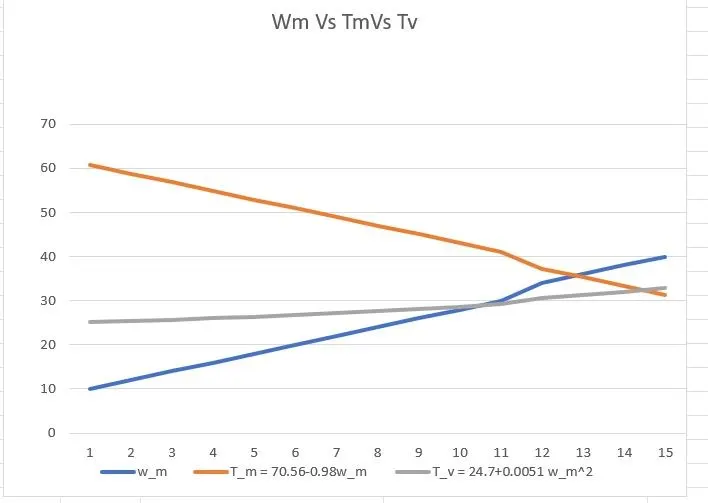
or by solving the above equation w^2+192.16-8992.16=0
w=38.91rad/s
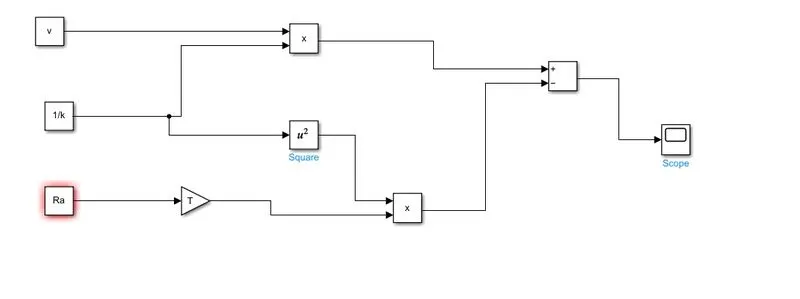
Q3) mathematical model of a DC motor for below equation using simulink
ω= V/Kϕ -Ra/Kϕ^2 .T
Q4) Authors view on brush less DC motor and Induction motors
induction vs dc brushless
Brushless DC motors provide high power in a small package. Oriental Motor manufacturers a wide range of AC motor and brushless DC (BLDC) motor products. So why choose one technology over the other? There are several key differences between the different technologies.
Motor Construction
Brushed DC motors depend on a mechanical system to transfer current, while AC and brushless DC gear motors use an electronic mechanism to control
current. The brushed motors have a wound armature attached to the center with a permanent magnet bonded to a steel ring surrounding the rotor. As the brushes come into contact with the commutator the current passes through to the armature coils.
AC induction motors and BLDC motors do not depend upon the mechanical system (brushes) to control current. The AC and BLDC motors pass current through the stator (electromagnet) which is connected to AC power directly or via a solid-state circuit.
In AC induction motors the rotor turns in response to the "induction" of a rotating magnetic field within the stator, as the current passes. Rather than inducing the rotor in a brushless DC motor, permanent magnets are bonded directly to the rotor, as the current passes through the stator, the poles on the rotor rotate in relation to the electromagnetic poles created within the stator, creating motion.
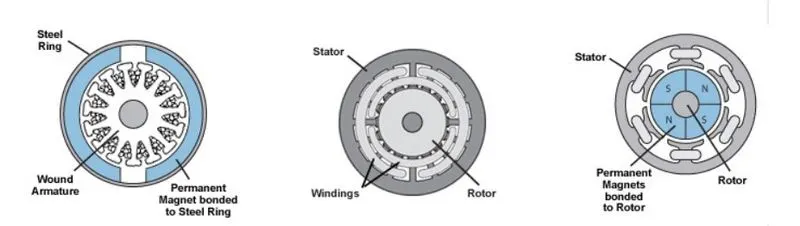
BRUSHED MOTOR CONSTRUCTION AC MOTOR CONSTRUCTION BRUSHLESS MOTOR CONSTRUCTION
EFFECIENCY
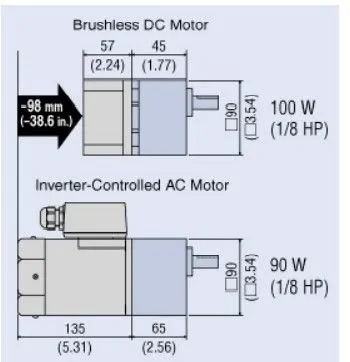
The efficiency of a system is defined as the amount of output received, as a percentage of what was input into the system. Therefore, when we talk about the energy efficiency of brushless DC (BLDC) motors, we are saying that we can obtain a relatively high amount of mechanical power, in return for the electrical power that we use.
All three technologies have power loss in the form of I-R losses. DC motors utilize permanent magnets so none of their energy needs to be used in the creation
of an electromagnet as in AC motors. The energy used by AC motors to create the electromagnet decreases the efficiency of the AC motor in comparison to the DC motors.
At the same time, BLDC motors are considered more energy efficient than brushed DC-motors. This means for the same input power, a BLDC motor will convert more electrical power into mechanical power than a brushed motor, mostly due to absence of friction of brushes. The enhanced efficiency is greatest in the no-load and low-load region of the motor's performance curve.
A BLDC motor, for the same mechanical work output, will usually be smaller than a brushed DC motor, and always smaller than an AC induction motor. The BLDC motor is smaller because its body has less heat to dissipate. From that standpoint, BLDC motors use less raw material to build, and are better for the environment
conclusion:
on author’s perspective:
DC brushless drives will likely continue to dominate in the hybrid and coming plug-in hybrid markets, and that induction drives will likely maintain dominance for the high-performance pure electrics.