Week-6 Challenge: EV Drivetrain
1)Which types of power converter circuits are employed in electric and hybrid electric vehicle?
Electronics used for conversion and control of electric power is known as power electronics and that conversion and control is done by the power converters.
There are typically four types of power converters:
1)AC to DC(RECTIFIERS)- Here the common example is the chargers which induces ac voltage and supply dc to the battery.
2)DC to AC(INVERTERS)- AC INDUCTION MOTORS
3) DC to DC( CHOPPER)- 1)STEP UP 2) STEP DOWN
4) AC to AC- Common example is fan regulator
FOLLOWING ARE THE TYPES OF POWER CONVERTER CIRCUITS IN ELECTRIC AND HYBRID ELECTRIC VEHICLES:-
- PLUG IN EV's- Here Rectifiers are used in AC to DC conversion where grid electricity is first introduced with the vehicle. The grid voltage obtained from the plug is 110V/60Hz or 220V/50Hz single phase AC input in household application of Plug in EV.
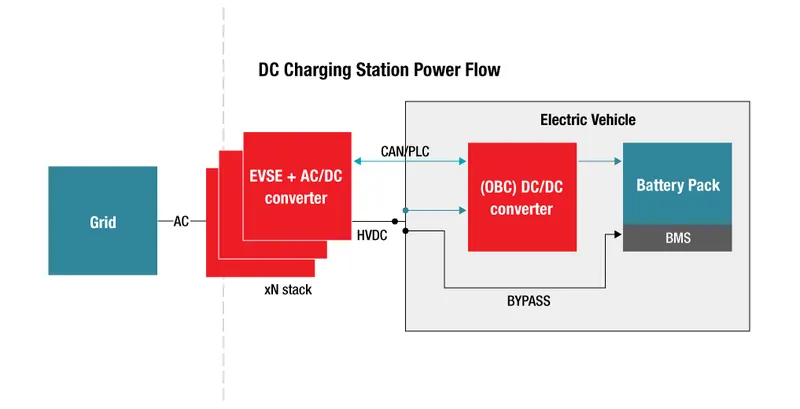
- POWER CONVERTERS- These are classified according to their input and output types namely DC-DC Converter and AC- AC Cylcloconverters. DC- DC converters are used to increase or decrease the input voltage stage to desired value at the output. Therefore, device known as buck converter or stepdown converter decreases the output value according to high input voltage and boost converter or stepup converter generates an increased output voltage.
When the EV driver switched into braking mode, the batteries are charged by electric motor due to bidirectional structure of converter. Therefore, bidirectional dc-dc converter is the key device in EV's.
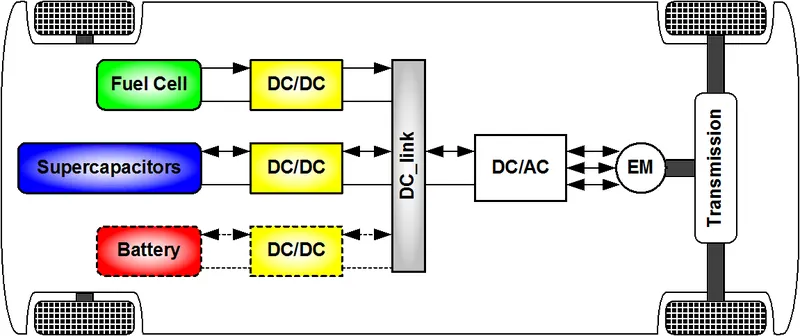
-INVERTERS- In EV's, inverters are used for DC to AC conversions. They are used to provide required ac voltage or current for ac induction motors from dc battery supply and consequently, the inverter control algorithms perform motor control operations in terms of torque and speed.
2) An Electric Vehicle's powertrain with 72V battery pack in shown in the diagram below. The duty ratio for acceleration operation is 'd1' and for the braking operation the duty ratio is 'd2'.
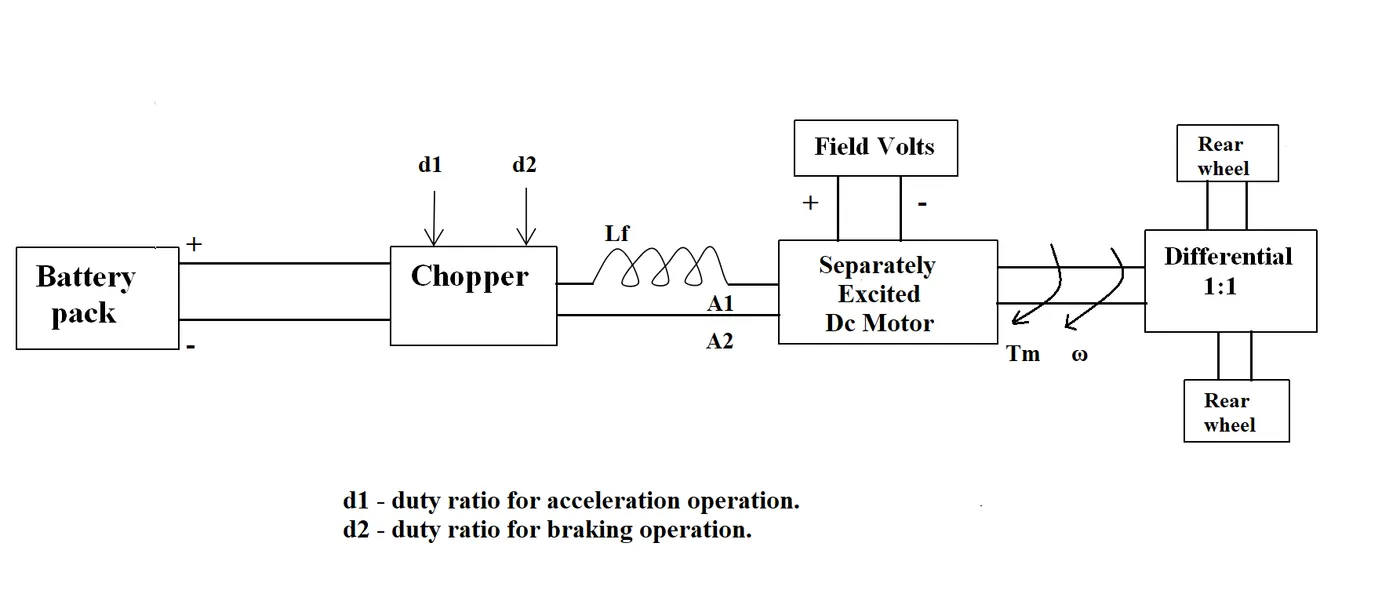
The other parameters of the electric vehicle is given below,
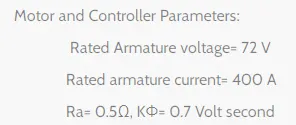
Motor and Controller Parameters:
Rated Armature voltage= 72 V
Rated armature current= 400 A
Ra= 0.5Ω, KΦ= 0.7 Volt second
Chopper Switching frequency= 400 Hz
The vehicle speed-torque characteristics are given by the below equation

What is EV steady state speed if duty cycle is 70%?
-Firstly calculating the average battery voltage provided for acceleration and braking operation:
V(avg)=V(bat)⋅dutyratio

V(avg)= 72*0.7= 50.4 V
The vehicle speed-torque characteristics are given by the below equation
Also , the torque speed characteristic equation is expressed as follows:
T=(50.4×kϕ−ω(kϕ)^2)/Ra- Equating both the equations,we get;
(50.4×0.7÷0.5)−(ω×(0.7)^2÷0.5)=24.7+(0.0051)×ω^2

70.56−0.98ω=24.7+(0.0051)×ω^2

 45.8=0.0051×ω^2+0.98×ω
Above is the quadratic equation, so formula for the quadratic is given by:
ω(1,2) = (−b ± √(b2 − 4ac))/2a
By Solving there were two values in negative and positive and speed value can never be in negative.
So, ω=38.95 rad/sec
3) Develop a mathematical model of a DC Motor for the below equation using Simulink.
ω">ω= V/Kϕ">ϕ -Ra/(Kϕ">ϕ)^2 .T
Implementing the torque speed characteristic equation in simuling is shown below:
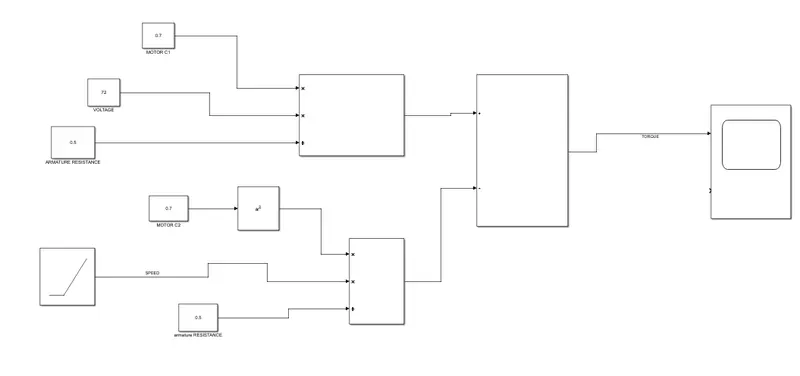
VALUES ASSUMED FOR MODEL SIMULATION ARE GIVEN BELOW:
Following are the blocks used:
1) Ramp block- This block is used as to give a ramp signal and in this case used as speed input with a increasing slope of 1.
2) Constant block- These blocks are used to input the values as shown above in the image.
3)Square block- it is used for squaring an output or a constant value.
4) Divide block- This block is used with 3 inputs taken, two are multiplication and the other one is division. Here resistance value is used for division.
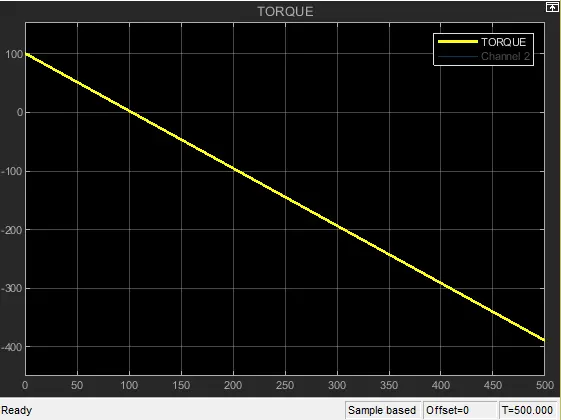
5)scope block- It is used to output the torque value with respect to speed.
Below is the plot generated from the above model:
4)INDUCTION vs DC BRUSHLESS MOTORS
-According to the author's perspective, as there are different kind of engines are used for different requirements (price , performance), similar is the case with the EV Drives, which in the present world are Induction Motors and Brushless DC motors. Author talks about positives and negatives of induction and dc drives which are listed below and their key differences.
- A brushless dc drive consist of rotor(includes two or more permanent magnents) and stator (core made up stacked laminations) and current flow through this windings to produce torque. Also power converter called inverter is required to generate the constant torque from the rotor. In case of Induction motor, stator is same but the main difference is at the rotor part which consist of peripheral conductors and as the current flows in the stator, it produces rotating magnetic field that enters the rotor.
- An induction motor can start under load without the need of inverter whereas dc motor produce no starting torque when directly connected to fixed frequency utility power.
- When an induction motor is given utility power, they have limited starting torque capabilities and peak torque when compared to DC machines.
- When an inverter is added with induction motor, torque performance is low in comparison with DC machines. But with feedback loops, desired frequency is attained.
- In DC drive, rotor heat is very less and rotor cooling is easier. In ideal brush drive, eddy and hysteresis losses due to magnetic field can be controlled or minimized but in permanent magnents BLDC, it cannot be compromised. In induction machines, since, with no presence of magnests, magnetic fields are adjustible.Also, Peak efficiencies in DC machines are comparitvely higher than induction and average efficiencies are may be higher in case of induction machines.
- Induction machines are difficult to control as their laws are complex and difficult to understand and achieving stability over the entire torque-speed range and temperature is more difficult in comparison to DC machines.
So, with the author's perspective, dc drives will continue in the hybrid and plug in hybrid markets and induction drives for pure electrics.