Week-6 Challenge: EV Drivetrain
1.Which types of power converter circuits are employed in electric and hybrid electric vehicle?
Sol:
Electronic circuits typically require dc voltage sources in order to function. Ac voltages
are used for bulk power generation, transmission, and local distribution. Thus, an ac-dc
converter is used to interface the ac grid to the dc battery.
Dc-dc converters are power electronics circuits which convert a dc voltage to a different dc voltage level. For example, the voltage of a fuel cell can drop significantly with
increased power demand, and a dc-dc converter is required to step up the fuel cell voltage
to a higher level for a more efficient powertrain.
A device that increases or decreases the voltage (AC or DC) of a power source depending on application. A converter that increases voltage is called a step-up converter and a converter that decreases voltage is called a step-down converter. In EVs/HEVs step-up and step-down converters are combined into one unit. An application of a step-up converter is converting EV/HEV battery voltage to about 650 volts to power the traction motor. An advantage of using a converter to increase voltage from the battery is a smaller and less expensive battery may be used while still utilizing an efficient high voltage motor. An application of a step down inverter would be decreasing the high voltage direct current from the HEV/EV battery to low voltage (12-14 volts) DC that can be used to charge the 12 volt auxiliary battery and operate light load devices such as lighting, radio, and windows.
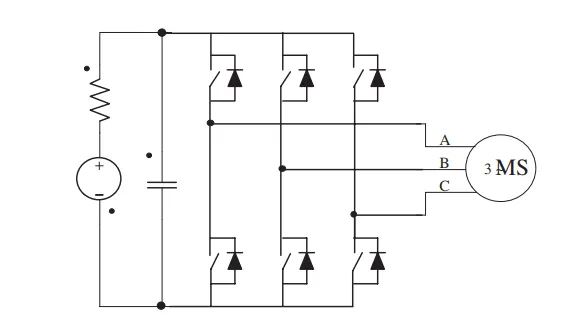
Voltage source inverters (VSIs) are used in hybrid vehicles to control the electric motors
and generators. Figure shows the power electronic circuit arrangement of a VSI
to control the induction motor, PM synchronous motors, and PM brushless motors. The
switches are usually IGBTs for high voltage, high-power hybrid configurations or MOSFETs for low voltage designs.
The output of the VSI is controlled through the means of pulse width-modulated (PWM)
signals to produce sinusoidal waveforms. Certain harmonics exists in such a switching
scheme. High switching frequency is used to move away the harmonics from the fundamental frequency
DC – DC Converters
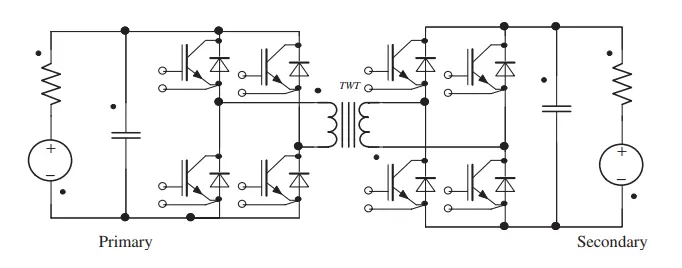
The bidirectional DC–DC converter in a HEV is also sometimes called an energy management converter, or boost DC–DC converter. This DC–DC converter is a high-power
converter that links the HV battery at a lower voltage with the HV DC bus. The typical
voltage of a battery pack is designed at 300–400 V. The best operating voltage for a
motor and inverter is around 600 V. Therefore, this converter can be used to match the
voltages of the battery system and the motor system. Other functions of this DC–DC
converter include optimizing the operation of the powertrain system, reducing ripple current in the battery, and maintaining DC link voltage, hence the high-power operation of
the powertrain.
2. An Electric Vehicle's powertrain with 72V battery pack in shown in the diagram below. The duty ratio for acceleration operation is 'd1' and for the braking operation the duty ratio is 'd2'.
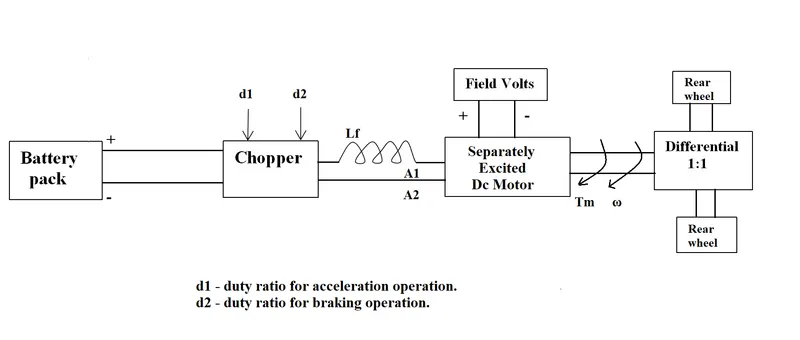
The other parameters of the electric vehicle is given below,
Motor and Controller Parameters:
Rated Armature voltage= 72 V
Rated armature current= 400 A
Ra= 0.5Ω, KΦ= 0.7 Volt second
Chopper Switching frequency= 400 Hz
The vehicle speed-torque characteristics are given by the below equation

What is EV steady state speed if duty cycle is 70%?
sol:
The torque of the motor is given by the equation,
Tm=(V/Ra)K-(K2/Ra)*ω2
Substitute the values given in the question,
Tm=(50.480.7)/0.5-((0.7*0.7)/0.5) ω2
Tm=70.56-0.98 ω2
At steady state Tv=Tm
24.7-0.0051 ω2=70.56-0.98 ω2
0.0051 ω2 +0.98 ω -45.85=0
On solving the quadratic equation above we get,
ω =38.92rad/s
3.Develop a mathematical model of a DC Motor for the below equation using Simulink.
ωω= V/Kϕ -Ra/Kϕ^2 .T
sol:
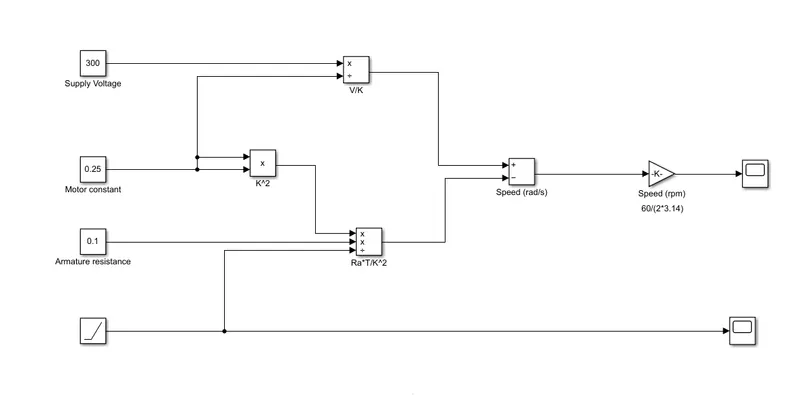
Following is the Simulink mathematical model for the equation of DC motor given in the question.
https://drive.google.com/file/d/1CXyY09Psf823_udCKoAZqpMBMf1JXFir/view?usp=sharing
In order to obtain the given equation, constant block, ramp signal, adder block multiplication-division blocks are obtained from Simulink library.
Supply voltage is taken as 300V, Motor constant as 0.25 and Armature resistance as 0.1ohm for calculating speed. From equation we get speed in rps. To convert rps to rpm a factor of 9.5493(60/(2*pi)) is multiplied.
As in graph, we need to plot speed with respect to change in torque, torque is not considered as constant and took as a ramp signal.
On simulation, both Speed and Torque graphs are obtained in the scope block.
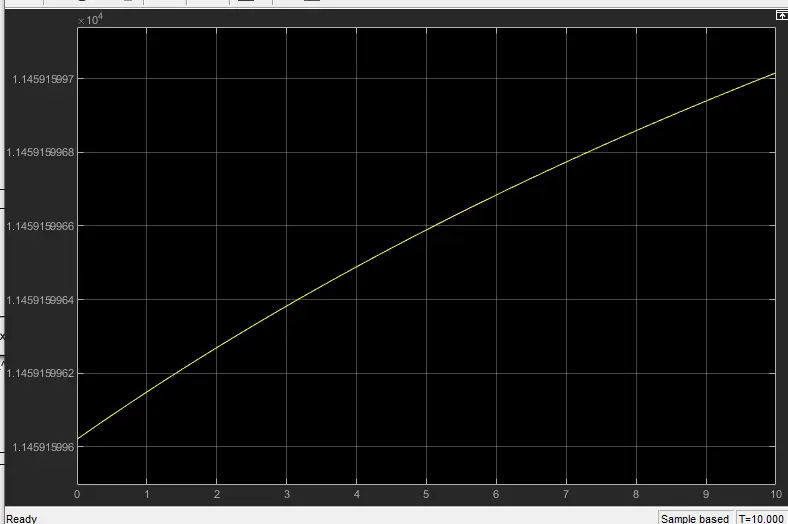
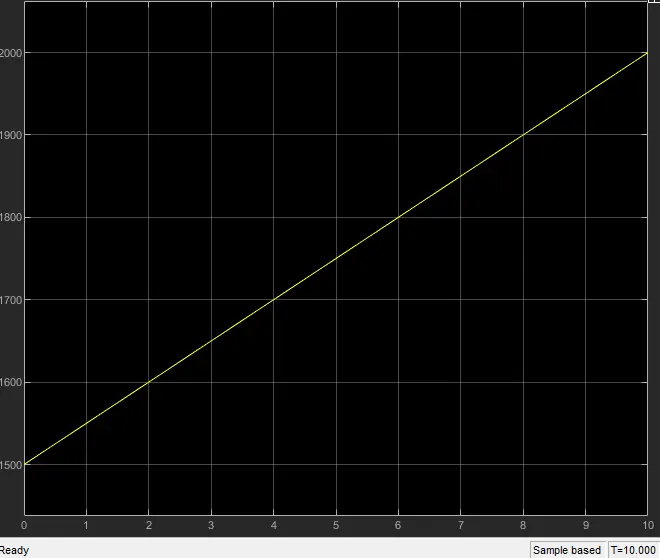
We observe that as torque is increased, speed of the motor decreases. We can conclude that speed is inversely proportional to the torque. We can also observe that obtained plot for speed is linear.
4. Refer to the blog on below topic:
Induction Versus DC brushless motors by Wally Rippel, Tesla
Explain in brief about author’s perspective.
sol:
According to the author, there is not best engine. Engine characteristics depends on price and performance. Author says it is impossible to select one best engine between induction motor and DC brushless motor. They both are equally good at their performance. Rather than choosing best among them, we need to look at the requirements needed to be fulfilled by the motor.
CHARACTERISTICS OF DC BRUSHLESS MOTOR:
- Rotor heating will be less.
- There is no starting torque with fixed frequency supply. So, inverter is surely needed.
- This can be operated for UPF loads, whereas, induction motor can operate till 0.85pf loads only.
- Peak energy efficiency is little higher in Brushless motor than induction motor.
- To reduce eddy current losses and hysteresis losses, B should be modified. Strength of magnetic field produced is adjustable but, we don’t have easy ways to vary the magnetic strength of the magnet.
- Rotor cooling is easier.
- Easier to control than induction motor as induction motor equations are difficult to understand.
- DC motor needs position sensor whereas Induction motor requires speed sensor.
CHARACTERISTICS OF INDUCTION MOTOR:
1. Induction motor can directly be connected to conventional utility .
- AC supply is must. Can’t be operated with DC.
- They have limited starting speed, limited maximum torque
- Torque performance is little lower than DC machine
- Induction motors have no magnets so magnetic field can directly be controllable
- Induction motor with smart inverter can have advantages over DC machines.
- For lighter loads, inverter reduces the voltage thereby decreasing the losses. Hence, efficiency is improved.
- Magnetic and conduction losses can be traded with efficiency. This is very important performance characteristics.
- DC brushless motor size is big, So, magnetic losses will be more and efficiency decreases. Whereas, even if size of induction motor is increased losses will not increase. So, for high performance, induction motor is preferred.
- Average efficiency is better
- Permanent magnets are costlier. Magnets are used in DC brushless motor and not in Induction motor . So, induction motor is cost efficient.
High performance Electric vehicles requires Induction motor whereas Hybrid Electric vehicle uses Brushless DC motor.If high torque is the requirement we can go for BLDC and for constant speed requirements Induction motors are preferable. Author also says that Brushless DC motor and Induction motor continue to persist for many upcoming years because of the best characteristics they are providing.