Week-6 Challenge: EV Drivetrain
Power converter employ in electric and hybrid electric vehicle are as follows:- There are 3 main type of converter use in EV and HEV vehicle such as (DC-DC converter, AC- DC converter, DC-AC converter).
AC- DC converter :- 1) These type of conveter are used to convert AC power into DC supply.These type of converter used in EV in EV charger. As we know the power generated into power plant is AC and it reach in our home at 240V,50 Hz supply. If the charger is connect at home then Ac supply is used but the battery is give the DC output so to convert the AC supply into dc to provide for battery charging.
2) In these circuit of AC to DC converter , the step down transformer is used which step down the AC, 230V to lower level for e.g 12 V or 24V but after converting AC high level to AC lower level not to DC supply. To convert the DC supply the group of diode to restrict the current fow only in one direction. It means the diode group remove the negative part in AC sine wave so it called as halfwave or full wave or bridge wave rectifire circuit. but after converting the wave form then only full DC waveform is not smoothen.
3) To smoothen these waveform filter capacitor is used. From all the component used in the circuit the DC output is obtain from AC waveform.
DC - DC converter:- 1) DC-to-DC converters convert one DC voltage level to another, which may be higher or lower, by storing the input energy temporarily and then releasing that energy to the output at a different voltage.The storage may be in either magnetic field storage components (inductors, transformers) or electric field storage components (capacitors).
2) These type of converter used in EV / HEV for step down the voltage of battery and step up the voltage of battery. The vehicle other system such radio ,air conditioner system, usic system, headlight are work on 12 V , 24 V so the DC-DC converter is ued to step down the voltgae of battery which give higher voltage and the motor require more voltage to run but battery wouldn't supply such requirement at that time the dc-dc converter feed the step up supply to motor upto 500 v.
3) Types of converter:- The converter are classsify into two types isolated and non-isolated.
| Isolated | Non- isolated |
| Buck converter :- step down the voltage | Forward converter |
| Boost converter :- step up the voltage | Flyback converter:- similar to buck boost but transformer is used for isolation. |
DC - AC converter :- 1) These type of converter is convert the DC supply into AC supply. In EV/HEV vehicle the power supply from battery which provide the DC supply but as we connect the AC induction motor so that purpose vehicle used DC - AC converter.these type of circuit is also known as (Inveter).
2) In case of EV/HEV the battery pack will supply its power to the inverter. In the inverter, the Dc supply change to an AC supply by using elctronic switch such as MOSFET , IGBT and these switch controlled by controller. the controller send the signal to switch to open and close and inverter also contain the transformer which consist of primary and secondary winding.
3) The supply first apply to primary winding and elctronic switch will repeately on-off and reverse the direction of current to generate the AC waveform.
EV vehicle powertrain with 72 volt battery pack:-
Given :- Motor and controller parameter
Rated armature voltage :- 72 V
Rated armature current :- 400A
Ra:- 0.5 K`phi`:- 0.7 Volt per second
Chopper switching frequency = 400Hz
Duty cycle = 70%
Torque speed characyeristic of vehicle = Tv= 24.7 + (0.0051)W^2
Solution :-
Torque equation = Tv= 24.7 + (0.0051)w^2
Duty cycle is 70% = 0.7
therefore ,
Actual voltage = 72 * 0.7 = 50.4V
Torque speed characteristic of DC motor,
T = (V*K `phi`/Ra) - ((K`phi`)^2/Ra) w
= (50.4 * 0.7 /0.5) - ((0.7)^2/0.5)w
= 70.56 - 0.98 w
From equation of torque of vehicle (Tv) and torque of dc motor T
equating the equation ,we get
24.7 + (0.0051)w^2 = 70.56 - 0.98 w
(0.0051)w^2 +0.98 w - 45.86 = 0
Dividing 0.0051 on both side ,we get equation
w^2 + 192.156w - 8992.156 = 0
By solving these equation to finding the root of equation we get,
w = 38.915 rad/s and w = - 231.07 rad/s
The speed of vehicle = 38.915 rad/s
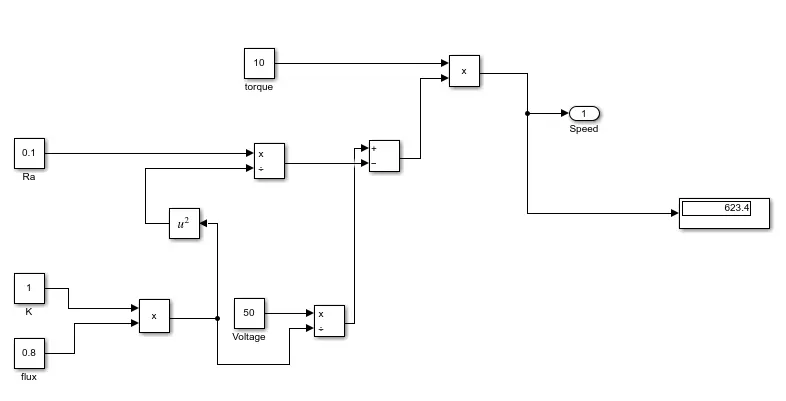
Induction vs DC brushless motor:-
In this blog the author write about te pure electric vehicle's motor. The author compare two motor which DC brushless motor and induction motor. He take close look of the point such as what are these two technologies? How do they work? What differentiates them? And what do they have in common?
While comparing the Both motor, the DC brushless motor having stator and rortor.the rotor includes two or more permanent magnets that generate a DC magnetic field. In another case of induction motor no permanent magnet is used. just stacked steel laminations with buried peripheral conductors that form a “shorted structure''. He wrote about Brushless DC motor need and inveter to control the current in right way. Without it, brushless motors are useless motors but in case of Induction motor has the ability to start under load. No inverter is needed.
The induction motor have some limitation that it does not operate on DC supply which fed by battery so that case add an inverter (without any feedback control) and it becomes possible to power an induction machine from a battery or other DC source; variable speed also becomes possible simply by adjusting the inverter frequency.After comparing all thing thing author get to conclude that DC brushless drives will likely continue to dominate in the hybrid and coming plug-in hybrid markets, and that induction drives will likely maintain dominance for the high-performance pure electric.