Week-6 Challenge: EV Drivetrain
1. Which types of power converter circuits are employed in electric and hybrid electric vehicle?
power converter deal with the transfer,control and conversion of power.Typically power can be classified into AC andDC supply.The type of converters are listed below.
- Ac to Dc:This is also called as rectifier circuit and it converts AC supply to a Dc supply.
- DC to AC:This type of power converter is known as inverter.It changes DC to AC.
- DC to DC:This converts DC from one level to another and is called chopper.They are classified into step down and step up choppers.
- AC to AC:This converts AC to AC and is called cyclo convertor.
The HEV may make use of the following:
- Rectifier:To convert the AC voltage from a 3 phase Ac motor to a suitable DC voltage to be stored in a battery.This circuit is also present in the charger circuit to convert AC from main line to DC to charge the vehicle battery.
- Inverter:The 3 phase AC motor requires AC to run but the power source is DC.The inverter converts the DC from battery source to suitable AC voltage for the motor.
- Chopper:Choppers may be used to convert high voltage DC to a lower voltage DC to power other auxillary devices like sensors,infotainments system,ECU etc
2. An Electric Vehicle's powertrain with 72V battery pack in shown in the diagram below. The duty ratio for acceleration operation is 'd1' and for the braking operation the duty ratio is 'd2'.
The other parameters of the electric vehicle is given below,
Motor and Controller Parameters:
Rated Armature voltage= 72 V
Rated armature current= 400 A
Ra= 0.5Ω, KΦ= 0.7 Volt second
Chopper Switching frequency= 400 Hz
The vehicle speed-torque characteristics are given by the below equation

What is EV steady state speed if duty cycle is 70%?
Given:
The following input parameters are given :
Battery pack voltage(V)= 72 V
Rated armature current(A) = 400 A
Armature resistance(Ra) = 0.5Ω
motor constant (kΦ)=0.7
Chopper Switching frequency= 400 Hz
Duty cycle = 70%
solutions:
Vehicle output voltage (Vv) is give by:
Vv = Battery voltage *Duty cycle
Vv = 72*0.70
Thus, vehicle voltage = 50.4 V
Equation for torque is given by:
Tv =`Vv.(k*phi)/(Ra)-(K.phi)^2/(Ra).omega........(1)`
where,
Tv= Vehicle torque(N-m)
Vv = vehicle voltage(volts)
`omega`= steady state speed of vehicle(rps)
kΦ = Motor constant
Ra = armature constant
`Tv= (50.4*0.7)/0.5 - (0.7)^2/0.5 *omega`
Tv = 70.56 -0.98`omega`........(2)
now, the vehicle speed_torque characterstics is given as,
...(3)
At steady state,
eq(2)=eq(3).........(4)
24.7+(0.0051 )`omega^2`= 70.56 - 0.98*`omega`
0.0051`omega^2+0.98omega-45.85=0.....(5)`
The above equation shall be solved by using the quadratic equation formula:
`x= (-b±√(b²-4ac))/(2a)`
`x=(-0.98±√(0.98²-4(0.0051)(-45.85)))/(2*(0.0051))`
=38.92 rad/sec
Thus,the steady state speed of the vehicle is 38.92rad/sec
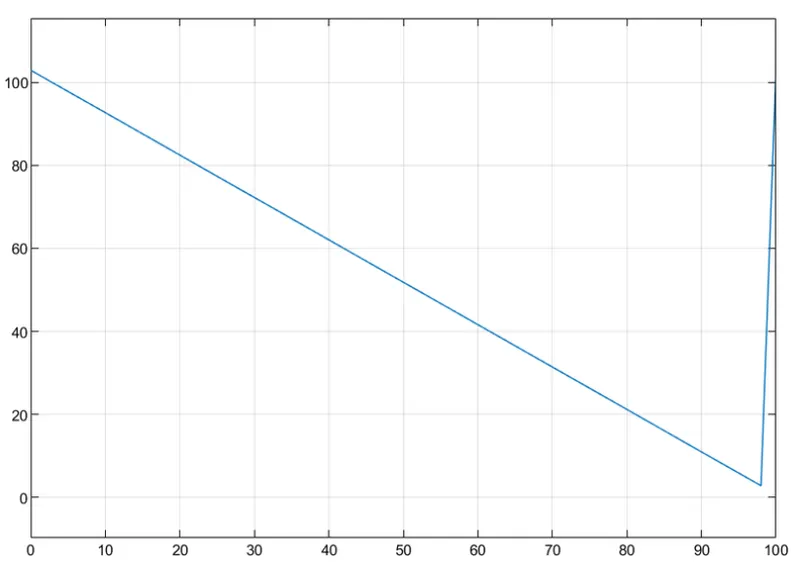
3. Develop a mathematical model of a DC Motor for the below equation using Simulink.
ω
= V/Kϕ -Ra/Kϕ^2 .T
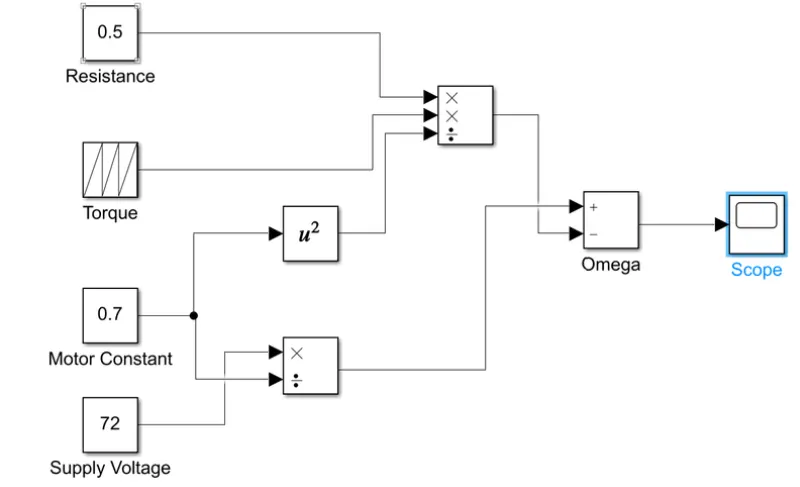
OUTPUT:
4. Refer to the blog on below topic:
Induction Versus DC brushless motors by Wally Rippel, Tesla
Explain in brief about author’s perspective.
The author named Wally Ripple in the above mentioned blog presented his perspective on
BLDC vs Induction motor on there suitability on electric vehicle's. Having said that, which is the best bldc motor or induction motor? well, if there was "one best" thing at doing all things,there would be one car manufacurer,with one engine or motor having monotonus design ! Hence due to relative advantage /disadvantage over one another there exists selection of different motor/engines based upon requirement for a particular vehicles.
Bldc motor:
The main thing with a Brushless DC motor is that it has permanent magnets (instead of electromagnets) for the Rotor. A permanent magnet generates a DC (Direct Current) magnetic field instead of AC magnetic field that is produced by passing AC current through an electromagnet. This magnetic field interacts with the magnetic field of the Stator to generate motion. The current in the Stator’s electromagnet can be varied to change the speed of motion.
Just because Rotor generates DC Magnetic field, even the Stator has to generate DC Magnetic Field. And this happens when the Stator coil gets DC (or Direct Current). However the current that comes through our regular electric supply is Alternating Current (or AC). That is why we need an “Inverter” and an electronic circuit that converts AC to DC of varying strength (to change the speed of the motor) to make it function properly.
In order to make the operation more reliable, efficient, and less noisy these BLDC motors are the best fit. They are also lighter compared to their conventional counterparts with the same power output.
Advantges of BLDC motor:
- heat generated due to rotor is minimal
- the peak point energy efficiency for a DC brushless drive will typically be a few percentage higher than for an induction drive.
- torque performance is better compared with the induction motor.
Disadvantages of DC brushless motors:
- functions only through the medium of inverter.
- as the machine size grows, the magnetic losses increase proportionally and part load effeiciency drops
Induction motor:
In induction motor , the rotor has no magnets. It has stacked steel laminations with buried peripheral conductors
Advantages:
- Induction motors are robust and can operate in any environmental conditions be it highly polluted or explosive environments.
- They are cheaper and nearly maintenance free in cost due to the absence of brushes, slip rings, etc. In a non inverter controlled induction motor, there are no electronics to worry about.
- If speed variation is not required then induction motors can give better efficiency at peak load.
- tolerate extreme temperature and speed.
- as machine size grows , magnetic losses do not necessarily grow
Disadvantages:
- Less efficient as compared to BLDC motors on an average.
- Lower power factor and can at best give power factor of 85% (or 0.85).
- Motion generates heat that can reduce efficiency of the motor.
CONCLUSION:
The author on his view on BLDC motor vs Induction motor summarizes that both induction motion and BLDC motor has to be developed side by side for EV applications since each has got its advantages and dis advantages