Week -2
- Make a Simulink model of Doorbell using solenoid block with the following details:
In the above arrangement, when the switch is closed the electromagnet receives electrical power from the battery and pulls the metal arm to hit the bell producing sound.
Create a situation where the switch is closed for 2 seconds and then released. Observe the physical movement of the plunger.
Assume remaining parameters.
Door bell theory:
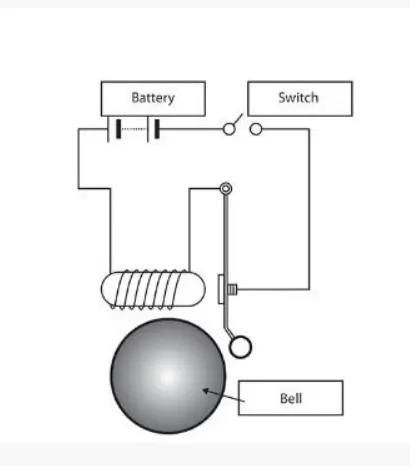
The above image represents the working circuit of the electronic door bell.When the switch is turned on the circuit becomes active and the solenoid activates the plunger which in turn hits the bell.
The solenoid is a simple electronic device that converts electrical energy into mechanical work. When an electrical current is introduced ,a magnetic field forms around the coil which draws the plunger in.The coil is made of many turns of tightly wound copper wire .When an electrical current flows through this wire, a strong magnetic field/flux is created.
Simulink model:
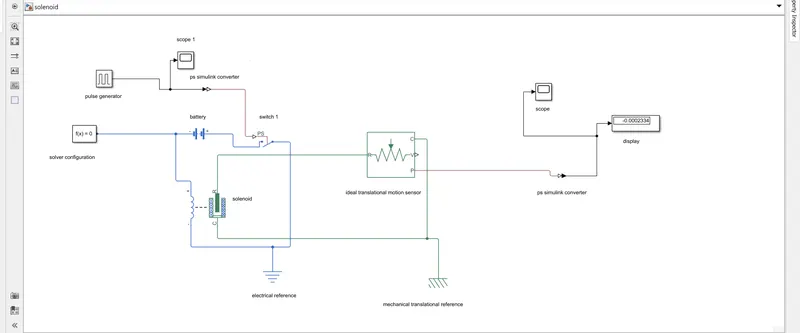
so to feed the input pulse generator lock is created.The input for the pulse generator is given below:
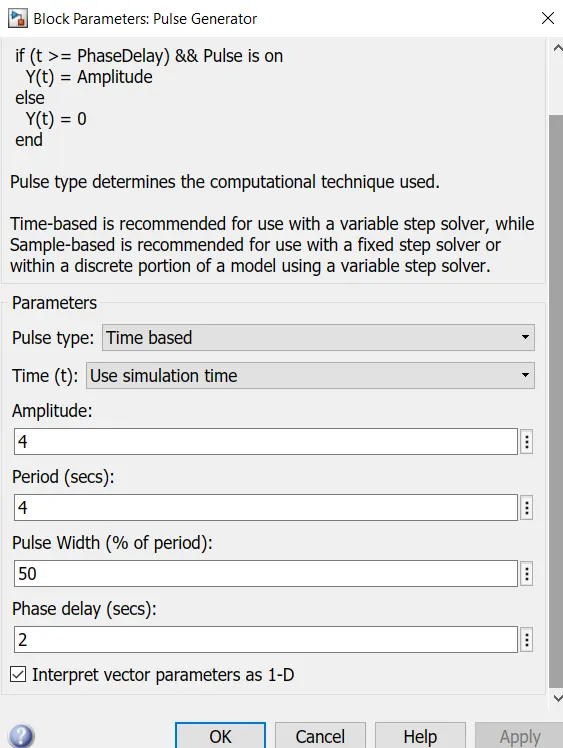
I have given the amplitude as 4 .To achieve 2 seconds of phase delay and 2 seconds to ring I have given the time period as 4 seconds with a pulse width of 50%.
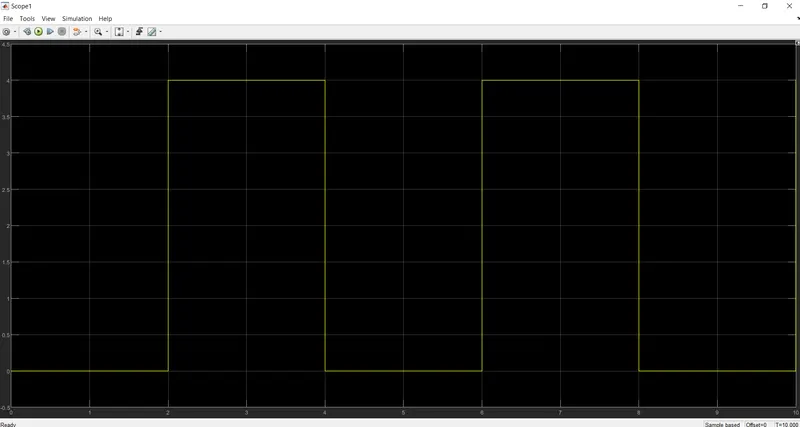
This is the input signal which is fed into the electrical circuit .The input has to be converted from the simulink input signal to the physical signal.This is connected to the switch.One end of the switch is connected to the positive terminal of the battery and the other end to the negative terminal of the Solenoid.The negative terminal of the battery is then connected to the positive terminal of the Solenoid.Electrical resistance is connected to the circuit and a solver configuration is also added.
The case 'c' of the Solenoid is connected to the mechanical reference and the Plunger 'R' is connected to the Translational conserving ports.The position 'p' of the translational motion sensor is connected to the output scope and display .Before this, the physical signal is converted into the Simulink signal.
Output:
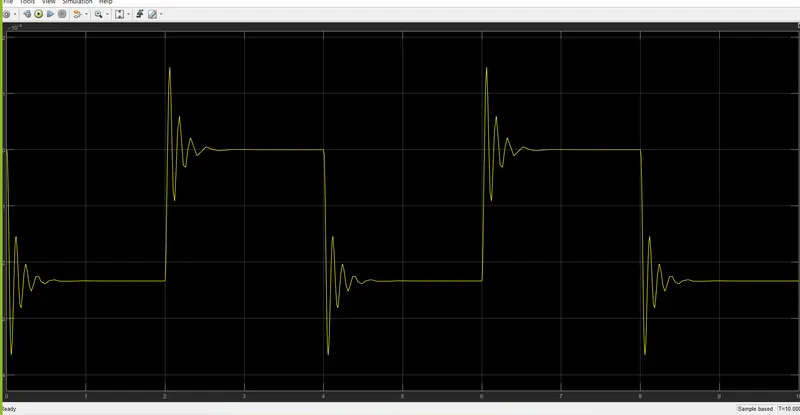
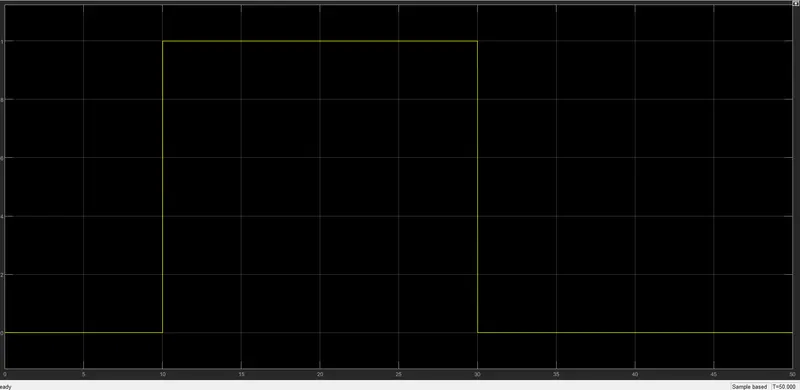
The amplitude/vibration shown at the bottom indicates the bell is ringing at the interval of 2 seconds with phase delay of 2 seconds.
The amplitude/vibration at the phase delay line is a concern in the output.
2. Use a thermistor to sense the temperature of a heater & turn on or turn off the fan as per the below conditions:
Temperature source: 20 °C from 0 to 10 seconds, 27 °C from 10 to 30 seconds, 23 °C from 30 to 50 seconds
Fan conditions: ON if the temperature above 25 °C, OFF otherwise
Thermistor theory:
A thermistor is a resistance thermometer or a resistor whose resistance is dependent on temperature .The term is a combination of "thermal" and"resistor".
There are two types of thermistors:Negative Temperture coefficient(NTC) and Positive Temperature coefficient(PTC).With an NTC thermistor,when the temperture increases,resistance decreases.Conversly,when the temperature decreases, resistance increases.This type of thermistor is used the most.A PTC thermistor works a little differently .When the temperature increases , the resistance increases, and when temperture decreases,resistance decreases.This type of thermistor is
generally used as fuse.
Simulink model:
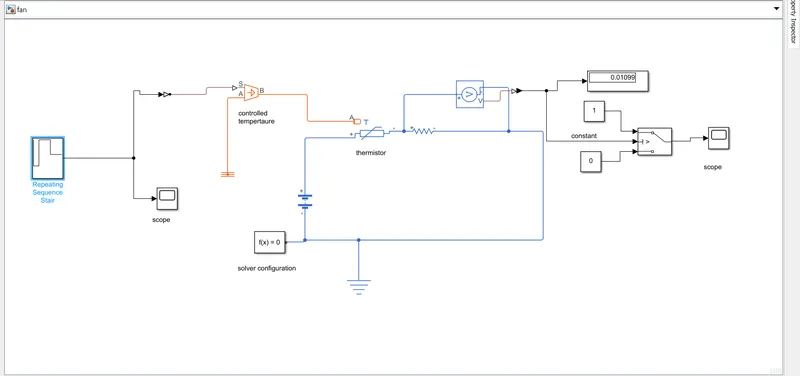
- Battery connected to the thermistor ,current flow through the positive signs of the Thermistor.
- Using a repeating sequence stair to create access to the signals connected with controlled temperature.
- given inputs to repeating sequence besed on the given inputs.
Temperature source: 20 °C from 0 to 10 seconds, 27 °C from 10 to 30 seconds, 23 °C from 30 to 50 seconds
Fan conditions: ON if the temperature above 25 °C, OFF otherwise
- Electric reference connected with the circuit .it must contain blocks.
- voltage sensor connected with circuit to measure the voltage.
- now the switch has three ports ,above threshold voltage connected to middle port .The other 2 ports are connected with constant blocks 1 and 0 switch on or off respectively.
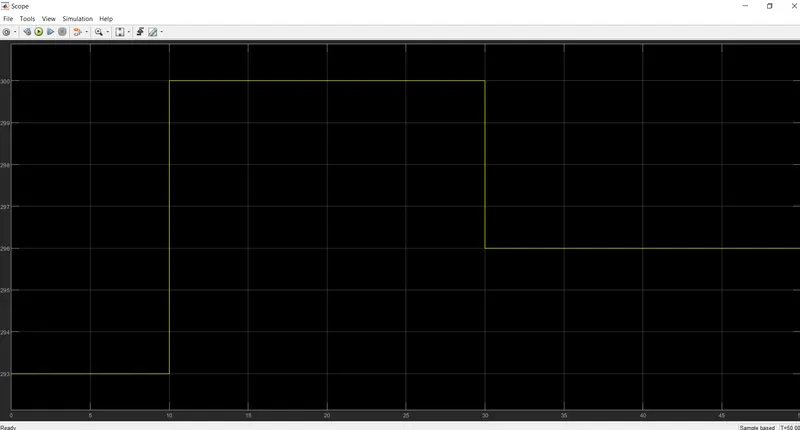
Output:
Temperature source: 20 °C from 0 to 10 seconds, 27 °C from 10 to 30 seconds, 23 °C from 30 to 50 seconds
Fan conditions: ON if the temperature above 25 °C, OFF otherwise