Week-4 Challenge WOT Condition Part-2
1.What is the difference between mapped and dynamic model of engine, motor and generator? How can you change model type?
Mapped engine: Mapped engine is the default settings in powertrain blockset.It is used to measure performance parameters of the vehicle by using standard lookup tables which are prefered to the system.This type of modelling is less accurate.The look up table values are based on the values of brake torque ,command torque and engine speed>if any other parameter like input engine temperature is selected then lookup table value are also a function of the temperature parameter.The data extracted from lookup tables are: air massflow,fuelflow,emission data,exhaust temperature and efficiency.The data is used to find out other parameters which are needed by the end user.
Dynamic engine:This type of model uses real time data fed by the user at run time for modelling .This model is accurate than mapped engine model.This type of model is used when the data of subsystems of a vehicle is required.We can calculate:Brake torque,fuel flow,port gas mass flow,exhaust temperature,exhaust mass flow rate and exhaust emissions.
Mapped motor:The mapped motor works in torque control mode.This type of motor is used when the user requires a faster simulation and doesnt have the knowlege of motor parameters.The output torque and reference torque is compared and changes are made .Input torque or speed can be specified,electrical losses and maximum motor power and torque can be defined.
Dynamic motor:In the dynamic motor a three phase interior permanent magnet synchronous motor(pmsm) is used.The block uses three phase input voltages to regulate the individual phase currents,allowing control of the motor torque or speed.This block is used when the user knows what parameters are to be used in that particular simulation.The motor is more accurate.
Mapped Generator:The mapped generator block is also similar like other blocks.Most of the data required is taken from the lookup tables corresponding to the given input parameters.Its simulation time is less.
Dynamic Generator:The dynamic generator involves user entering the parameters manually during the run time for their particular applications.The results take time and are more accurate.
To change between mapped and dynamic model:
- Open the powertrain module blockset for the required vehicle.
- click on passenger car/vehicle block and select electric plant or engine.
- Right click on engine/Ev motor/generator based on vehicle model and select variant.
- under variant, scroll to label model active choice and choose mapped or dynamic for the required calculation.
2.How does the model calculate miles per gallon? Which factors are considered to model fuel flow?
For a conventional gasoline vehicle,the fuel efficiency is calculated via miles-per-gallon(MPG).However,fuel efficiency for hybrid models is calculated via miles-per-gallon equivalent(MPEG).MPG is the number of miles your car can grive per gallon of gas.Figuring out an MPGe rating is little more complicated.Since engines that use an alternative source of fuel cant be measured by liquid gallons of fuel,the MPGe rating is calculated by figuring out the number of miles a vehicle can go using the same energy content as a gallon of gas.The EPA calculates that 33.7 kilowatt-hours of electricity is the equivalent to one gallon of gas.
In case of our Ev model,inside the visualization blpck we have another block named performance calculations.
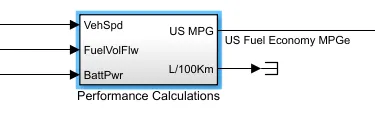
If we get inside this block we find the actual (MPG) calculations
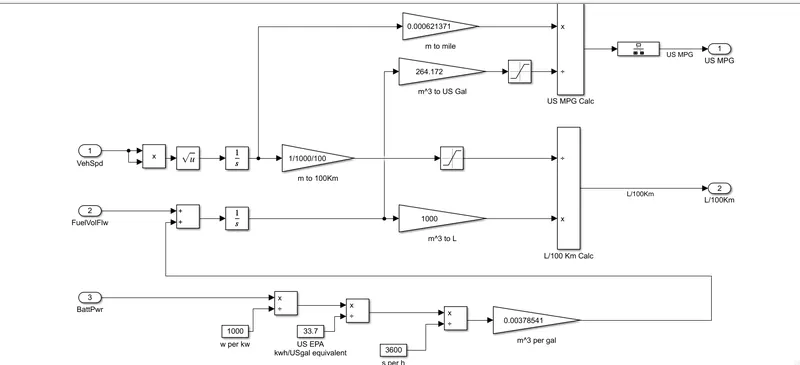
Here,three different inputs are taken into consideration:
- Vehicle speed
- Fuel flow
- Battery power
The vehicle speed input is in m/s which is converted into miles by multiplying with 0.000621371.
Similarly the kilogram of fuel is converted into cubic meter by multiplying by 1/(1000*0.739).
This cubic meter value is converted into gallons by multiplying it with 264.172 The mile value and gallon value is used to find MPG of the vehicle.
Now the battery value is initially converted from watts to kwh by dividing with 1000 and then to gallon equivalent by again dividing it with 33.7(since 33.7 kwh = 1 gallon)
Then divide the value by 3600 to get in per seconds and multiply by 0.00378541 to get the value in cubic meter per gallons.
3. Run the HEV ReferenceApplication with WOT drive cycle. Change the grade and wind velocity in the environment block. Comment on the results.
Model:
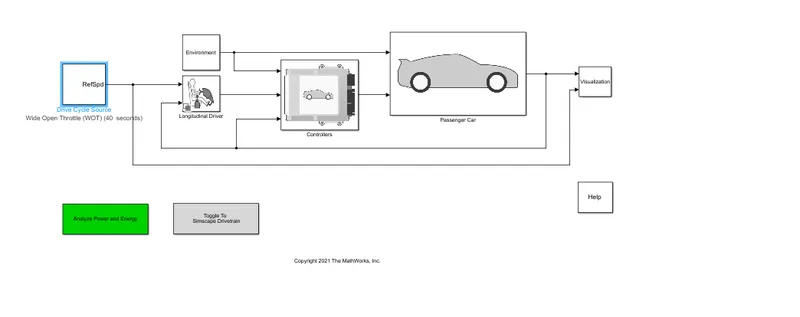
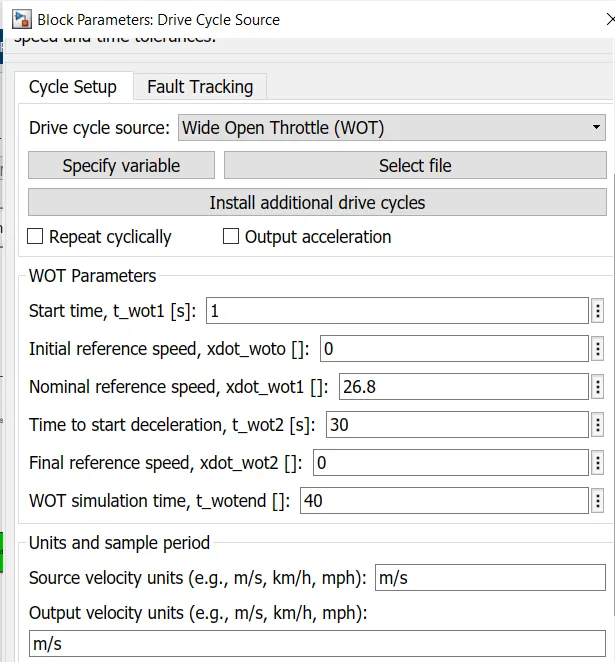
we have changed the drive cycle to wide open throttle(WOT) with a sample time = 40 sec.
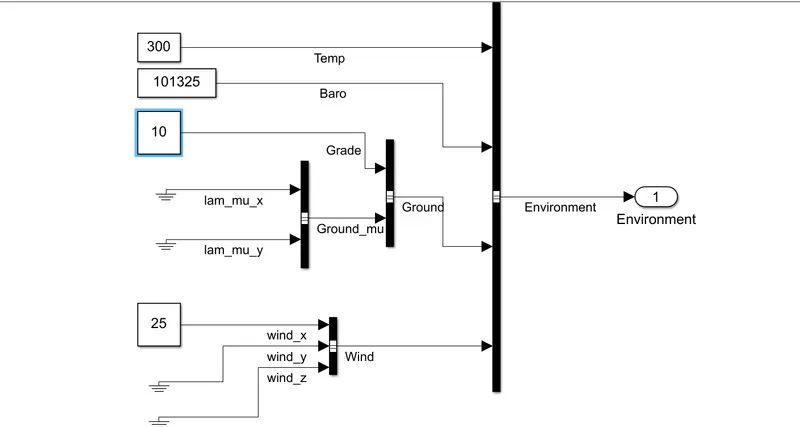
We have also altered the "Enviroment" block and changed wind speed to 25m/s and grade = 10.
The simulation was run for a time period of 40 seconds.
Input parameters:
Enviroment Block:
Results:
Conclusions:
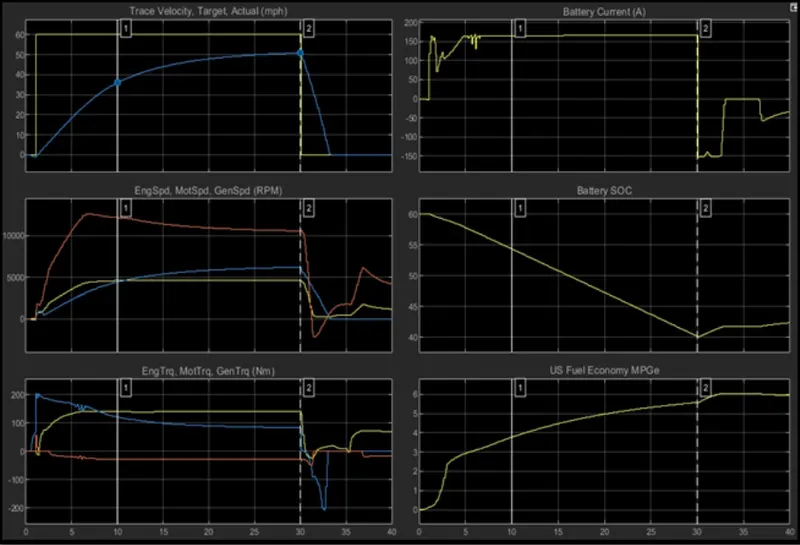
Plot1:Trace velocity Target actual:
Top velocity achieved = 50.1 mph
Time taken to accelerate = 29.034 sec
Time taken to decelerate = 3.226 sec
Plot 2:Motor and engine RPM:
Top motor RPM =12550 RPM
Top engine RPM = 6188 RPM
Plot3:Motor and engine torque:
Maximum motor torque = 50Nm
Maximum engine torque = 205.3 Nm
Plot4:Battery current:
The battery supply current is at its maximum value of 167 ampere when full throttle is applied by the user.It reduces drastically to the value of negative 150 during deceleration of the vehicle.
Plot5:Battery SOC:
The battery soc falls from 60%to40% during the acceleration of the vehicle and it increases slightly to 43% during deceleration due to regenerative braking.
PLot6:Fuel economy:
Maximum fuel economy achieved = 6.056
4. Keeping all other parameters same, compare the simulated results of hybrid and pure electric powertrains.
Simulated result of HEV:
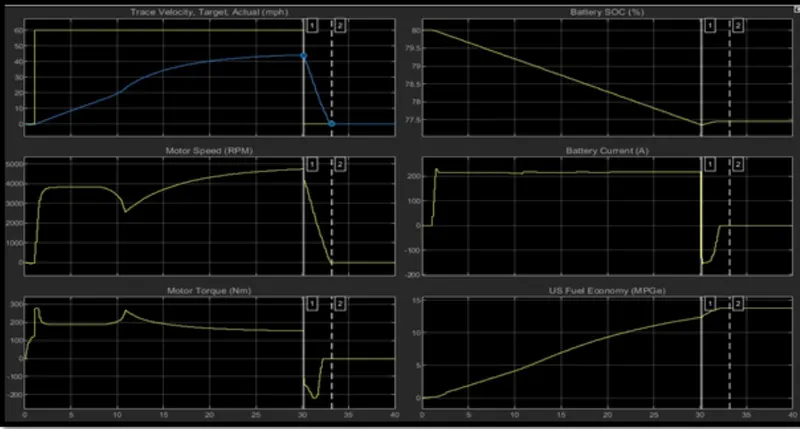
Simulated result of EV:
All the inputs are kept same:
Drive cycle -Wide open throttle(WOT)
simulation time - 40sec
Grade- 10
Wind velocity - 25m/sec
Conclusion:
- The top speed achieved by hybrid vehicle is more than that of pure ev.
- The battery capacity of pure EV is much more compared to that of HEV since in Ev battery is the only driving unit.
- Higher fuel economy is achieved in case of pur EV.