Week-6 Challenge: EV Drivetrain
1.POWER CONVERTERS:
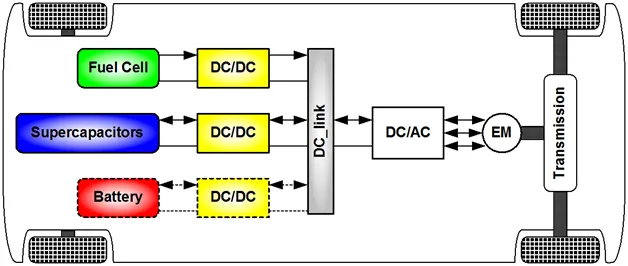
In electric vehicle and HEV, the power electronics converters are considered as the key elements that interface their power source to the drive train of the EVs. There are 3 types of converters widely used.
- AC-DC Converter (On-Board Charger)
- DC-DC Converter
- AC-DC Converter
AC-DC CONVERTER
On-board charging systems (OBCs) convert AC power from an external charging source into a DC voltage that is used to charge the battery pack in the vehicle. OBCs also perform other functions including charge rate monitoring and protection. With DC Fast Chargers, which plug directly into the quick charging connector, OBCs are bypassed. On-board charging systems take the AC input source, convert it to high voltage DC through the rectifier and provide Power Factor Correction (PFC). The resulting DC signal is chopped into a switched square wave, driving a transformer to create the required output DC voltage. The chopping of the input signal is accomplished using isolated gate drivers, such as Si8239x, Si823x, Si823Hx, and Si827x.
The output voltage is filtered to the final DC voltage using sync FETs under the control of additional isolated gate drivers. The output voltage can be monitored to provide closed-loop feedback to the system controller using isolated analog sensors.
DC-DC CONVERTER:
a DC to DC converter is a category of power converters and it is an electric circuit which converts a source of direct current (DC) from one voltage level to another, by storing the input energy temporarily and then releasing that energy to the output at a different voltage. The storage may be in either magnetic field storage components (inductors, transformers) or electric field storage components (capacitors).
DC/DC converters can be designed to transfer power in only one direction, from the input to the output. However, almost all DC/DC converter topologies can be made bi-directional. A bi-directional converter can move power in either direction, which is useful in applications requiring regenerative braking.
The amount of power flow between the input and the output can be controlled by adjusting the duty cycle (ratio of on/off time of the switch). Usually, this is done to control the output voltage, the input current, the output current, or to maintain a constant power. Transformer-based converters may provide isolation between the input and the output
The most common DC/DC converters can be grouped as follows:
- Non-Isolated converters
- Isolated converters
NON-ISOLATED CONVERTERS:
The non-isolated converters type is generally used where the voltage needs to be stepped up or down by a relatively small ratio (less than 4:1). There are five main types of converter in this non-isolated group, usually called the buck, boost, buck-boost, Cuk and charge-pump converters. The buck converter is used for voltage step-down, while the boost converter is used for voltage step-up.
The buck-boost and Cuk converters can be used for either step-down or step-up. The charge-pump converter is used for either voltage step-up or voltage inversion, but only in relatively low power applications.
ISOLATED CONVETERS:
Usually, in this type of converters a high frequency transformer is used. In the applications where the output needs to be completely isolated from the input, an isolated converter is necessary.
There are many types of converters in this group such as Half-Bridge, Full-Bridge, Fly-back, Forward and Push-Pull DC/DC converters
DC-AC CONVERTERS:
The DC-AC converter is required to convert the DC power to a suitable AC power for the electrical machine. The power output from battery pack is converted using inverter to be used in electric motor.
2.
- Motor controller Parameters:
Rated Armature Voltage = 72V
Rated armature current = 400A
Ra = 0.5Ω, kj= 0.7Volt second
Chopper switching frequency = 400Hz.
Tv = 24.7 + (0.0051)w2 ...............(1)
Duty cycle = 70%
Actual Voltage = 0.7*72 = 50.4V
Torque Equation for motor is
T = Vkj/Ra –((Kj)2/Ra).w
T = 50.4 * 0.7 /0.5 – (0.72/0.5).w
T = 70.56 – 0.98 . w …………………………………………………..(2)
Solving Eqn (1) and (2)
24.7 + (0.0051).w2 = 70.56 – (0.98).w
0.0051. w2+0.98w - 45.86 = 0
By solving the equations we get
w = 38.915 rad/sec and w = -231.072 rad/sec
So, the EV steady state speed if duty cycle is 70% is 38.915 rad/sec.
3. SIMULINK MODEL FOR THE EQUATION:
clear all
close all
clc

motor_speed = linspace(0,1000,50);
speed_constant = input('enter the value of motor speed constant');
voltage = input('enter the battery voltage');
ra = input('enter the value of armature resistance');
back_emf = 1;

% To find motor constant:
k_fi = ((back_emf*60)/(speed_constant*6.28));

% The DC machine characteristics equation:
T = ((voltage*k_fi)/ra -(((k_fi)^2/ra).*motor_speed));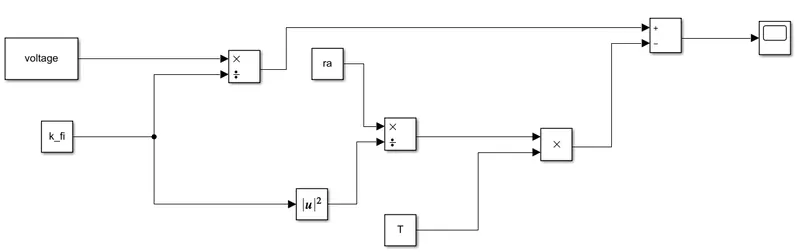

4. nduction Versus DC brushless motors by Wally Rippel, Tesla
- In the beginning, the author describes the dominance of Internal combustion engines in the world of automobile industry and also discuss different types of engines. He also explains that all the engines were similar and it was up to the user to select according to their requirement. He also explains about the induction motor and brushless DC motors.
- Then he explains about the working of 3 phase induction motor and brushless DC motor.
- He also explains about the advantages and disadvantages between the two motors.
- Induction motors have some advantages such as it has no magnets. The motor has the ability to start under the load. No inverter is needed. Some disadvantages are they cannot operate from DC power source. Shaft speed is proportionate to the line frequency. Hence, when used with the utility power, they are constant speed machine. When operated from utility power, they have limited starting torque and somewhat limited running peak torque capabilities.
- Brushless DC motors has some advantages such as much less rotor heat is generated with DC brushless drive. The peak point energy efficiency for a DC brushless drive will typically be a few percentage points higher than for an induction drive. Some disadvantages are: as machine size grows, the magnetic losses increases proportionately. Permanent magnets are expensive and difficult to handle.
- The author seems to agree that the DC brushless drives will likely to continue to dominate in the hybrid and coming plug-in hybrid markets.