Week-6 Challenge: EV Drivetrain
1) Which types of power converter circuits are employed in electric and hybrid electric vehicle?
AC to DC/ RECTIFIER :
- AC - DC converter. A rectifier is a device that converts an oscillating that converts two directional alternating current (AC) into a single directional direct current (DC). Use of rectifier in EV as charging of batteries.
- The essential components of a rectifier includes transformer, control block, filter and switching unit.
- Transformer adjust the primary AC source supply to the input of rectifier stage. Usually it is a step down transformer that reduce the supply voltage to a circuit operating range.
- The rectifier converts the low voltage AC supply to DC supply. It consists of diode / thyristors based on type of rectifier. the output of the rectifier is of pulse DC and hence it is filtered using filter circuit which is usually made with a capacitor or a choke.
DC to AC/ INVERTER :
- An inverter is a device used to convert the DC to AC power in a electric vehicle. The invverter can change the speed at which the motor rotates by adjusting the frequency of alternating current.
- Fixed DC voltage is obtained from batteries or by DC link in most power electronic converter. The output of the inverter can be variable or fixed AC voltage with variable or fixed AC voltage with variable or fixed frequency.
DC to DC CONVERTER :
- DC to DC converter is a category of power converters and it is a elcetric converter which converts a sourse of DC direct current from one voltage level to another, by storing the input energy temporarly and then releasing that energy to the output at a different voltage.
- The storage may be in either magnetic field storage components or electric field storage components.
- DC to DC converters can be used to interface the elements in the electric power train by boosting or chooping the voltage levels. It is used for auxiliary Ev.
2) An Electric Vehicle's powertrain with 72V battery pack in shown in the diagram below. The duty ratio for acceleration operation is 'd1' and for the braking operation the duty ratio is 'd2'.
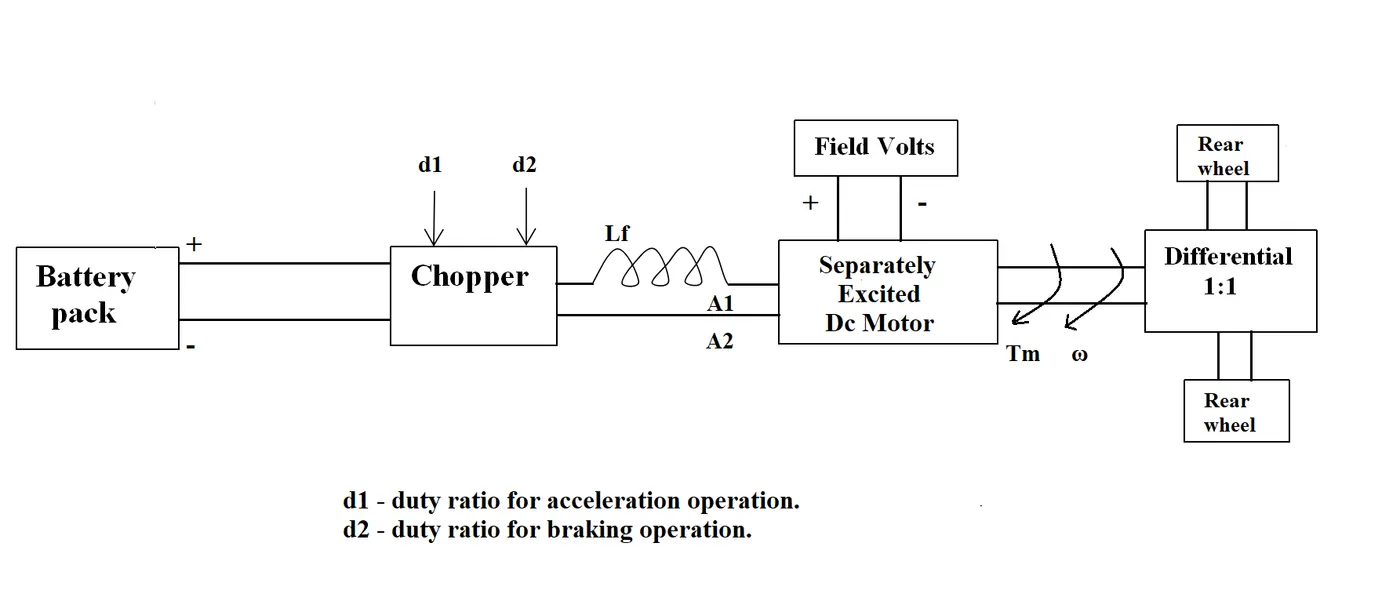
The other parameters of the electric vehicle is given below,
Motor and Controller Parameters:
Rated Armature voltage= 72 V
Rated armature current= 400 A
Ra= 0.5Ω, KΦ= 0.7 Volt second
Chopper Switching frequency= 400 Hz
The vehicle speed-torque characteristics are given by the below equation

What is EV steady state speed if duty cycle is 70%?
Using the torque formula, To find the speed in rad/sec
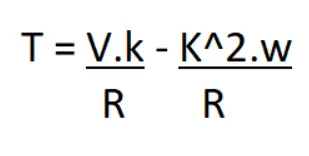
T = torque
V = armature voltage
R = resistance
W = speed rad/sec
Comparing the equations
24.7 + 0.00551*w^2 = ((v*k)/R) - ((k^2)*W/R)
24.7 + 0.00551*w^2 = (72*0.7*0.7)/0.5 - (0.7^2/0.5)*W = 24.7 + 0.00551*w^2
70.56 - 0.98*W = 24.7 + 0.00551*w^2
W^2 + 192.15*W - 8992.15 = 0
To find the roots of the following equations

As the speed value cannot be in negative value
W = 38.95 rad/sec
3) Develop a mathematical model of a DC Motor for the below equation using Simulink.
ω = V/Kϕ - Ra/Kϕ^2 .T
FILE LINK : https://drive.google.com/file/d/1KWDwSAUVo1VpUiA3J2D9g2a4egXvlVWv/view?usp=sharing
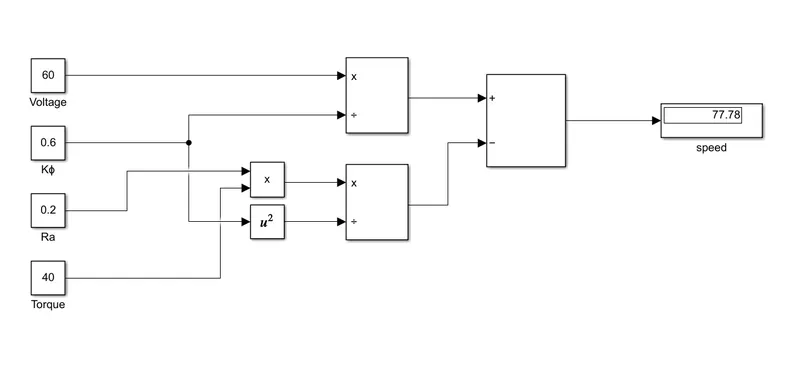
- The speed is determined with the help of mathematical model in simulink. By using the given formula ω = V/Kϕ - Ra/Kϕ^2 .T
- Scope block is used to give the values of voltage, torque, Ra, and Kϕ and the values are taken respectively.
- The subtraction, divide, product and square block are added respectively.
- To get the output display block is used.
4) Explain in brief about author’s perspective.
Refer to the blog on below topic:
Induction Versus DC brushless motors by Wally Rippel, Tesla
According to the blog by walley rippel, Tesla " Induction and brushless DC motor " the author mentioned about the positive and negative side of induction and brushless DC motor. The construction of both the motors are explained.
Induction motor :
- The induction motor basically uses a 3 phase induction motor which was discovered by nikola tesla 1889. In this motor it uses a steel laminated device instead of magnet. Current flowing in the stator windings produce a rotating magnetic field that enters into the rotar.
- The current interacts with the magnetic field generated by stator to produce a force which is required to produce rotor torque. The induction motor cannot be operated in DC voltage as it required AC current.
- It is used to reduce the magnetic losses and conduction losses. This will lead to increase the performance and it is used much and very efficient for high performance.
- The controlling or mechanism of induction motor is more complex. The torque generated is low and the motor temperature rises when it works at high speed.
DC brushless motor :
- The DC brushless motor uses more than 2 permanent magnet which generates a DC magnetic field. According to walley rippel the brushless dc motor needs a proper flow of current in rotar and stator if the voltage is not delivered properly the current will not be generated and the torque will be reduced.
- The brushless motor does not create any starting torque. To maintain electrical to mechanical conversion there should be a smooth flow of current.
- The main advantage in brushless DC motor is that there is low heat generation in the stator. The cooling capacity is better when compared to inducion motor.
Conclusion :
- According to the sensors, the DC brushless motor requires position sensors, whereas induction motor needs only speed sensor. The permanent magnet needs more maintanence and cost of the permanent magnet is comparetively high.
- According to the author the induction motor drive is only best for pure high performance EV. The brushless DC motor is are usefull for hybrid as well as plug in hybrid vehicles.