Week-6 Challenge: EV Drivetrain
AIM -
1. To determine the types of power converter circuits are employed in electric and hybrid electric vehicle.
2. To determine the EV Steady State Speed when the duty cycle is 70%.
3. To develop a mathematical model of a DC Motor for the equation using Simulink.
4. To explain the author's perspective on the given topic .
OBJECTIVE - 1
To determine the types of power converter circuits are employed in electric and hybrid electric vehicle.
1. AC -DC Power Convertor (Rectifier)
- Converts AC line voltage to DC battery voltage using rectifier
- Example - EV Charger
2. DC - AC Power Converter (Inverter)
- An Invertor is a circuit which transfer power from 1DC level to another AC Voltage or Frequency.
- Example - EV Motor Drive
3. DC -DC Power Converter (Chopper)
- Converts high DC Voltage to low DC Voltage or Viceversa.
- If we reduce voltage from High voltage to Low Voltage than it is called Step Down Chopper.
- If we increase the voltage from low voltage to High voltage than it is called Step up Chopper .
- Example - Power Auxilliary Head light ,Sound system etc.
OBJECTIVE- 2
To determine the EV Steady State Speed when the duty cycle is 70%.
GIVEN -
An Electric Vehicle's powertrain with 72V battery pack in shown in the diagram below. The duty ratio for acceleration operation is 'd1' and for the braking operation the duty ratio is 'd2'.
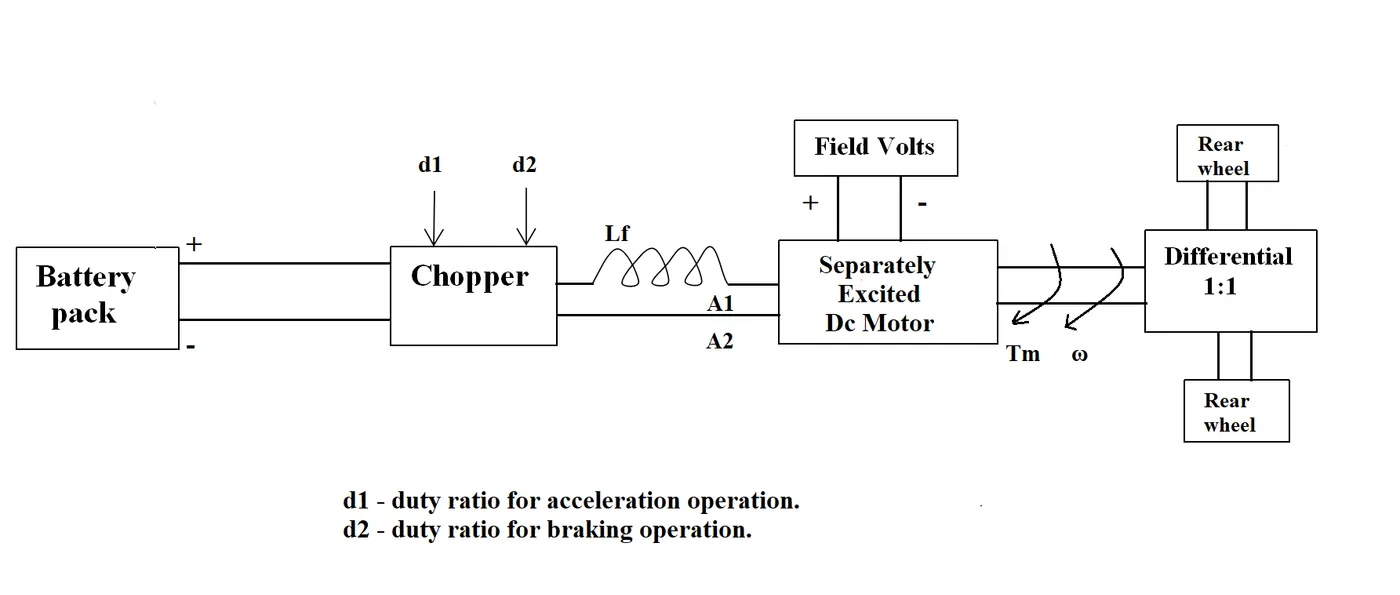
The other parameters of the electric vehicle is given below,
Motor and Controller Parameters:
Rated Armature voltage= 72 V
Rated armature current= 400 A
Ra= 0.5Ω, KΦ= 0.7 Volt second
Chopper Switching frequency= 400 Hz
The vehicle speed-torque characteristics are given by the below equation
 --------Eqn (1)
To Calculate - Steady state Speed
Solution -
We Know That -
Angular Speed equation of DC motor is given by -
ω">ω= V/Kϕ">ϕ -Ra/Kϕ">ϕ^2 .T
also ,
From the above equation
T = - ( KΦ)^2*ω/Ra + V ( KΦ) / Ra -------Eqn (2)
Given V = 72 v = 72 * 0.7 = 50.4 V
Putting all the given value in equation (2)
T = - ((0.7)^2*ω/0.5) + ((50.4)(0.7)/(0.5))
We get -
T = - 0.98 ω + 70.56 ----Eqn (3)
Equating Equation (1) and (3)
24.70 + (0.0051)*(ω)^2 = - 0.98 ω + 70.56
(0.0051)*(ω)^2 + 0.98 ω - 45.86 = 0
ω = - 230.39 rad/sec and ω = 38.23 rad / sec
OBJECTIVE 3 -
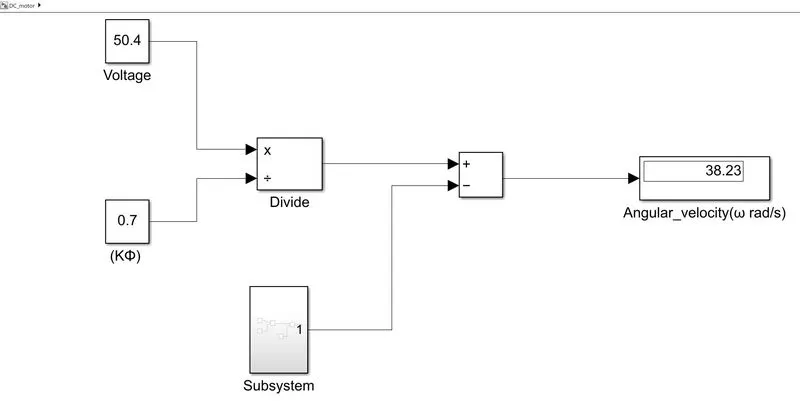
To develop a mathematical model of a DC Motor for the equation using Simulink.
Given Equation -
ω">ω= V/Kϕ">ϕ -Ra/(Kϕ">ϕ)^2
To calculate Angular Speed Value (rad/s)
Assuming Parameters -
V = 50.4 V
KΦ = 0.7 volt second
Ra = 0.5 ohm
T = 33.09 Nm
Simulink Model -
Subsystem -
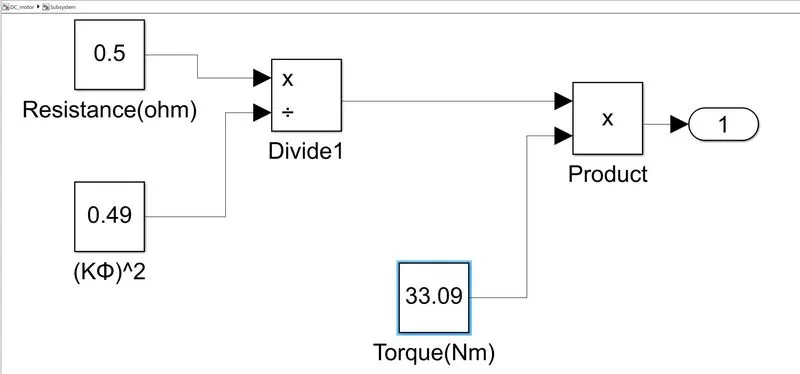
Conclusion - The valu of Angular Speed comes out to be 38.23 rad/sec .
OBJECTIVE 4 -
Author's Perspective Induction Versus DC Brushless Motors.
- Author show the interest in the new technologies like EV and HEV ,
- He mentioned the difference between 3 phase Induction motor and DC brushless motor.
- With brushless machines, the rotor includes two or more permanent magnets that generate a DC magnetic field (as seen from the vantage point of the rotor). In turn, this magnetic field enters the stator core (a core made up of thin, stacked laminations) and interacts with currents flowing within the windings to produce a torque interaction between the rotor and stator. As the rotor rotates, it is necessary that the magnitude and polarity of the stator currents be continuously varied – and in just the right way - such that the torque remains constant and the conversion of electrical to mechanical energy is optimally efficient. The device that provides this current control is called an inverter. Without it, brushless motors are useless motors.
- 3-phase induction motor is connected to utility type 3-phase power, torque is produced at the outset; the motor has the ability to start under load. No inverter is needed. (Were an inverter needed, Tesla’s invention would have been useless until sometime in the 1960s.) The fact that induction motors are directly compatible with conventional utility power is the main reason for their success. In contrast, a brushless DC motor produces no starting torque when directly connected to fixed frequency utility power. They really need the aid of an inverter whose “phase” is maintained in step with the angular position of the rotor.
CONCLUSION -
- Author differentiate the EV and HEV also the types of converters used in the modern Vehicle .
- Author also discuss about the best possible option available in the market.