Week-6 Challenge: EV Drivetrain
1)
- Types of Power converters used in Hybrid and Electric Vehicles.
- EV charger (AC to DC)
- Motor Drive (DC to AC Inverter)
- Chopper (DC to DC)
- Cycloconverter (AC to AC)
2)
Given:
Motor and Controller Parameters:
Rated Armature voltage= 72 V
Rated armature current= 400 A
Ra= 0.5Ω, KΦ= 0.7 Volt second
Chopper Switching frequency= 400 Hz
Duty cycle=70%
The vehicle speed-torque characteristics are given by the below equation
Consider Vt-àOutput voltage from Battery,
Tt-àVehicle Torque similar to Tv
Ω=((Vt/kØ)-(Ra/ (kØ) 2)).Tt
We know that duty cycle=70%,
i.e., Vt = Vbat * Duty cycle.
=> Vt =72 * 0.70
=> Vt =50.4
Ω=(50.4/0.7)-(0.5/(0.7) 2). Tt
Tt =(72- Ω)/1.020
Tt =70.58-0.98 Ω
But we know that,
Tv=24.7+0.0051 Ω2
Comparing Tv and Tt,
24.7+0.0051 Ω2 =70.58-0.98 Ω
0.0051 Ω2+0.98 Ω-45.88=0
(Ω-38.92)( Ω+231.08)=0
=> Ω=38.92,-231.08
Since speed cannot be a negative, consider only the positive value,
Therefore EV steady state speed is 38.92 radian/sec.
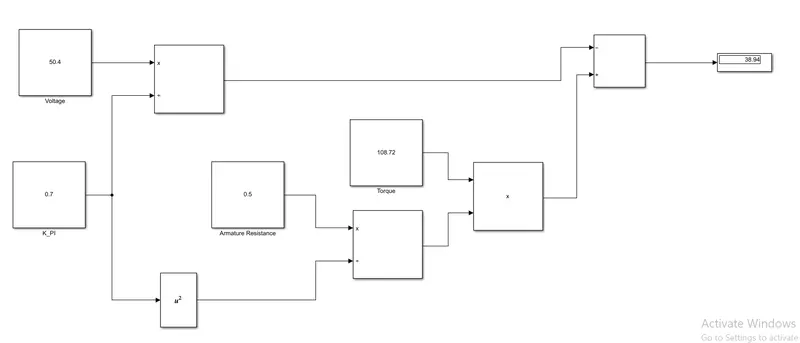
3)The mathematical model for
Ω=((Vt/kØ)-(Ra/ (kØ) 2)).Tt
4)
According to Wally Rippel,
DC Brushless motor:
Rotor includes two or more permanent magnets that generate a DC magnetic field. The magnetic field enters the stator windings, the current flows through the windings such that there will be a torque interaction between rotor and stator. The polarity and magnitude of the stator current has been continuously varied, so that torque becomes constant results in conversion of electrical to mechanical energy. Inverter plays a major role in current control.
Induction motor Drive:
Arrangement of stator for DC Brushless and Induction motor are similar. The major difference is with rotor. There is no permanent magnet with rotor, Only steel stacked laminations. Current flowing in the stator produces rotating magnetic field in the stator.
Observations between DC Brushless and Induction motor:
When 3-phase induction motor is connected to the 3-phase power, torque is produced. The motor has the ability to start under load without any inverter.
DC Brushless motor do not have any starting torque when connected to the conventional utility. Inverter needs to be connected with the BLDC motor for maintaining angular position of the rotor.
The major drawback of Induction motor is that, works only on AC, not on DC.
This drawback can also be overcome by adding inverter. Variable Speed can also be possible by altering inverter frequency. Torque performance can also be altered by adding some feedback loops so that inverter helps to achieve motor desired output.
Induction motor/BLDC:
The conclusion is that DC brushless drives will likely continue to dominate in the hybrid and coming plug-in hybrid markets, and that induction drives will likely maintain dominance for the high-performance pure electrics. The fact that so much of the hardware is common for both drives could mean that we will see induction and DC brushless live and work side by side during the coming golden era of hybrid and electric vehicles.