Week-6 Challenge: EV Drivetrain
AIM
1. which type of power converter circuiuts are employed in electric and hybrid vehicle
1. AC to DC power converter (rectifier)
this phenomena as a converter is used in the charger circuit, where the power source is AC and battery used to store the power is of DC
rectifier is an electrical device that converts alternating current to direct current,
it consist of two types full and half wave
half wave
full wave
2. DC to AC power converter (inverter)
this phenomena as a converter is used in the circuit bw motor and the battery, where the battery stores and delivers its o/p as DC and the motor used is AC single or three phase motor, inverter is an electrical device that converts direct current to alternating current
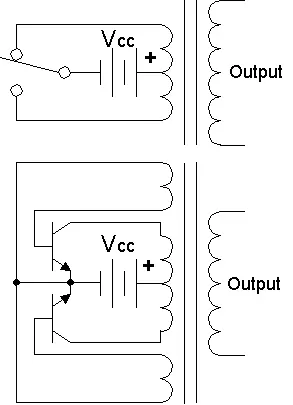
3. DC to DC power converter (chopper)
chopper is a device that converts fixed input DC to variable DC output voltage
in EV and HEV automobiles its used to step up and step down the battery voltage for the auxillaries which are usually rated less voltage than that of the battery voltage

2. what is EV steady state speed if the duty cycle is 70% for the given EV powertrain with motor characteristic of
rated armature voltage = 72v
rated armature resistance = 0.5ohm
rated armature current = 400A
k`phi`= 0.7
chopper switching frequency = 400Hz
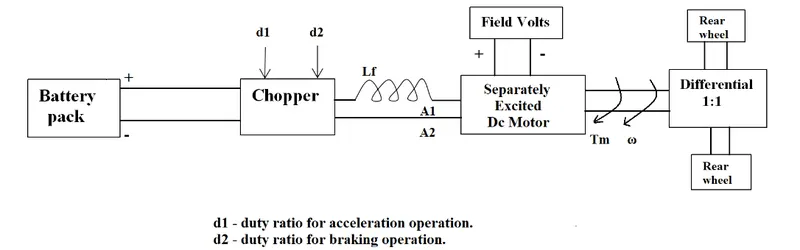
vehicle speed-torque characteristics given as [ Tv = 24.7 +0.0051`omega`^2]
staedy state in an EV means that the state at which the motor and the vehicle characteristics match together
duty cycle = 70% ie 70/100 = 0.7
Vo avg= Vbatt* d
Vo = 72*0.7
Vo = 50.4v
from speed- torque relation from the motor
`omega`= (v/k`phi`) - (Ra/k`phi`^2)*T
rearranging the equation for T = [(V*k`phi`)/Ra]-[(k`phi`^2)/Ra]*`omega`
substituting the values in equation we get T= (50.4*0.7)/0.5 - 0.7^2/0.5*`omega`
ie T= 70.56 - 0.98`omega`
both the motor and vehicle characteristcics are in the mathematical expresson, solving both would form a qaudratic eqaution, where it can be solved for `omega`
T= 24.7 +0.0051`omega`^2 and T= 70.56 - 0.98`omega`
ie 0.0051`omega`^2 + 0.98`omega`- 45.89 = 0
`omega` = 38.92 rad/sec
3. refering to the blog https://www.tesla.com/blog/induction-versus-dc-brushless-motors, explain in brief about authors perspective
this blog is all about AC induction motors and DC brushless motors, its construction, control stratergies, efficiency and cost
DC brushless motors
a DC brushless motor rotor includes two or more magnets, stator comprises of thin stacked laminations
works on the basics of torque interaction between rotor and the stator
an inverter is used to vary the magnitude and the polarity of the stator current
less rotor heat is generated with the DC brushless drive and cooling is easier
peak point efficiency is generally higher for this drive. The DC brushless drive can also operate at unity power factor
there is no easy way of changing B with permanent magnets, which results in more losses
Permanent magnets are expensive , difficult to handle due to very large forces that come into play when anything ferromagnetic gets close to them
Induction motors
an induction motor rotor has no magnets its comprised of stacked steel laminations with buried peripheral conductors that form a “shorted structure.”
Currents flowing in the stator windings produce a rotating magnetic field that enters the rotor. Accordingly, an induced voltage exists across the shorted structure ,. In response to this voltage, currents are produced within the rotor conductors that are approximately proportionate to the voltage, hence the speed difference. Finally, these currents interact with the original magnetic field to produce forces a component of which is the desired rotor torque.
3 phase induction motor can start under load, no need of inverter, cannot operate in DC,
constant speed machines, have limited starting torque and somewhat limited running peak torque capabilities, when compared to DC type machines.
torque performance is low compared with DC machines.
best power factor for the induction drive is about 85 percent
induction motors will likely retain a cost advantage over PM machines
the field weakening capabilities of induction machines, inverter ratings and costs appear to be lower, especially for high performance drives. Since spinning induction machines produce little or no voltage when de-excited, they are easier to protect.
Induction machines are more difficult to control. The control laws are more complex and difficult to understand. Achieving stability over the entire torque-speed range and over temperature is more difficult with induction than with DC brushless. This means added costs,
in the upcoming future theres a possibility of combination of both Dc brushless and AC induction motors coupled to work together, where AC induction motor has dominance in high performance sector and the DC motor has its own advantages.