Week-6 Challenge: EV Drivetrain
1. Usually converters are used in an electric appliance or in an electric circuit to regulate the power flow from a lower level to a higher level and vise versa.
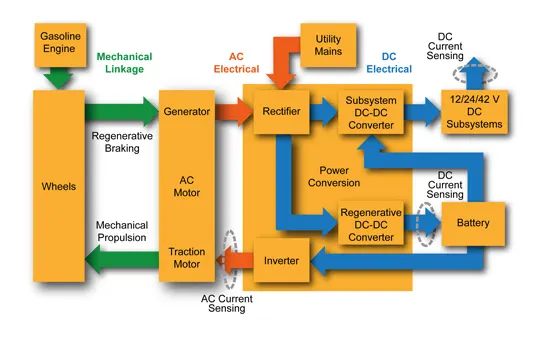
Typical HEV system block
Now-a-days we use various power converters in an electric/hybrid vehicle depends on the functions it has to be performed. They are likely:
(a) Rectifier(AC -> DC) -- EV Charger(Bidirectional Converter for Plug-In Electric Vehicles;
Bidirectional Battery Charger for an Electric Vehicle;
Integrated Bidirectional Converters for Plug-In HEV Applications;
AC–DC Converter for Plug-In Hybrid Vehicle;
Bidirectional Resonant Converter)
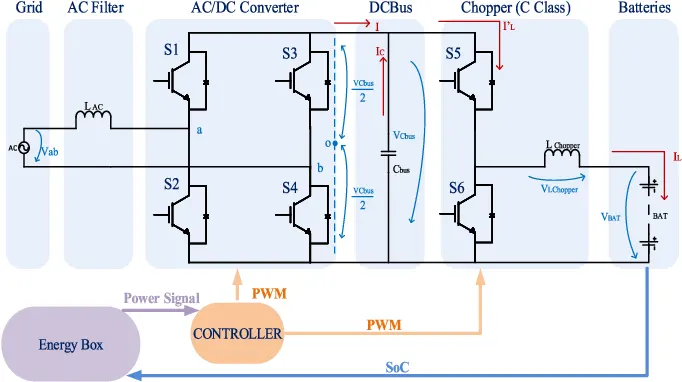
Bidirectional Battery Charger for an Electric Vehicle
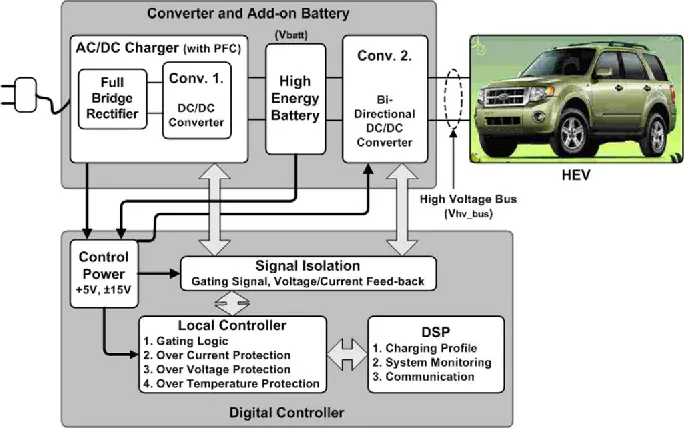
Integrated Bidirectional Converters for Plug-In HEV
(b) Inverter(DC -> AC) -- Motor Drive
(c) Chopper(DC -> DC) -- Bidirectional DC-DC Converter for Ultra-Capacitor Applications;
Auxillary System in the car (Audio system, Touch display, Back camera, Headlights, USB charger, etc.,)
Bidirectional DC-DC Converter for Ultra-Capacitor
(d)Isolated Bidirectional AC–DC Converter for a DC Distribution System
Bidirectional T-Type Converter Topology for EV Applications
Multilevel Two-Quadrant Converter for Regenerative Braking
Multiphase Integrated On-board Charger for Electric Vehicle.
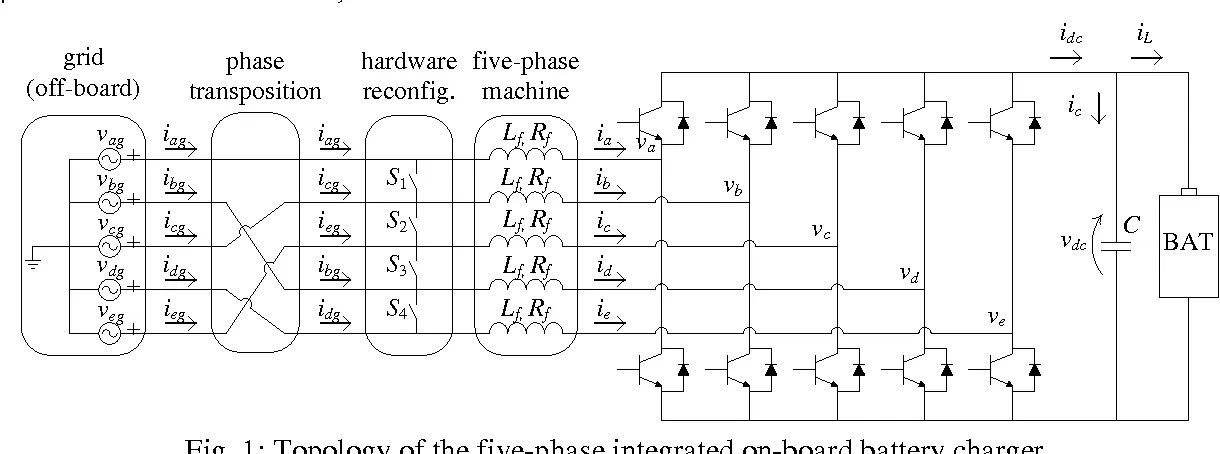
Multiphase Integrated On-board Charger for Electric Vehicle
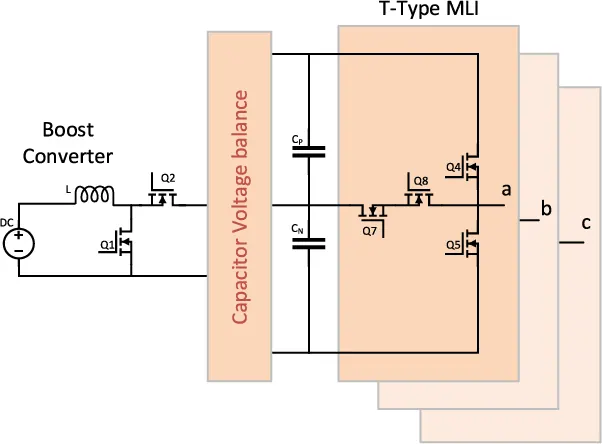
Bidirectional T-Type Converter Topology for EV
2.
Given,
Armature voltage = 72V
Armature current = 400A
Ra = 0.5ohm
K'phy' =0.7Volt second
chopper frequency = 400Hz
Tv = 24.7+(0.0051)ω^2
As duty cycle = 70% then,
V = 72*0.70 = 50.4
w.k.t ω = ((V/K'phy') - (Ra/(K'phy')^2)))*T
=> T = ((V*K*ϕ)/Ra) - ((ω*(K*ϕ)^2)/Ra) --- (a)
Substitute values in eq(a)
T =((50.4*0.7)/0.5) - (ω*(0.7)^2)/0.5) => T= 70.56 - 0.98ω --- (b)
Equate (a)&(b)
0.0051ω^2 +0.98ω -45.86 = 0
ω = 38.914 , -231.071
Therefore ω = 38.914 rad/sec.
3.
Wally Rippel, who is a long-time developer and advocate of battery electric vehicles, has a prominent role labeled as himself, "Research Engineer, AeroVironment". He became very famous for his work on Volkswagen Micro Bus in 1958. He had very close exposure to electric vehicles for a quite long time. He has witnessed the both DC motor and Induction motor era in EV.
He had clearly explained the pros and cons for both DC motor and I.Motor which are widely used, and he inferred each characteristic with a keen explanation.
Based on speed-torque characteristics, peak power delivered, overall efficiency, the average power of the motor for a driving cycle.
In EV's we use a Brushless DC motor as commutator motor's results in more losses. This consists of permanent magnets which will induce a magnetic field in the stator lead to rotation of the motor due to fleming's principle.
As DC motor is considered Te=Ka*'flux'*Ia
=Bav*I*l*Z*r (r-- airgap radius;l-- conductor length; Z-- no. of conductors; Bav-- flux density)
Bav = (P*'flux')/(2*3.14*r*l)
So we can use this motor for high torque applications even under low speeds, can attain peak efficiency, speed control can be achieved by varying the armature & field flux with a wide range of speeds.
It can't start under loaded conditions, permanent magnets are expensive, very large forces come into play when anything ferromagnetic gets close to them, low performance, magnetic losses are present.
As Induction motor is considered Te= K*V1^2*s
= (I2^2*r2)/(2*3.14*Ns*s) [I2,r2-- secondary side current,resistor;
Ns-- synchronous speed; s-- slip]
K= Kt/r2 where Kt`prop` Vs^2
Now, coming to the Induction Motor it can't offer high torque but an average steady-state torque can be attained, efficiency is high, can start at loaded conditions, at light loads the inverter can reduce voltage such that magnetic losses are reduced and efficiency is maximized.
The main issue we face here is the peak efficiency, speed control is difficult, complex control circuit.
At last, he concluded that both have their best pros which are very essential for a successful vehicle operation with fewer losses and high efficiency throughout the driving cycle. He also thought of a dual-motor(DC & I.M) in the vehicle which can be switched as per the requirement.