Week-6 Challenge: EV Drivetrain
Q1 : Which types of power converter circuits are employed in electric and hybrid electric vehicle?
A motor drive consists of a power converter and the controller. The power electronic convertor handles the flow of bulk power from the source to the motor input terminals. The controller process the command input and the feedback information to generate the switching signals for the power concerter semiconductor switches.
The power concertor can be a DC drive supplying a DC motor or an AC drive supplying an AC motor.
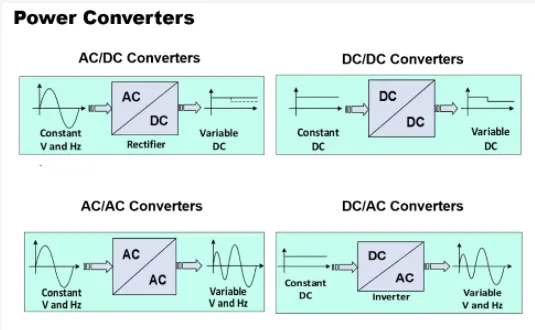
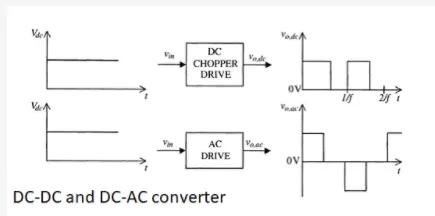
A DC/Dc convertor in its basic form converts unregulated DC input voltage at a certain level to regulated DC output voltage at a different level with very high conversion efficiancy.These are operated at very high frequency.The switches are turned ON and OFF by pulse width modulation.
The power convertor is made of high power fast acting semi conductor devices,such as bipolar junction transistor. There are some other transistors such as MOSFET,IGBT,SCR,GTO,MCT . these devices are used as on-off electronics switch to convert the fixed supply voltage into a variable voltage and variable frequency supply.
All these devices have a control input gate or base through which the devices are turned ON and OFF as per the command generated by the controller.
There are two types of step converters that is When a low voltage input is converted into a high voltage it is a step-up converter and when a high voltage input is converted into a low voltage output it is a step down converter.
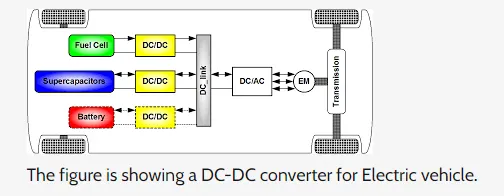
Q2:An Electric Vehicle's powertrain with 72V battery pack in shown in the diagram below. The duty ratio for acceleration operation is 'd1' and for the braking operation the duty ratio is 'd2'.
Given EV characteristics equation :
Tv = 24.7 + 0.0051ω^2
Rated armature voltage , Es = 72V
Rated armature current , Ia = 400A
Ra = 0.5Ω,KΦ = 0.7V-s
Chopper switching frequency = 400Hz
Also it has been stated that duty cycle is 70%
D = 0.7
Solution :
Torque speed relationship for a motor is given by the following equation:
Tm = (KΦ*Es*D)/Ra-(KΦ^2/Ra)*ωm
Also the no load speed of a motor is given by
Tm = KΦ*Ia
The gear ratio will be taken as 1 since it is given 1:1 on the differential
Hence G = 1
Therefore ωm = ω and Tm = Ttr
On substituting the values of the parametersin the torque motor formula
Tm =(0.7 * 72 * 0.7)/0.5 - (0.7^2/0.5) * ω
ω^2 = 8992.156 - 192.151 * ω
ω^2 + 192.151 * ω -8992.156 = 0
On solving we get
ω = 38.91 rad/s
Q3: Explain in brief about author’s perspective.
In the blog of induction and DC brushless motor, the author has mentioned about positive and negative side of both the induction and DC motor.
In case of DC motor ,permanent magnets are used which produces a rotating magnetic field . This magnetic field when induces a current in the conductors results in force generation in the rotor and this results in rotation of the rotor
Whereas in case of the induction motor , the current is supplied to the stator which results in the generation of emf, when this emf comes in contact with the rotor which is generally a squirrel cage type abd results in current induced in the rotor. Unlike the DC motor, the rotor consists of conductor plates and placed in a cage like structure. This also consists of bars around them in which current get induced and the rotor starts rotating .
One of the main difference is that much less rotor heat is generated with the DC brushless drive. Rotor cooling is easier and peak point efficiancy is generally higher for this drive. It is mentioned that the DC brushless can drive at unit power factor, whereas the best power factor for the induction drive is 85%.
In case of DC brushless motor, the strength of the magnetic field is adjustable . When at low speed the maximum torque is required magnetic field should be maximum. ie inverter and motor current maintained at their lowest optimize efficiency. Whereas there is no such adjustment in case of induction motor.
As machine suze grows, magnetic losses increases proportionally and part load efficiency drops. In case of induction motor, as machine size grows, losses do not necessarily grow.
The construction of DC brushless motor is costly compared with an induction motor,due to the use of permanent magnets.
The author concludes that there is no clear winnerto prefer one over the other .He states that Dc brushless drives are better fit for hybrid electric vehicles and AC induction drives are better for high performance pure electric vehicles.He hopes in the future that these two motors can work side by side .