Week-6 Challenge: EV Drivetrain
Question 1:
Solution:
There are basically three types of power converters employed in a vehicle and which are as follows:
a) AC to DC Converters(Rectifier): As the availibility of DC Source is very limited as an electrical outlets in every places so the basic operation of a Rectifier is to convert the alternating current(AC) to the direct current(DC) which is to be required for various electrical appliances. Nowadays for rectification purpose semiconductor diodes of various types like Junction Diodes, Schottky Diodes, etc. are widely used. There are various types of rectifier used according to the requirement which are as follows:
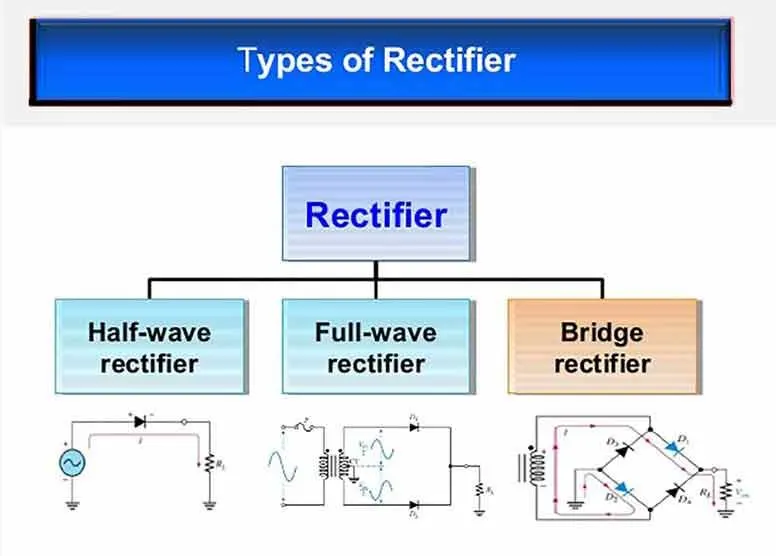
According to the application purpose these rectifiers are used such as for low power applications Single Phase Full wave or Half Wave rectifiers are used whereas for Industrial application Three Phase full wave rectifiers are widely used.
b) DC to AC Converters(Inverters): Inverter just do the opposite of the Rectifier which is to convert the DC to AC. The overall performance parameters like Input Voltage, frequency, Output Voltage, etc. depends on the circuit configuration. Inverters are basically used in various electrical power applications where handling of high currents and high voltage is utmost important. A typical power inverter circuitry requires a stable DC power source can capable of providing huge amount of current according to the requirement. For the purpose of handling the current these inverters are classified as follows:
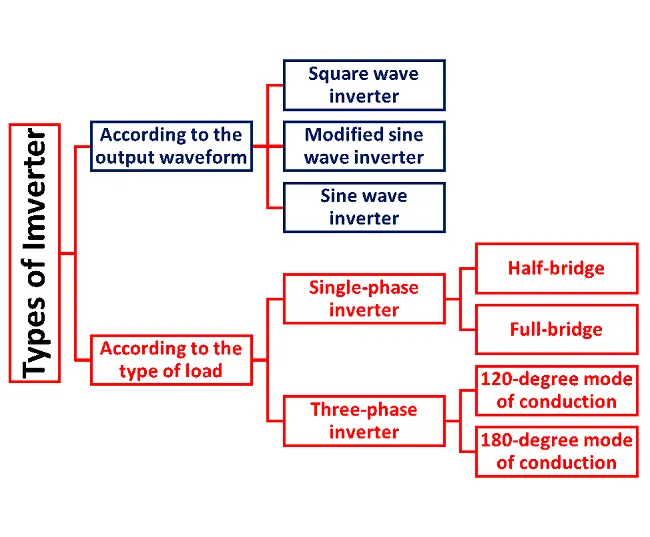
c) DC to DC Converter(Chopper): A Chopper is a very useful device when it comes to fast switching and also in power control and signal applications. It is a device which converts fixed DC input to a variable DC output. In Power Electronics domain all the switching element used are either fully ON or fully OFF so therefore its losses are low and the circuit can work with a high efficiency. However the amount of current going into the load is discontinuous and may require smoothing or a high switching frequency to avoid noise or interference from harmonics and this is the reason Choppers are widely used. Generally there are two basic types of Chopper used whic are as follows:
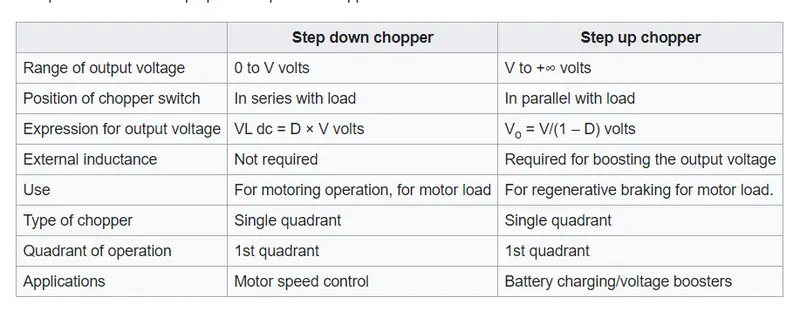
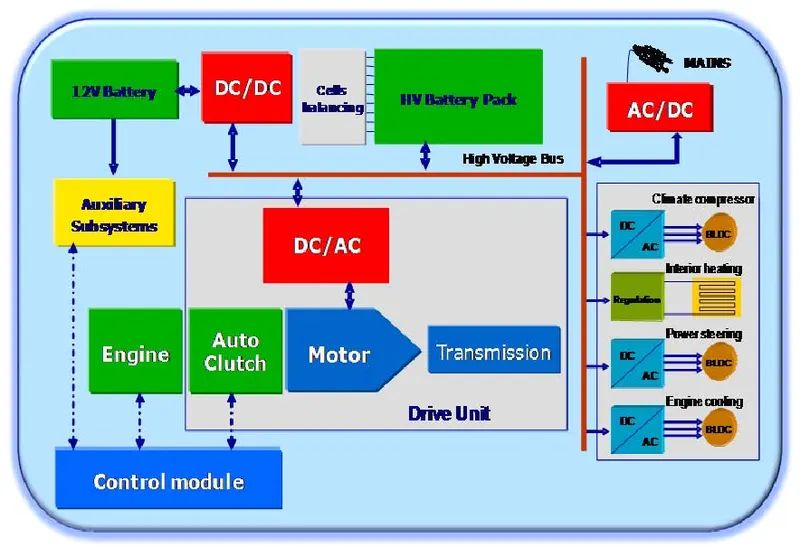
So after getting an Overview of the Power Converters, the arrangement of the Power Converters in the EV and HEV vehichle are as follows:
In EV Vehicle:
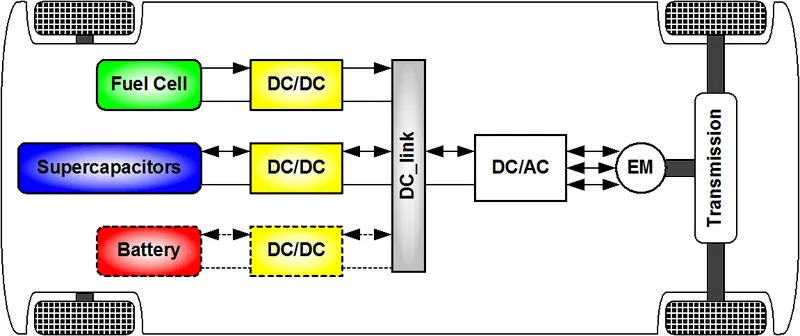
In HEV vehicle:
Question 2:
Solution:
Given: Battery Voltage-72V
Rated Armature Current-400A
Armature Resistance(R)-0.5`Omega`
K`phi`-0.7Volt second
Chopper Switching Frequency-400Hz
Duty Cycle(D)-70% or 0.7
Now, The Torque Speed equation of a DC Motor is given by:
`T=((Kphi)*V)/R-((Kphi)^2*omega)/R`
By comparing this value of T with the Torque-Speed characteristics given in the question as follows:

we get:
`((Kphi)*V)/R-((Kphi)^2*omega)/R=24.7+(0.0051)*omega^2`
Here V is the average voltage which is D*Battery Voltage.
Therefore, V=0.7*72=50.4V.
Now in the equation, Putting the value of all the constant parameters given above we get the ultimate equation as:
`0.0051*omega^2+0.98*omega-45.86=0`
Using Sreedhar Acharya Formula, the value of speed will come as:
`omega=(-0.98+-sqrt(0.98^2-4*0.0051*(-45.86)))/(2*0.0051)`
Neglecting the -ve value of the Speed as it is practically impossible,
The ultimate value of the speed will come as:
`omega=38.9149`rad/sec
In RPM it will be:
N=371.8RPM.
Therefore this will be the Steady State Speed of EV at 70% Duty Cycle.
Question 3:
Solution:
From the author's point of view, vehicle parts has come across a long way starting from engine to batteries to motors. Where engine types are nowadays customised according to performance and personal requirements, batteries are modified from lead acid to lithium type and DC motors are upgraded to either Brushless DC or Induction Motor. Now according to the author Wally Rippel, it is very much hard to predict which parts of the vehicle will get modified or obsolete in the coming future but one thing he can surely say that there will be no replacement of Brushless DC or Induction Motor in the Motor segment in the coming years due to its unique advantages.
The author now presented a brief introduction of both the Motors along with its advantages of one over the other, where starting from the Construction- DC Brushless Motors consists of Rotor which includes two or more permanent magnets that generate a DC magnetic field which in turn interacts with the magnetic field of the Stator core thereby producing the current which ultimately produce the required Torque however as the Rotor rotates for maintaing a constant torque it is necessary to continuously vary the magnitude and the polarity of the Stator current in the right way and this basically done by connecting an Inverter in between the DC input and the Motor.
From the Induction Motor perspective, the Stator constructon is same as that of the Brushless DC but the Rotor doesn't consists of any magnets but instead it is just a stacked steel laminations with peripheral conductors that ultimately form a Shorted structure. Here also the Current flowing in the Stator windings produces a rotating magnetic field that interacts with the Rotor conductors and thereby prodcuing a magnetic field whose frequency is less than that of the Stator frequency and the Rotor starts moving at a Slip Speed. This field then produces the current which will interact with the Stator field and ultimately produce the Rotor Torque. Here initially as the magnetic field of both the Stator and the Rotor winding is varying in nature with 120deg phase shift so Starting Torque will get generated easily and so no inverter is required unlike Brushless DC Motor. Thus according to the author this is the major advantage of Induction Motor as it can get easily compatible with conventional utility power.
Now the author gives us an overview of the advantage and disadvantage of both the motors which are as follows:
Advantages of Brushless DC Motor over Induction Motor:
- It can be easily operate from a DC source.
- It produces High Starting Torque and High Peak Torque than the Induction Motor.
- Less Rotor Heat is generated while working thereby less cooling arrangement is required.
- Brushless DC Motor can operate at unity power factor thereby providing higher efficiency whereas for Induction Motor it can be maximum 85%.
- Induction motor are very difficult to control because achieving stability over the entire Torque-Speed range and over the corresponding temperature is very complex and cumbersome, which is not the case for Brushless DC Motor.
Advantages of Induction Motor over Brushless DC Motor:
- No inverter arrangement is required thereby making the design less complex that Brushless DC.
- As Induction machine does not contain any Permanent magnet so the value of the Magnetic Intensity(B) can be adjustable by Voltage to Frequency control technique thereby at lighter loads the value of B will be less which will reduce the losses(Hysteresis and Eddy Current) to a great extent and maximize the efficiency. This advantage of the Induction Motor is extremely crucial at higher performance where we can efficiently control the losses unlike the Brushless DC counterpart.
- With Brushless DC as the machine size grows the magnetic losses also gets increased significantly thereby reduces the efficiency to a great extent, however for Induction Motor as the value of B depends only on the Voltage and the Frequency so it is independent of the Machine size and thereby the losses are constant w.r.to size.
- Brushless DC Motor are expensive due to high cost of Permanent Magnet which is not the case for Induction Motor.
Therfore in Conclusion the author Wally Ripple predicted that DC Brushless Drives will continue to dominate the Market of HEV and Plug-in HEV vehicles whereas Induction Motor Drives will predominate in the market of High Performance Pure EV.