Week-6 Challenge: EV Drivetrain
Aim:
* To determine the types of power converter circuits are employed in electric and hybrid electric vehicle.
* To determine the angular Velocity and speed torque of the motor with respect to the given requirements.
* From the given Blog, Explain in brief about author’s perspective.
Solution:
1) Determining the types of power converter circuits are employed in electric and hybrid electric vehicle:
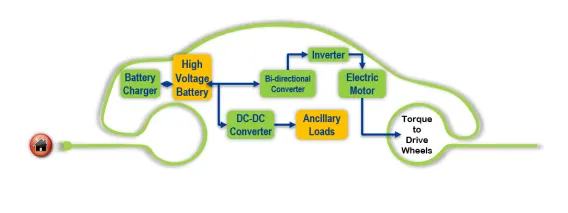
* DC-DC converters are designed to transfer power in only one direction, from the input to the output in the Electric Vehicle.
* Unidirectional DC-DC converters cater to various onboard loads such as sensors, controls, entertainment, utility, and safety equipments.
* A bi-directional converter can move power in either direction, which is useful in applications requiring regenerative braking.
* Almost all DC/DC converters are made as bi-directional.
For Electric Vehicles:
i) Charging:
* Since, most of the charging points are given as AC supply for storing the current into a battery, which provides only DC, Rectifier is Needed.
ii) Battery to Motor:
* Motor might be Brushless DC motor type or AC Induction Motor.
* So, If AC induction Motor is used, It should be used with an invertor right after a battery to supply AC voltage to the motor.
* If DC brushless motor is used, It should be ised with an inverter to generate a SQUARE WAVEFORM, controls the Motor Torque.
* To step down the voltage CHOPPER is used so far.
For Hybrid Vehicles:
i) Charging:
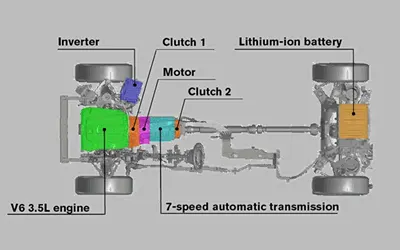
* The battery is charged by using DC generator, also called as DYNAMO.
* Nowadays, the alternators are used, that produces AC current. So, the rectifiers are used to convert to DC current for charging the battery.
* Besides the generator, there is a power converter between the battery and electric motor for converting the DC to required AC current.
* If DC Brushless motor is used, It is used to convert DC to square wavweform.
2) Determining the angular Velocity and speed torque of the motor with respect to the given requirements:
Given Data:
Motor and Controller Parameters:
Rated Armature voltage= 72 V
Rated armature current= 400 A
Ra= 0.5Ω, KΦ= 0.7 Volt second
Chopper Switching frequency= 400 Hz
The vehicle speed-torque characteristics are given by the below equation
 --(1)
--(1)
Torque Speed Equation:
T = ((Km*φ*Es)-(Km*φ)^2)*w/0.5) --(2)
T = (((0.7*72*(70/100))/0.5)-((0.7^2)*w/0.5)
T = 70.56 - 0.98w --(3)
Putting (3) in (1)
24.7 + (0.0051)w^2 = 70.56 - 0.98w
0.0051w^2 - 0.98w - 45.86 = 0
When subsitiuting by using POLYNOMIAL EQUATION:
w = 38.9 rad/s
w = -281.9 rad/s.
3) From the given Blog, Explain in brief about author’s perspective:
* The author says about the working of the DC brushless and AC induction motor. He compares and contrasts about the DC and AC motor. Here are some points below:
DC brushless:
* Incompatible and also Conventional type motor, with 3 phase AC supply, and Inverter is required.
* Operates in DC
* The rotor has permanent magnet, which is somehow difficult to handle.
* Using Permanent Magnet, The magnetic field and the magnetic losses are not under control.
* The peak point efficiency is higher.
* Since the magnet is permanent, it is not able to control the loss.
AC induction:
* Compatible with conventional type motor, with 3 phase AC supply
* Cannot Operate with DC, hence Inverter is must needed.
* Rotor does not have Permanent magnet, hence it is easier to handle.
* The Magnetic field and the magnetic losses are not under control.
* The maximum efficiency is 85%
* Since the magnet is small, the loss can be able to control.
Hence, The author concludes that the Electric vehicles do come with AC induction motors, with higher efficiency and more performance.
And moreover, the motors are to be controlled and also should be minimized and maximized of the currents. Thus, The pure Hybrid, PHEV do prefer in the future over the AC induction Motor.
Result:
The determination of the types of power converter circuits are employed in electric and hybrid electric vehicle and the angular Velocity and speed torque of the motor with respect to the given requirements are done.
From the given Blog, Explain in brief about author’s perspective also has compared between the AC induction and DC brushless motors.