Week 5 - Turbulence modelling challenge
Objective:
- To do a literature review of various turbulence models explained in the Turbulence modeling video (Week-5) and explain why DNS isn’t feasible according to Kolmogorov's scale.
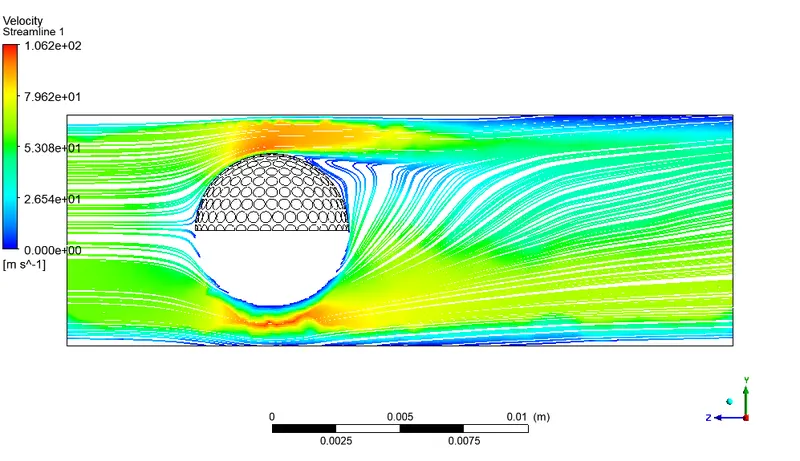
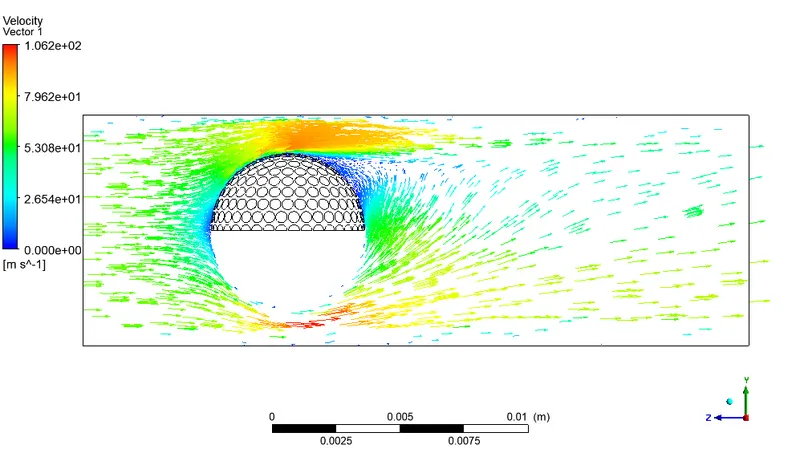
- To performs a 3D simulation and explain the recirculation region using velocity vectors.
- To explain the direction the ball will curve by visualizing the wake region.
Turbulence Model:
- Single equation models
- Spalart–Allmaras (S–A)
The Spalart–Allmaras model is a one-equation model that solves a modeled transport equation for the kinematic eddy turbulent viscosity.It was designed specifically for aerospace applications involving wall-bounded flows.
- Two equation models:
- k–ε (k–epsilon)
K-epsilon (k-ε) turbulence model is the most common model used in computational fluid dynamics (CFD) to simulate mean flow characteristics for turbulent flow conditions. Two-equation turbulence models allow the determination of both, a turbulent length and time scale by solving two separate transport equations. This model is based on model transport equations for the turbulence kinetic energy (`k` ) and its dissipation rate (`epsilon` ). - k–ω (k–omega)
In computational fluid dynamics, the k–omega (k–ω) turbulence model is a common two-equation turbulence model that is used as a closure for the Reynolds-averaged Navier–Stokes equations (RANS equations). The model attempts to predict turbulence by two partial differential equations for two variables, k and ω, with the first variable being the turbulence kinetic energy (k) while the second (ω) is the specific rate of dissipation (of the turbulence kinetic energy k into internal thermal energy). - SST (Menter’s Shear Stress Transport)
SST (Menter's shear stress transport) turbulence model is a widely used and robust two-equation eddy-viscosity turbulence model used in computational fluid dynamics. The model is a blend of the k-omega turbulence model and K-epsilon turbulence model such that the k-omega is used in the inner region of the boundary layer and switches to the k-epsilon in the free shear flow. - Reynolds stress equation model
The Reynolds stress equation model (RSM), also referred to as the second-moment closure model, is the most complete classical turbulence modeling approach. Popular eddy-viscosity-based models like the k–ε (k–epsilon) model and the k–ω (k–omega) models have significant shortcomings in complex engineering flows. This arises due to the use of the eddy-viscosity hypothesis in its formulation. Abandoning the isotropic eddy-viscosity hypothesis, the RSM closes the Reynolds-averaged Navier-Stokes equations by solving transport equations for the Reynolds stresses, together with an equation for the dissipation rate.
Why DNS isn’t feasible according to Kolmogorov's scale?
The number of points of discretized length N = L/dL, Thus for N to be maximum dL should be minimum in order to account for the smallest possible eddies.
`dL_(max) = eta`
Where `eta` is the minimum size of eddies:
`eta = (nu^3/epsilon)^(1/4)`
where `epsilon = U^3/L_(max size of eddies)`
Thus the ratio of the largest to the smallest eddies is.
`L/eta = (Re)^(3/4)`
thus `N_(min)` `prop` `(Re)^(3/4)` and thus for 3-D analysis it would be `(Re)^(9/4)` thus the grid size has to be small enough to capture the smallest possible eddies.
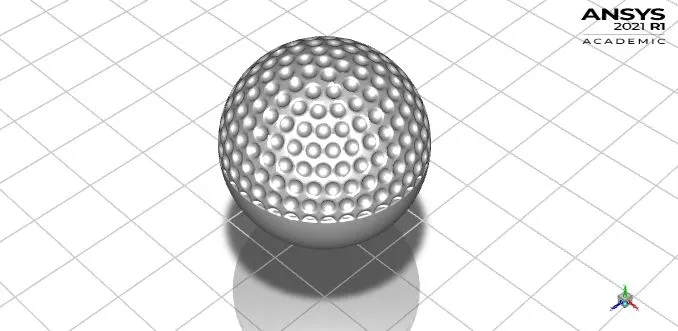
Geometry:
Mesh:
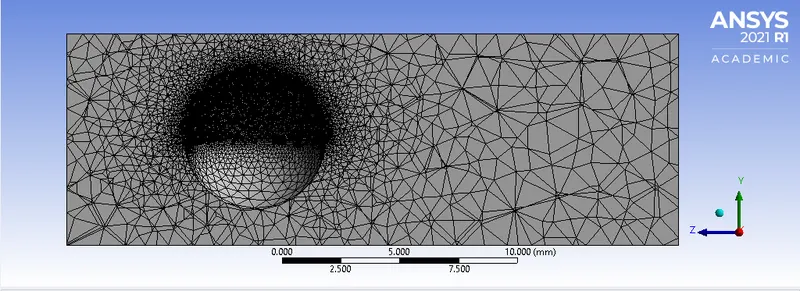
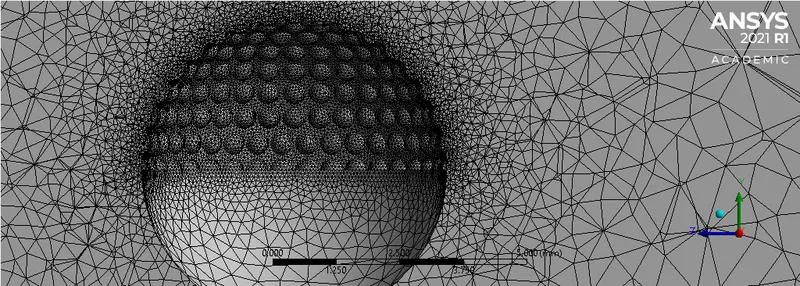
- The mesh was course as due to the limitation of a maximum number of elements in the academic version.
Setup:
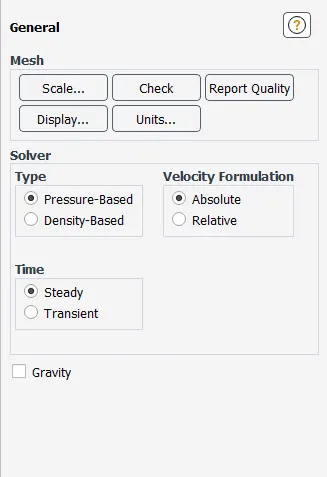
- General:
- Viscous model:
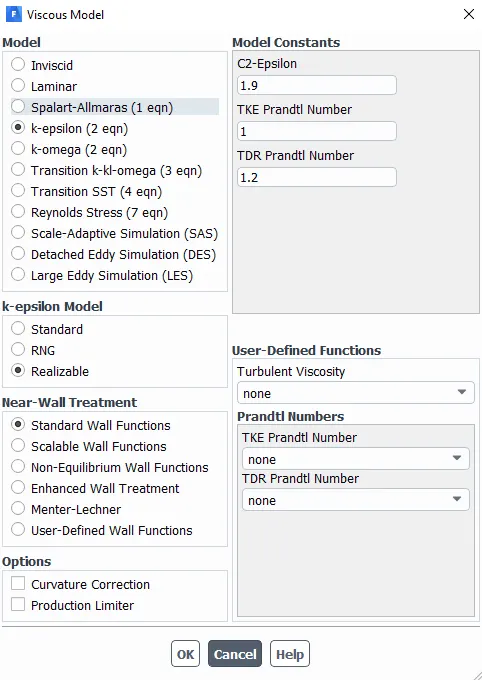
- Boundary condition:
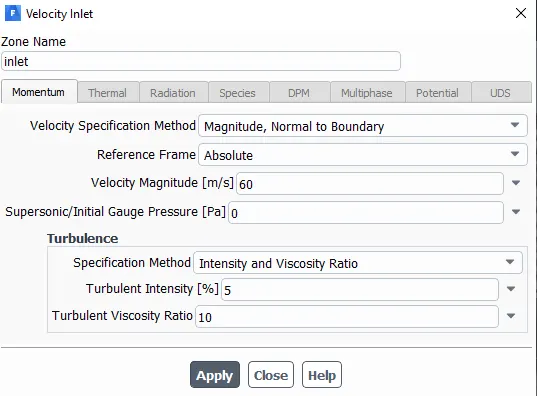
Results:
- Pressure contour:
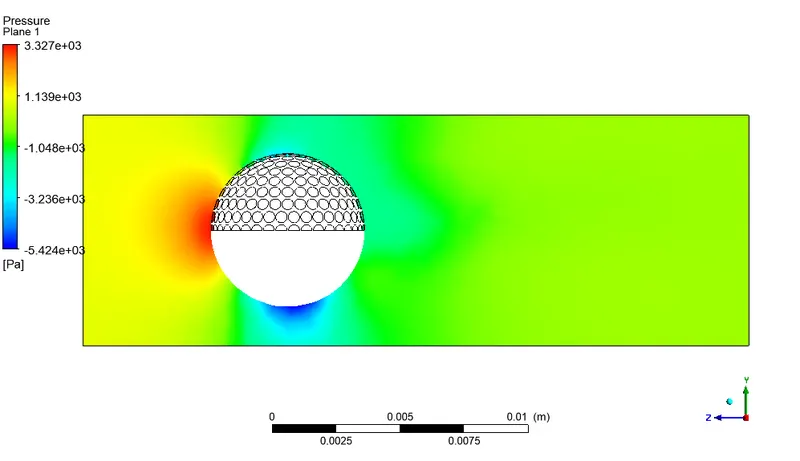
- Velocity Contour:
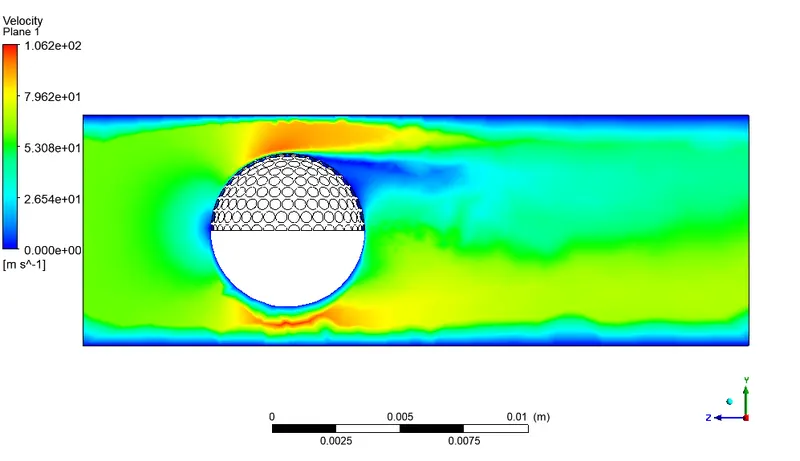
- Velocity Streamlines:
- Velocity Vectors:
Conclusion:
From the streamline and vector plot, it can be easily inferred that the wake region is created in the side which is smooth will in turn help in moving the ball towards the direction of dimples. Thus the upward direction.