Week 5 Sphere pressing on a plate
Objective:
We perform analysis to simulate a sphere pressing on plate. Both plate and Sphere and Plate is structural steel but plate has structural steel non-linear. The sphere should press 4mm into the plate and retract it to reveal a plastically deformed plate.
Setup:
We need to add Structural Steel NL from general materials non linear in the engineering data as the first step. Once that is done we load the geometry by importing the model. After opening the geometry in spaceclaim we update the model. After the updation open the mechanical module. Once opened name the parts as sphere and plate while assigning the plate Structural Steel NL. After that delete the default contact and then manually add one. The new contact will be surface of the sphere and the top surface of the plate to be the target. Changing the contact type to frictional and giving a frictional coefficient of 0.74, rest of the settings are kept as default for connections. Selecting the model at the top of the tree and then select symmetry. From the symmetry we insert symmetry region for two surfaces in the X axis and Z axis direction. Once that is done we give a sizing for the plate with a mesh size of 1.5mm and leaving the sphere with defualt mesh size. Update the mesh and then moving onto the analysis settings we split up the process into 4 steps change the solver type to direct and switch on large deflection, rest all settings of analysis settings is kept default. We then give a fixed support to the bottom surface of the plate, and a displacement to the top surface of the sphere by giving tabular values of -2,-4,0 and 0. After giving the values of dsiplacement the required solutions are selected and the simulation is run. The coeeficient of friction value was determined from Roy Mech tribology tables.
Directional Deformation in Y axis:
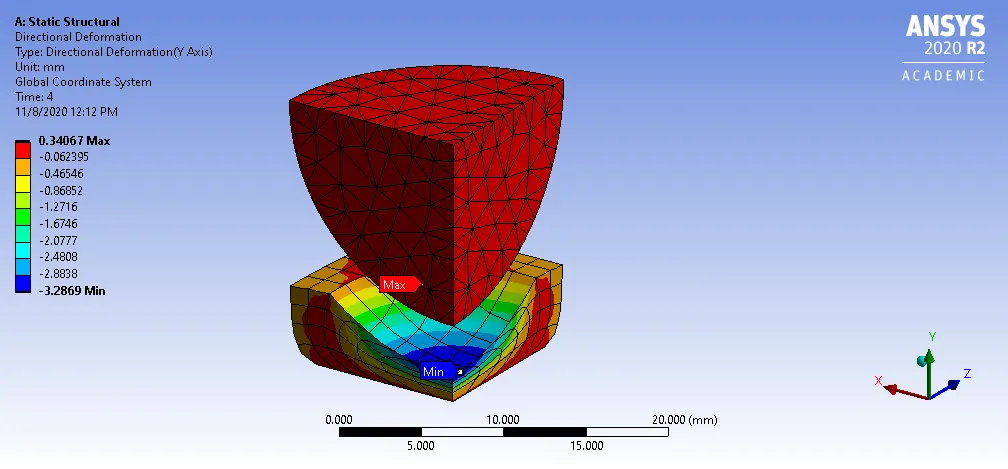
As you can see in the above picture that the minimum deformation along y axis occured at the point of initial contact with the sphere, which means that it has the least movement from its initial position in the surface. Also the fact that the plate didnt move back up after the removal of the sphere indicates that the deformation has occured in the plastic region.
Equivalent Strain:
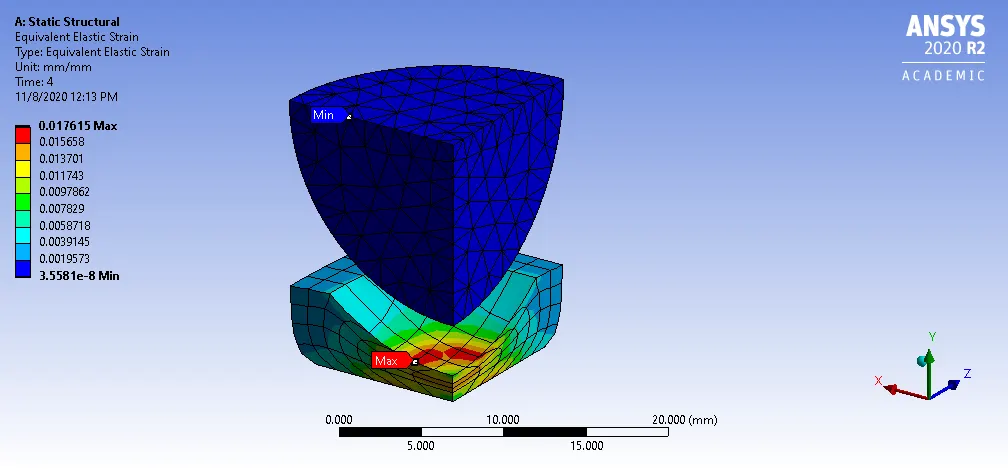
As expected the maximum strain has occured on the plate where the maximum deformation has occured. The maximum strain that occured is 0.017615 mm/mm.
Equivalent Stress:
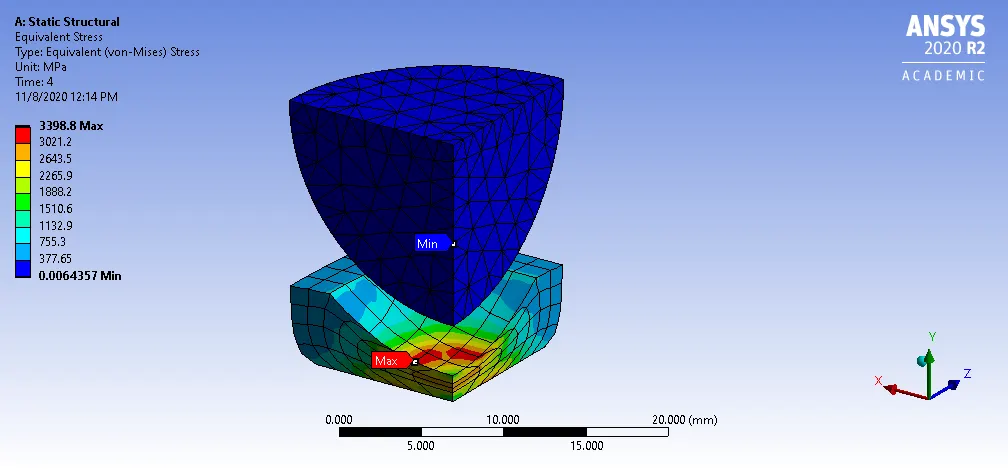
The maximum stress and maximum strain coincides in the location. The maximum stress thats produced was 3398.8 MPa.
The plate was plastically deformed which was clear from the non return of the plate to its original shape after the lifitn of the sphere. The maximum stress and strian occured at the point where the deformation occured or at the plastic region.