Week 5 Sphere pressing on a plate
Aim: Statis structural analysis of sphere pressing on plate.
Procedure:
Open Static structural model in ansys workbench.
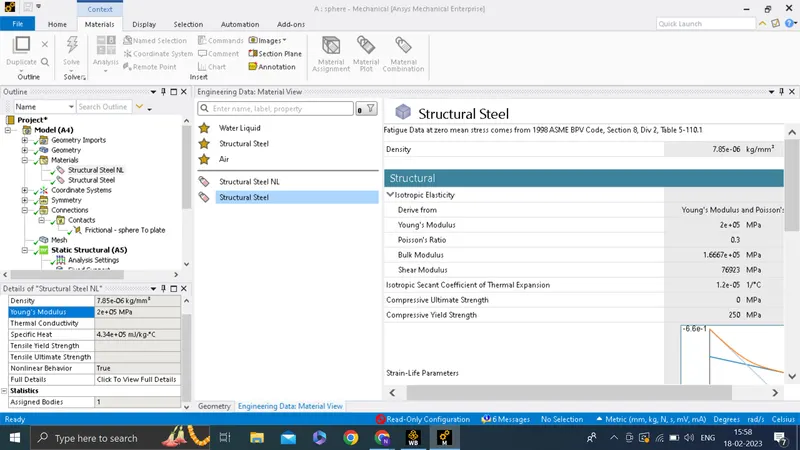
open engineering data tab and select required material, here we select Structural steel, & Structural steel NL. and the mechanical property of the material as per given below
Structural steel
Density : 7850 kg/m³
Young's Modulus: 2e+11 Pa
Poisson's Ratio: 0.3
Bulk Modulus: 1.6667e+11 Pa
Shear Modulus: 7.6923e+10 Pa
Isotropic Secant Coefficient of Thermal Expansion: 1.2e-05 1/°C
Isotropic Thermal Conductivity: 60.5 W/m·°C
Specific Heat Constant Pressure: 434 J/kg·°C
Isotropic Resistivity: 1.7e-07 ohm·m
Tensile Yield Strength: 250 MPa
Compressive Yield Strength: 250 MPa
Tensile Ultimate Strength: 460 MPa
Compressive Ultimate Strength: 0
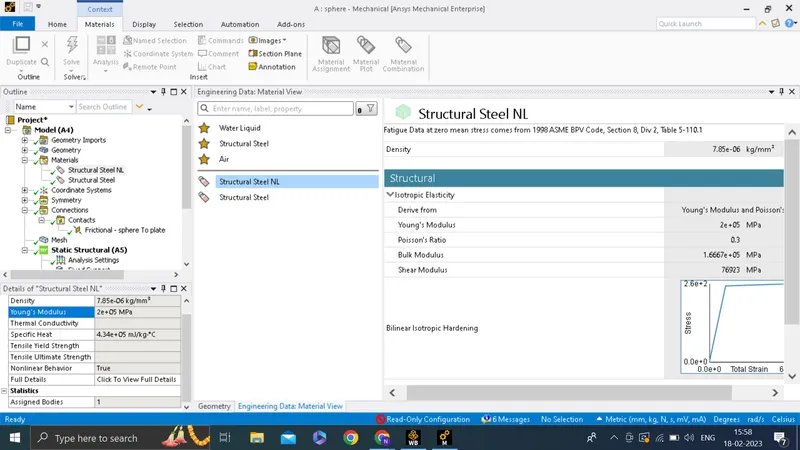
Structural steel NL
Density : 7850 kg/m³
Young's Modulus: 2e+05 MPa
Poisson's Ratio: 0.3
Bulk Modulus: 1.6667e+11 Pa
Shear Modulus: 7.6923e+10 Pa
Specific Heat Constant Pressure: 434 J/kg·°C
Now import geometry in spaceclaim in ansys workbench and check the geometry .
after looking all good we cloce spaceclaim and uodate model and open mechnaical module in ANSYS workbench
again we expand the geometry tan and rename material as per convenient as here we give name as sphere and plate.
assign plate material as Structural steel NL and shere as structural steel.
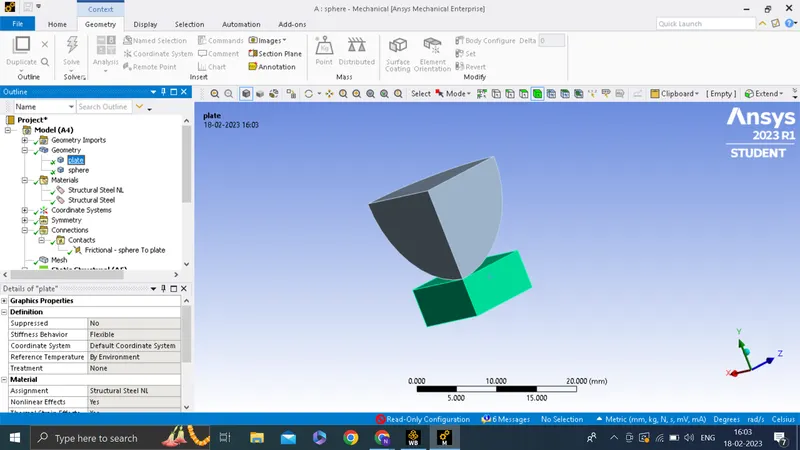
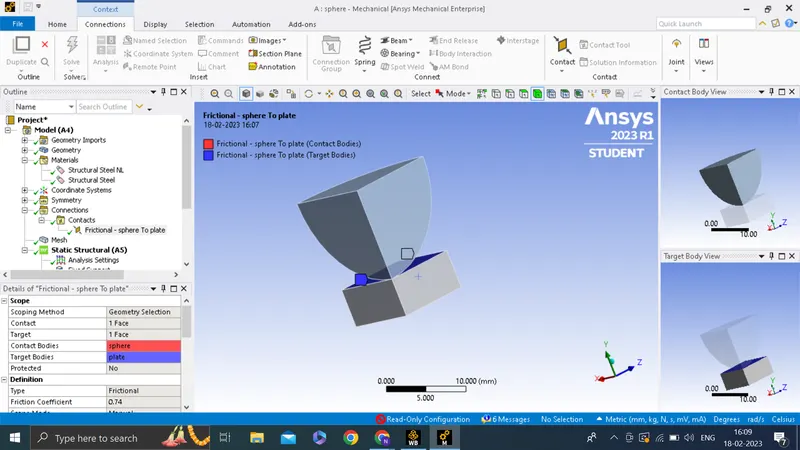
for connection : we delete default generated contact and generate manual contact region,
set sphere as contact and plate as target ,
select contact face - outer face of sphere,
target face: upper face of plate
type : frictional
frictional co-efficient : 0.74
Fromulation : augmented lagrange
Interface treatment : add offset, ramped effect
update stiffness: each iteration 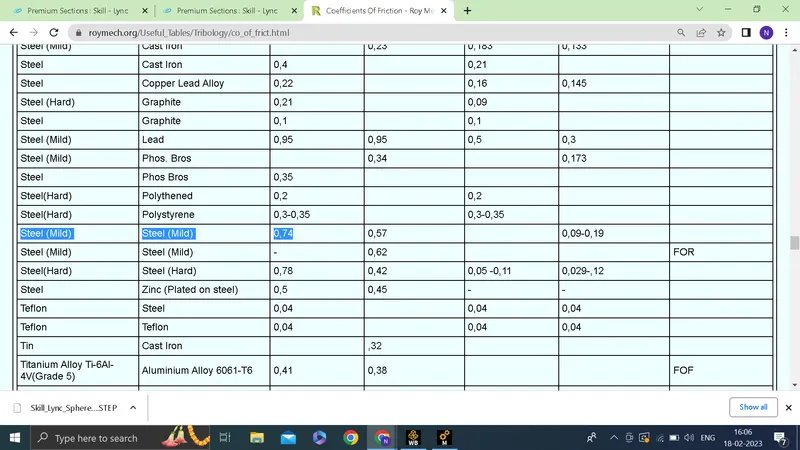
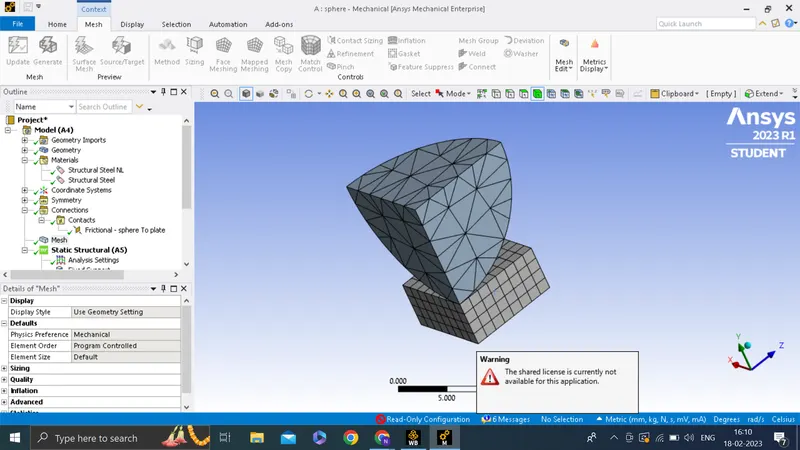
for mesh : we will use defaut mesh
Static analysis sttting :
no of step : 5
solver typpe : direct
Large deflection: on
output controll, set all parameter to "YES"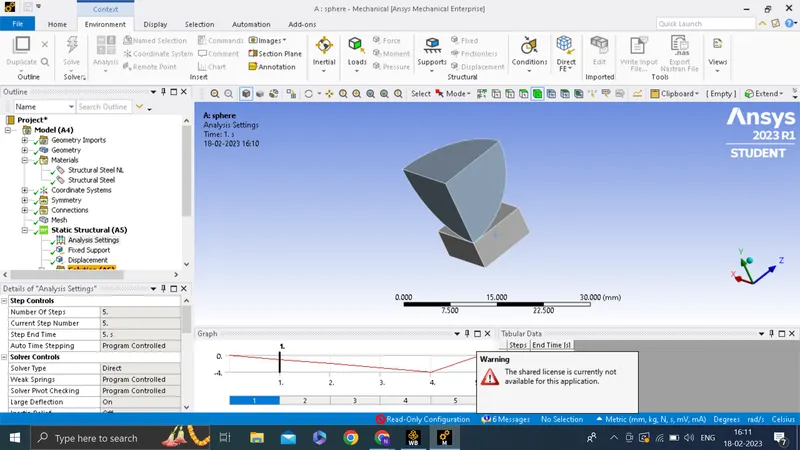 '
'
after analysis setting we will provide fix support to the plate lower face 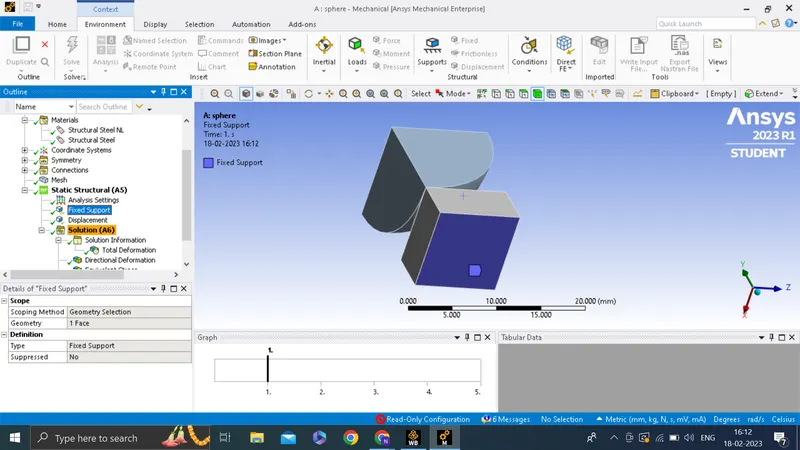
and displacement load to the sphere , select outer face of sphere and select static structural and select displacement
define by- component
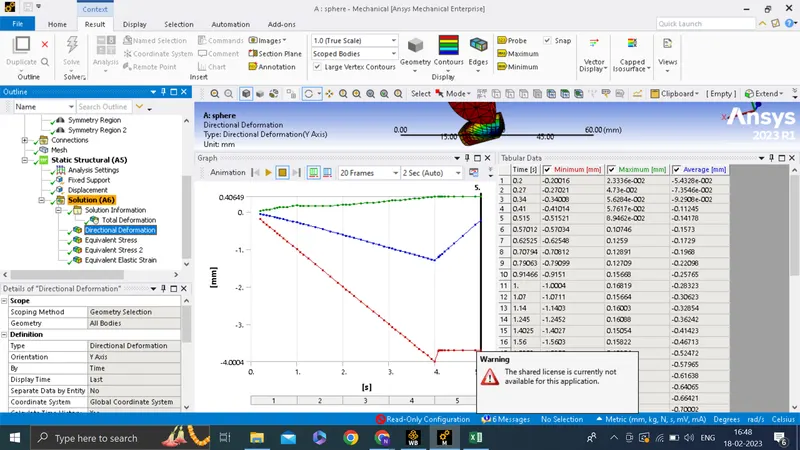
Y componenet - tubular data , and tubuar data as per given below
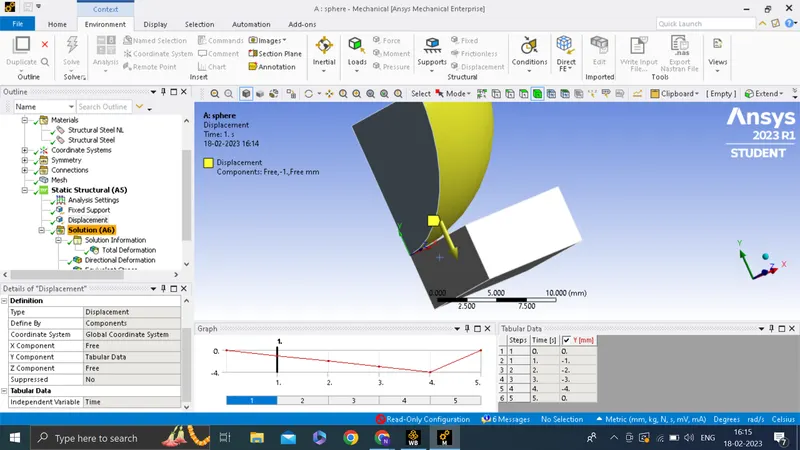
now we will define symmetry region to the system, for that we select one size of sphere and plate face and select symmetry in model tab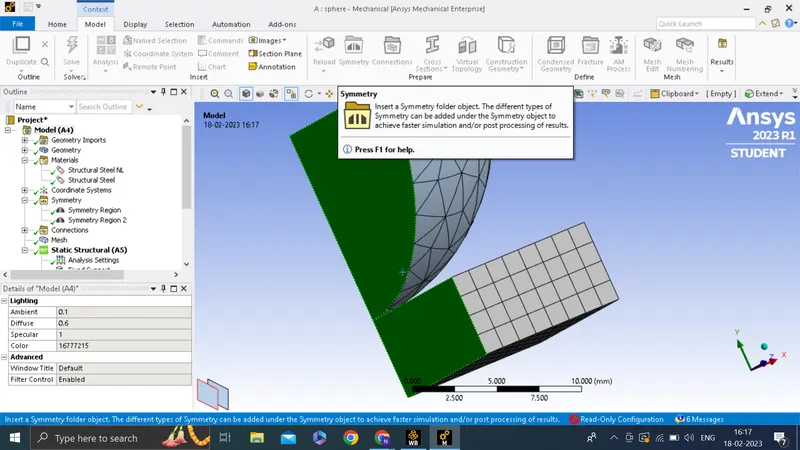
scope mode manual
type symmetry
co-ordination system: global coordinate system
symetry normal -z axis for 1st case ,
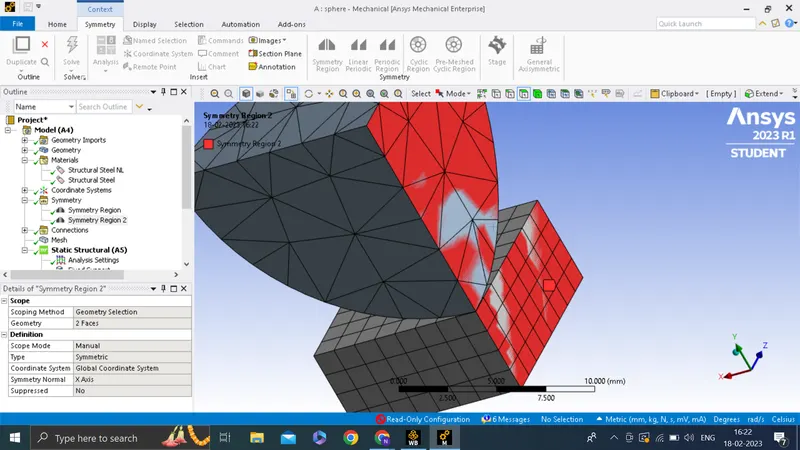
now select 2nd cuted portion of sphere and plate face and select symtry in model tab
scope mode manual
type symmetry
co-ordination system: global coordinate system
symetry normal -X axis iin 2nd case
now list down the required output and solve the simulation
Picture :
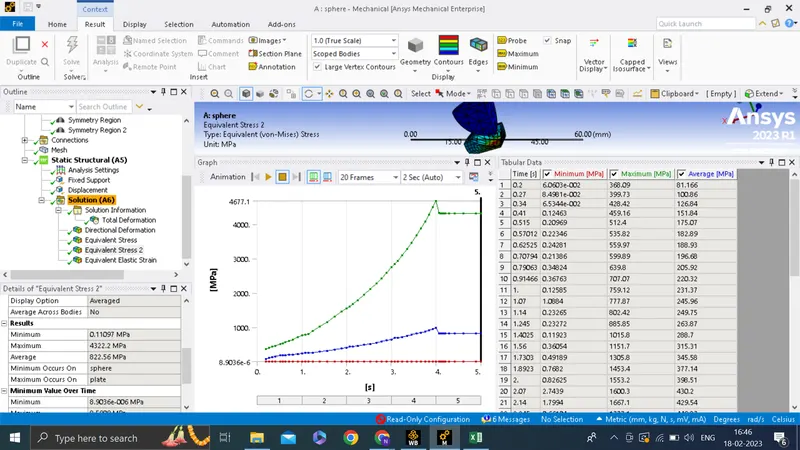
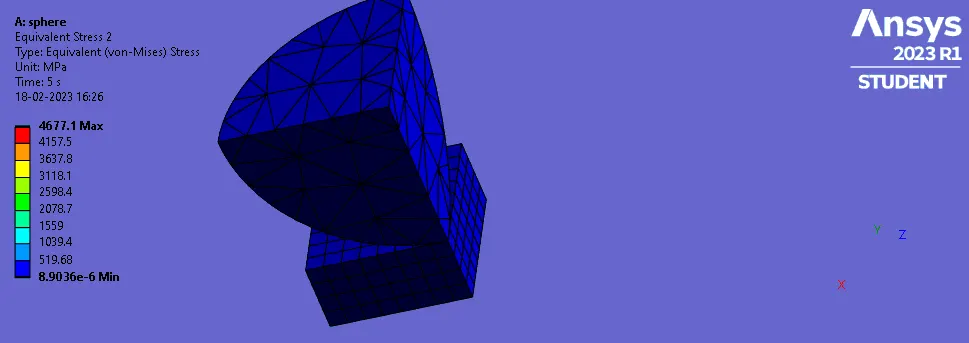
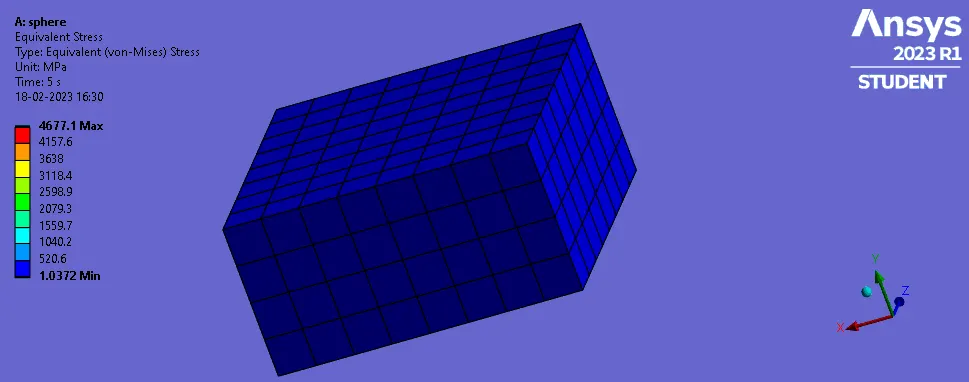
Equivalent stress On whle steup
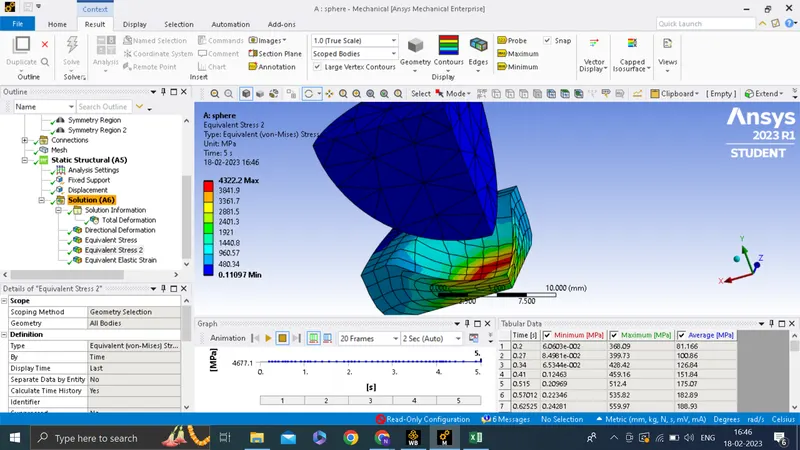
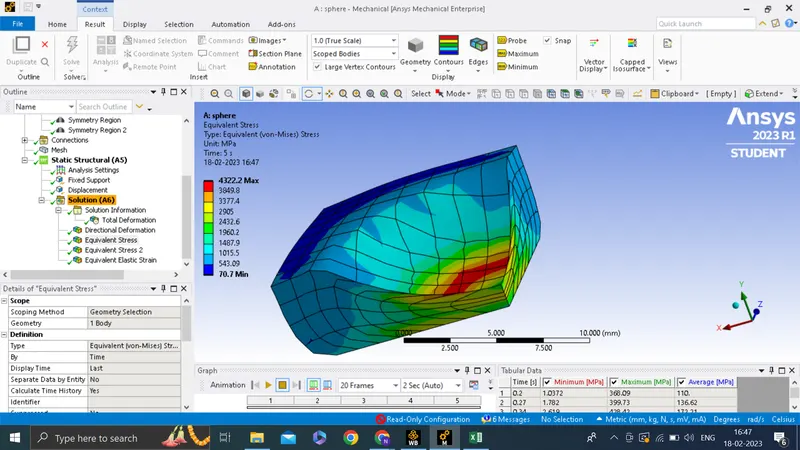
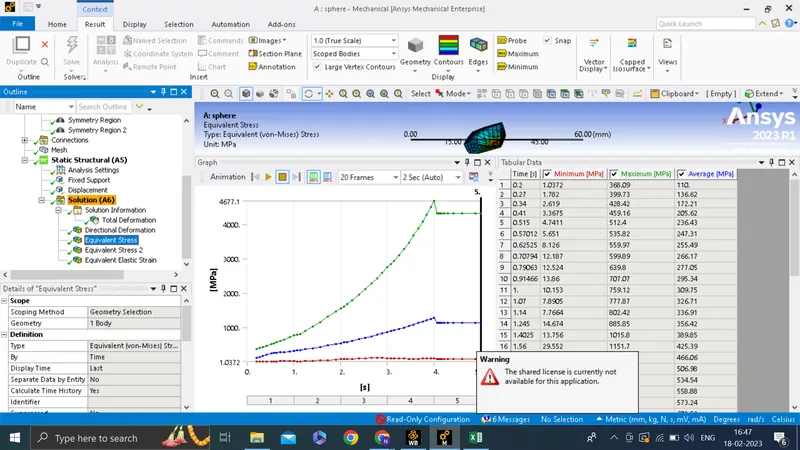
Equivalent stress on plate
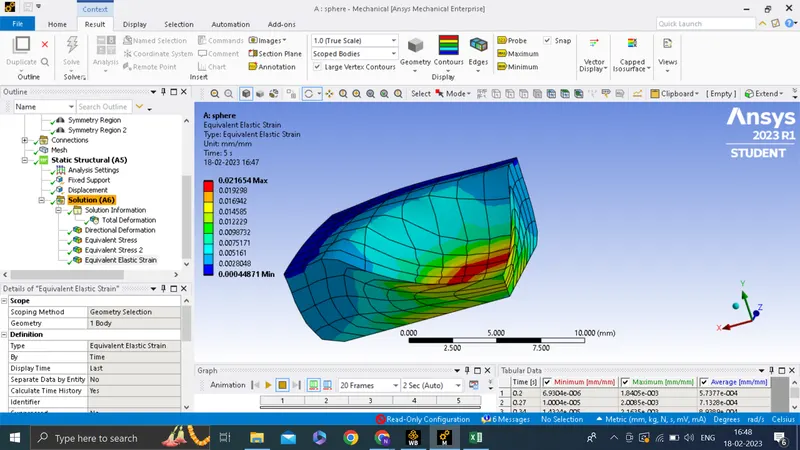
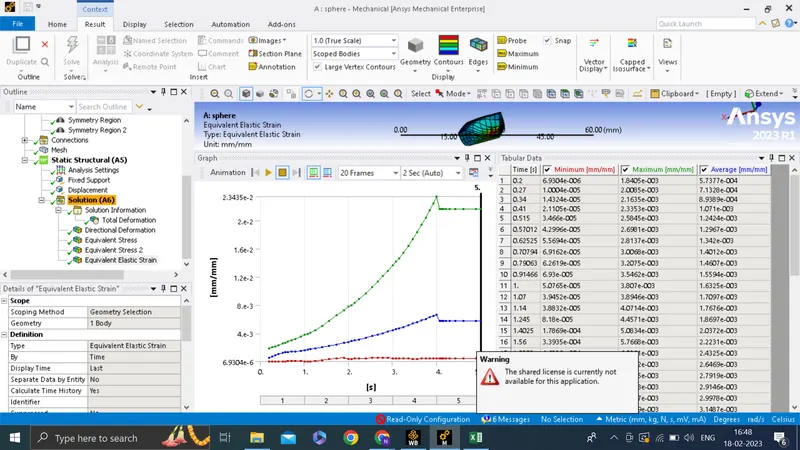
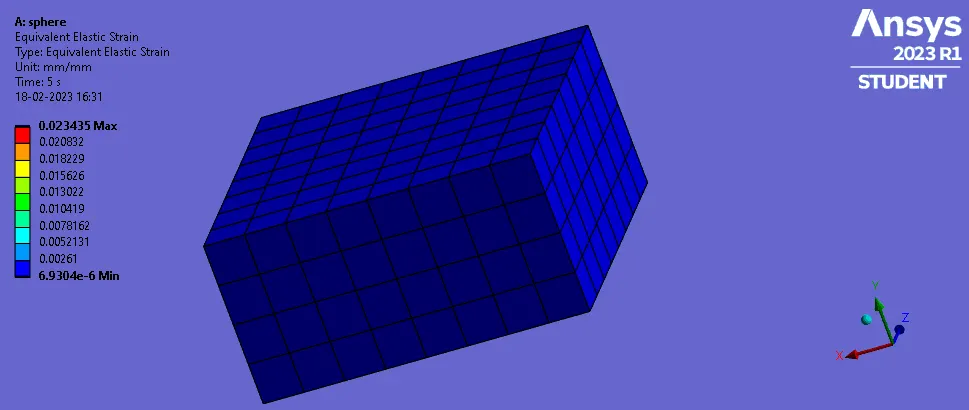
Equivalent strain in setup
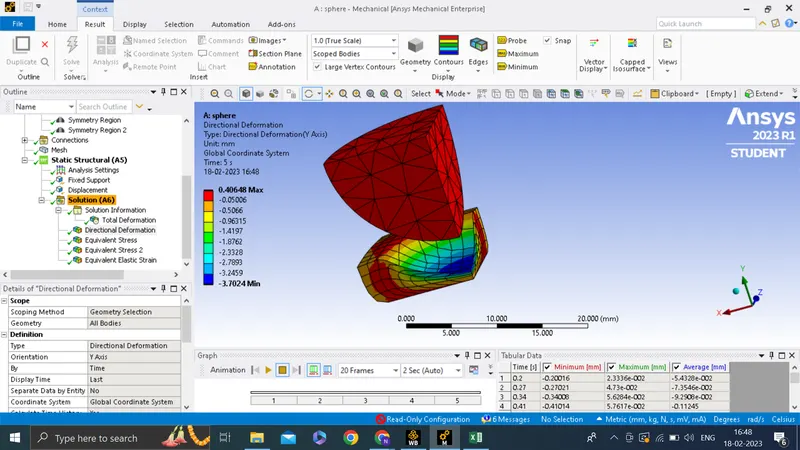
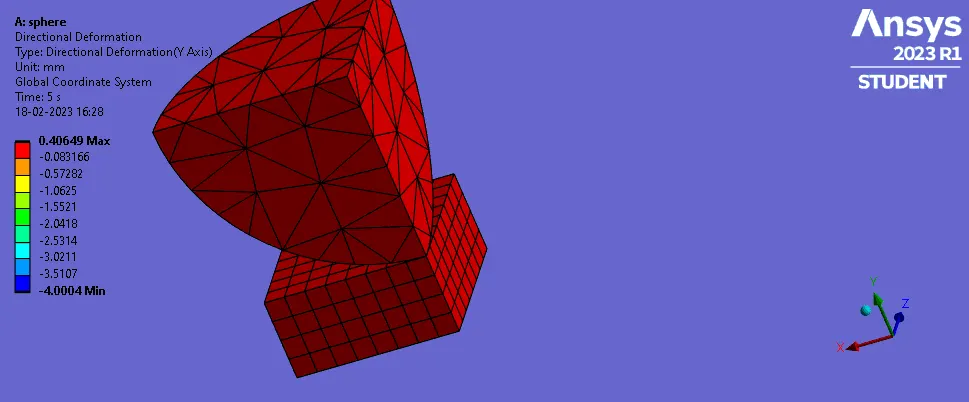
DIrectional deformation in y axis
Result
The equivaolent stress on whole setup is as given below
| Time (s) | Minimum (Mpa) | Maximum(Mpa) | Average (Mpa) |
| 5 | 0.11097 MPa | 4322.2 MPa | 822.56 MPa |
Results of Equivalent Stress, shows the development of high stress which are way beyond the Tensile & Compressive strength of Structural Steel. The maximum Stress developed on the model is 4322.2 MPa.
The plate's maximum stress is 4322.2 MPa, which is greater than the structural steel NL's young's modulus of 250 MPa. The plate underwent plastic deformation because the amount of stress created was greater than the Young's modulus.
The equivalent strain on whole setup is given below
| Time(s) | Minimum | Maximum | Average |
| 5 | 4.49E-04 | 2.17E-02 | 5.77E-03 |
The equivalent stress on plate
| Time (s) | Minimum (Mpa) | Maximum(Mpa) | Average (Mpa) |
| 5 | 0.11097 MPa | 4322.2 MPa | 822.56 MPa |
Max Equivalent stress acts on the plate at the bottommost point of impact, just before the sphere starts to retract.
Since the center portion of the plate is deforms more, here the strain developed is more.
Directional deformation in y axis
| Time( s) | Minimum (mm) | Maximum (mm) | Average (mm) |
| 5 | -3.7024 | 0.40648 | -0.22601 |
The results show that the plate underwent plastic deformation. By absorbing the work done by the sphere, the plate is continuously stretched beyond the elastic limit, storing strain energy in the molecules.
t is evident from the Directional Deformation along Y-axis results that the spherical body descended by 4 mm, pressing against the plate in the process and creating plastic (non-reversible) deformation in the plate.