Week- 5 - Solid meshing
- Understand 3D meshing and different element shapes used in solid meshing.
- 3D meshing on a solid object.
- Assign and check for the quality parameter in 3D meshing.
Quality Criterion to be followed:
|
S.No |
Quality Criteria |
Value |
|
1 |
Target/Average length |
1 |
|
2 |
Minimum Length |
0.5 |
|
3 |
Maximum Length |
2 |
|
S.No |
Quality Criteria |
Value |
|
1 |
Tet collapse |
0.2 |
Abstract: In this challenge, we are going to mesh the car rear mirror with the help of solid tetra meshing. we are going to assign volumetric meshing to the solid geometry( above 6mm thickness).
Methodology:
- Import geometry
- Topological error cleanup
- Quality criterion and meshing parameter setup
- Surface meshing
- Define volume to the geometry and tetra mesh generation
- Check for the surface kinks & dents
3D-Meshing
It is also known by the term solid meshing or volume meshing. In solid meshing all three dimensions are comparable. (x~y~z). The element types are solid. The solid elements have 3 translational DOF The elements shape in 3D meshing are 1) Tetra 2) Penta 3) Hexa 4) pyramid.
Volume Meshing
This is a method of representing a solid with the help of a 3D element inside the geometry. In this technique, we mainly use the tetra and hexa element to define the geometry volume. The propagation of the element can be either structured or unstructured depending upon the requirement of analysis. They are mainly used for the auto-generation of the element in an unstructured method of meshing.
Structured Meshing
These types of mesh have implicit connectivity whose structure allows for easy identification of elements and nodes. Often these structured meshes have an orthogonal quadrilateral(2D) or hexahedral elements(3D). it also possible to access coordinate easily because the size of the element does not vary element to element.
pros
- Memory efficient
- Fast to solve
cons
- Hard to mesh for angle and curved surfaces.
Unstructured Meshing
These meshes have very general connectivity, whose structure is arbitrary and therefore the connectivity of the element must be defined and stored. The element types are non-orthogonal, such as trial element(2D) and tetra element(3D).
pros
- Complex-geometry easy to mesh
cons
- Slower to solve
- Greater memory requirement
Procedure
Importing Geometry and topological cleanup
once you have imported the geometry try to do a topo on the full model. Then go for the geometry checkup.
Execute the check and fix all the errors.
Note: For observing the geometry carefully you can alter the perimeter length by switching to the mesh module and goto length tab under the perimeter section(macros as well as perimeter).
Store the different parts of the geometry under different lock views. This will help you to proceed with the meshing easily.
once done with setting up the parameter we can now proceed with meshing.
Tetra collapse: This quality parameter is very important while doing tetra meshing & it should be fixed as far as possible.
Surface Meshing
The spot mesh algorithm gives a better result than the free mesh algorithm with better-optimized tria element adjustments. Also, we will use the ortho tria element for capturing the curved surface.
Part by part we will see and try to capture all the curved areas 1st with ortho tria elements and flat surfaces with the normal tria elements.
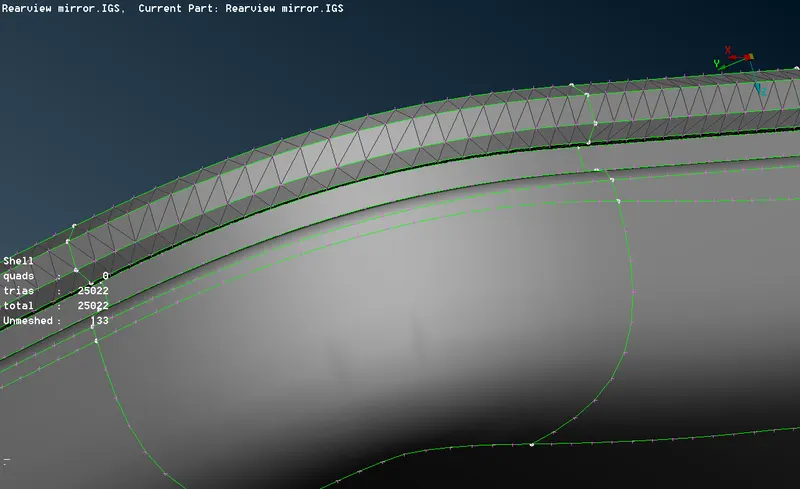
Similarly, cover all the curved regions with ortho tria elements and flat surfaces with normal tria elements.
All the 4 parts surface meshed
1)Rotating socket
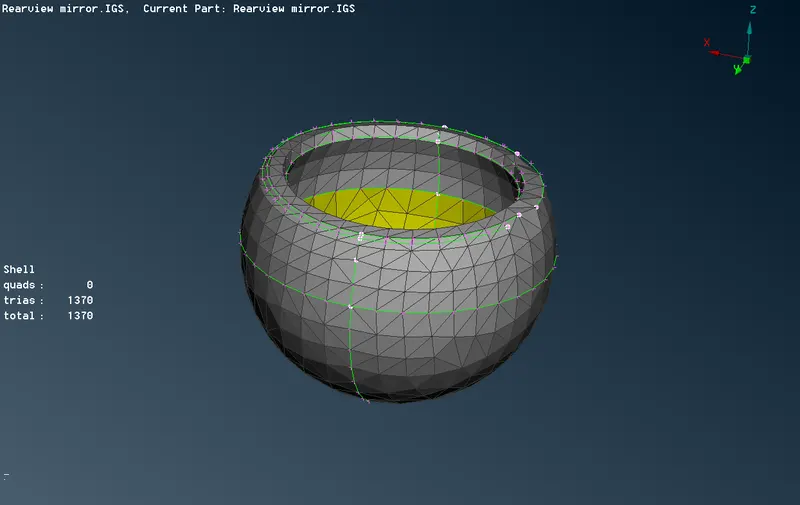
2)Mirror back
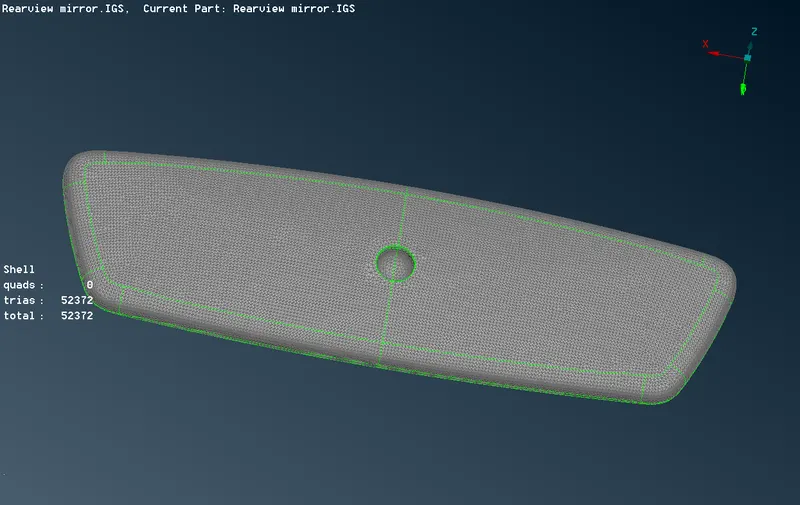
3) Mirror
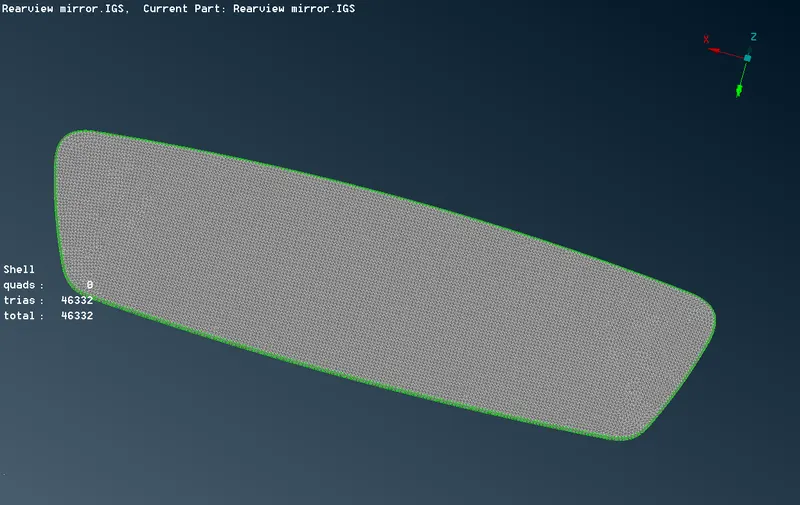
4) Support base
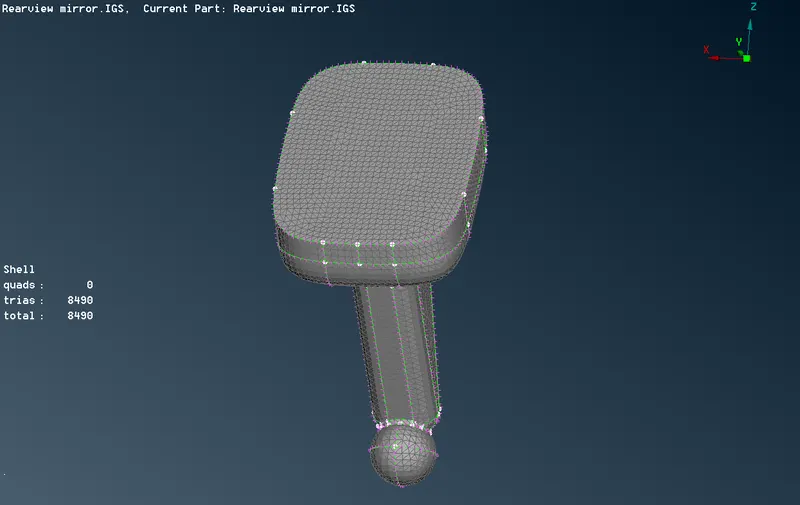
Once we are done with surface meshing check for any quality failure and fix it if any with the help of reconstruction and smooth option.
Volume Meshing and Tetra Mesh Generation
Solid Map Meshing
In solid meshing, the ability to mesh is referred to as mappability. Mappability is directional and can be likened to putting a surface mesh on one face of the solid, then
extending that mesh along a vector through the solid volume. To achieve this, though, the user had to put the shell mesh on the surface before the solid map function was performed and had to do it for each desired face. There are algorithms that can automatically generate the elements inside the volume referring to surface mesh patterns.
After completing surface meshing on a solid geometry we need to define a volume before generating mesh inside it.
This can be done by switching to the volume mesh module and goto to define under the volume section (manual mode of defining )
Select the geometry to define a volume. Check the volume assigned in the list option. Do the same for all 4 parts.
Note: we need to provide a type of solid property to each part so as to define a volume.
You can either choose the Tetra FEM or RAPID tetra algorithm depending upon the need of the mesh generation.
Mirror geometry volume meshed
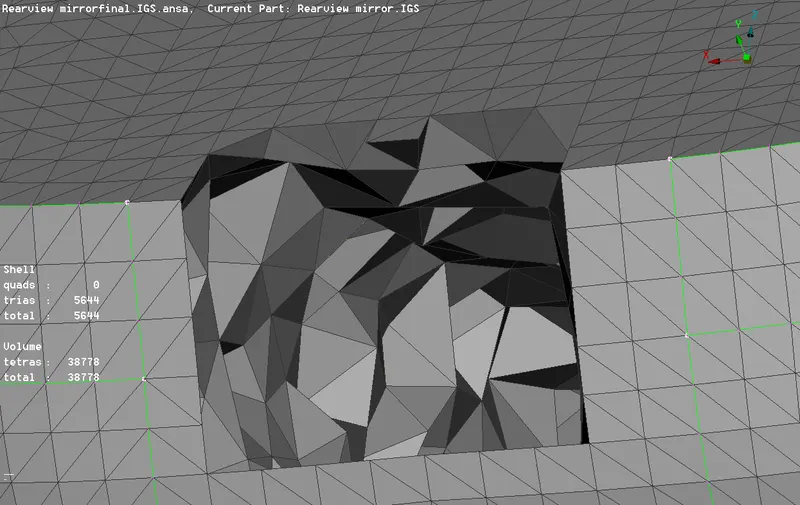
Unstructured mesh generation inside the volume of the object. Irregular tetra mesh inside the geometry.
Note: check for any kink and dips on the volume surface so as to avoid surface deformation. if so clear them by the manual move method of nodes.
Methods of improving quality for poor elements
- Manual adjustment
- Drag node
- Auto quality improvement
There are options to move the nodes with move free tab and move nodes or otherwise auto fixing. The auto fixing may ruin your surface so make sure you check for surface kink and dip.
Conclusion:
The volume meshed achieved is better satisfying all quality aspects and surface achieved is also smooth without much kinks and dips. the usage of tho tria elements on curved elements has really made a difference in mesh smoothness, especially over fillet areas. I have chosen the rapid tetra algorithm as the number of elements formed is 1117 less which will definitely save time and space. The tetra mesh achieved is unstructured and can be seen through the section views while keeping the surface mesh as it is.
Learning outcome:
- 3D meshing on a solid object
- Fixing quality in 3D meshing
- Different algorithms awareness in volume generation
- usage of ortho tria elements on curved surfaces