Week 5 - Rayleigh Taylor Instability
Introduction to GUI based CFD using Ansys Fluent
Week 5 - Rayleigh Taylor Instability
Instabilities in Fluid Dynamics:
1. Rayleigh Taylor instability
This interfacial instability between two phase of fluid, with different densities occurs when the lighter fluid is pushing the heavier fluid.
2. Richtmyer-Meshkov instability
This type of stability occurs when two different fluids are accelerated impulsively. It starts with disturbances of small amplitude that gradually grows with time.
3.Plateau-Rayleigh instability
This type of instability signifies the breakdown of fluid, as of their surface tension, (in a stream) of same volume but with less surface area, something like a breakdown into smaller fine particles.
Rayleigh Taylor instability:
In present case, the Rayleigh Taylor instabilty analysis is done on two different phases of fluid. The two rectangular domains are assigned with air and water, being shared a common interface (boundary). The base mesh size is kept 0.5mm and both the domains are patched such that there is only fluid with higher density at topmost part and the fluid with only less density, here air, in lower part.
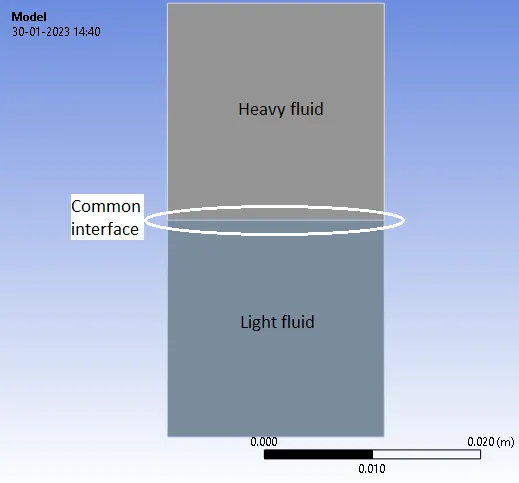
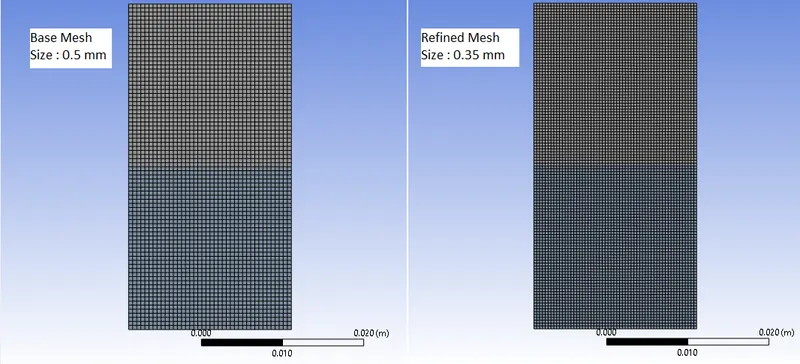
The Transient simulation is performed as the chaotic behaviour for mixing increases with time, or say the instabilities grow with time. The case is then refined with combination of two fluids, namely air at standard condition and another an user defined material having density of 400 kg/(m^3) and viscosity 0.001 kg/m-s.
The Atwood number is a dimensionless number used for studyin hydrodynamic instabilities, which is defined by;
`A = (rho1 - rho2)/(rho1 + rho2)`
where, `rho1` = density of heavy fluid, `(kg)/(m^3)`
`rho2` = density of light fluid, `(kg)/(m^3)`
The Atwood Number for the baseline setup with air and water is 0.998, while, for the latter case is 0.994.
Simulation of the Base mesh:
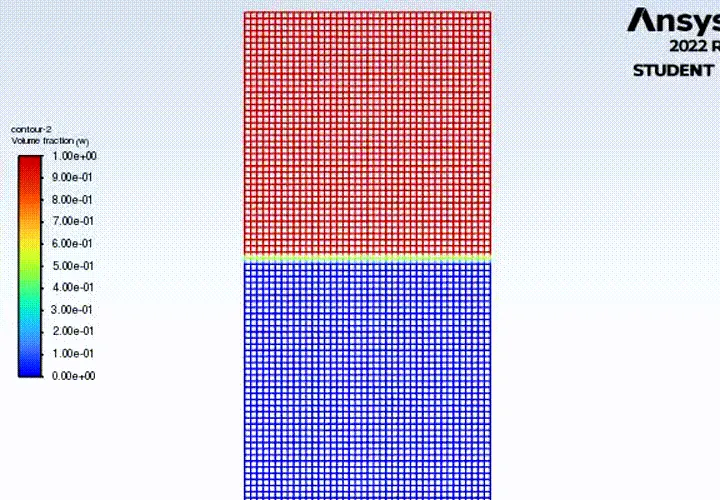
Simulation of the Refined mesh:
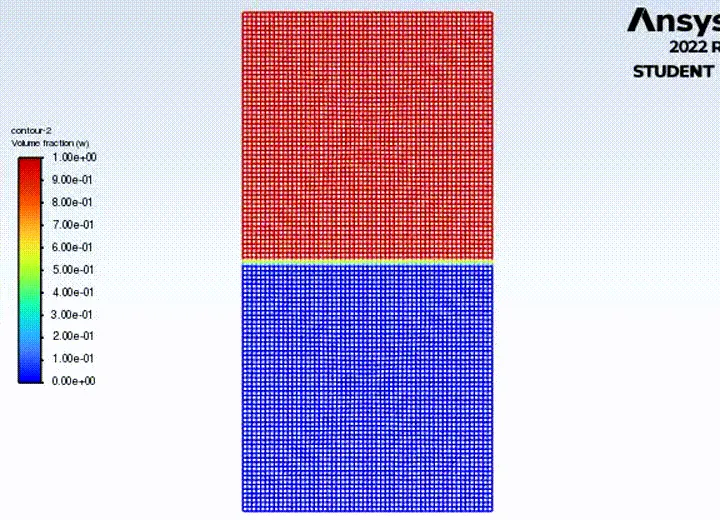
Conclusion:
As seen in the simulation, the one with less Atwood Number has more instablities and consequenlty, it takes more time to get settled up. The mixing is more erratic as well. The baseline mesh and the refined mesh can be considered as the particles in a fluid continuum in both the phases, so more refined the mesh is, the more time it could take to resolve the instabilties of mixing. Additionally it also depends on the density and viscosity of fluid as those fluids with high viscosity resist the deformation and mixes slowly, there are more shear forces and cycle time is more.