Week 5 - Rayleigh Taylor Instability
Objective
- Perform the Rayleigh Taylor instability simulation for 2 different mesh sizes with the base mesh being 0.5 mm with an air-water mixture.
- Perform the Rayleigh Taylor instability simulation for a user-defined material-water mixture for the refined mesh.
Theory
Rayleigh-Taylor instability is a fluid instability that occurs at the interface between two fluids of different densities when the denser fluid is supported above the lighter fluid.
The instability arises due to the action of gravity on the density difference between the two fluids. When the interface between the fluids is disturbed, small perturbations in the interface can grow and amplify over time. This leads to the formation of characteristic patterns such as spikes, bubbles, or complex mixing structures.
Practical CFD models that have been based on mathematical analysis of RT waves
- Kelvin-Helmholtz Instability: The Kelvin-Helmholtz instability occurs at the interface between two fluids moving at different velocities with a tangential velocity difference across the interface. It is commonly observed in atmospheric phenomena like cloud formations, ocean waves, and the shearing layers of gas in astrophysical objects. When there is a velocity difference across the interface, shear forces develop, causing the fluids to interact. If the velocity difference exceeds a critical threshold, the interface becomes unstable. Small perturbations on the interface grow and roll up into large vortices or waves, leading to the mixing and deformation of the fluids.
- Richtmyer-Meshkov Instability: The Richtmyer-Meshkov instability occurs when a shockwave passes through an interface between two fluids with different densities. It is relevant in areas such as inertial confinement fusion, astrophysics, and explosive detonations. When a shockwave interacts with the interface, it imparts momentum and causes the fluids to mix and deform. If the interface is perturbed, the shockwave can generate complex flow patterns, including vortices, spikes, and bubbles. The instability growth depends on factors such as the density ratio, shock strength, and interface perturbations.
- Plateau-Rayleigh Instability: The Plateau-Rayleigh instability, also known as the Rayleigh-Plateau instability, is observed in slender fluid columns or liquid jets that break up into droplets due to surface tension. This instability is relevant to understanding the formation of droplets in various natural and industrial processes. The instability arises due to the competition between surface tension, which tends to minimize the surface area of the fluid column, and inertia, which opposes the surface tension forces. When the fluid column exceeds a critical length-to-diameter ratio, small perturbations on the interface grow, leading to the formation of droplets. The resulting droplet sizes and spacing are determined by the balance between surface tension and inertia.
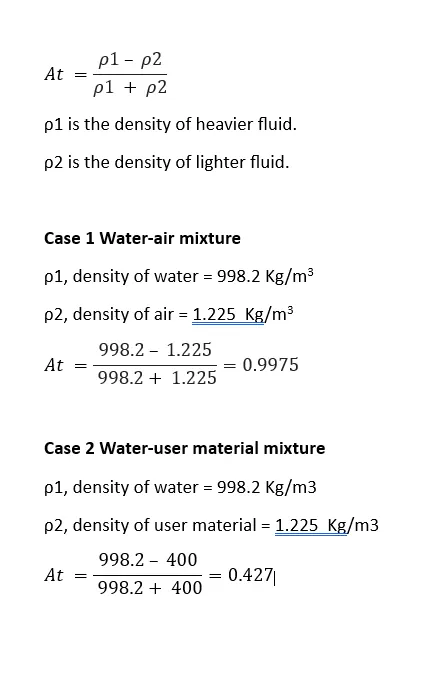
Atwood Number
The Atwood number, denoted as At, is a dimensionless parameter used in fluid dynamics to characterize the density difference between two fluids in a system. The Atwood number ranges from 0 to 1, where 0 represents identical densities, and 1 represents a maximum density difference.
WORK FLOW
Geometry.
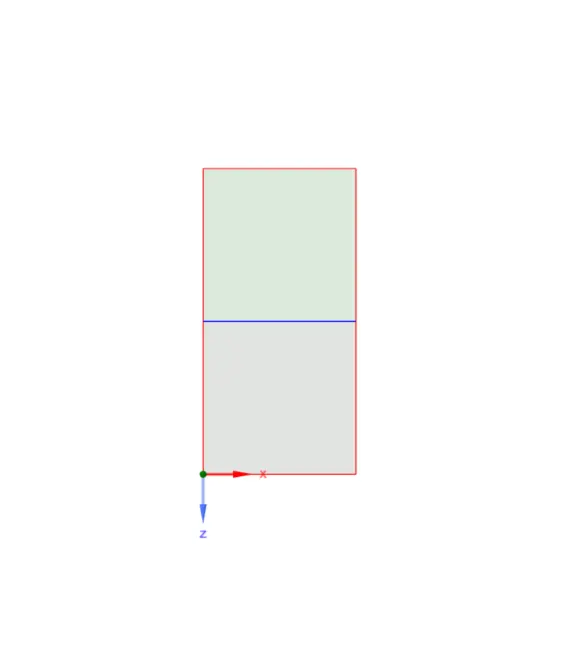
The geometry was created in the space claim. The geometry consist of 2 squares with dimension 20*20mm with one on top of the other. The upper square was name as water and the lower square was name as air. The coomon edge between the domain was shared using the share tool.
Meshing
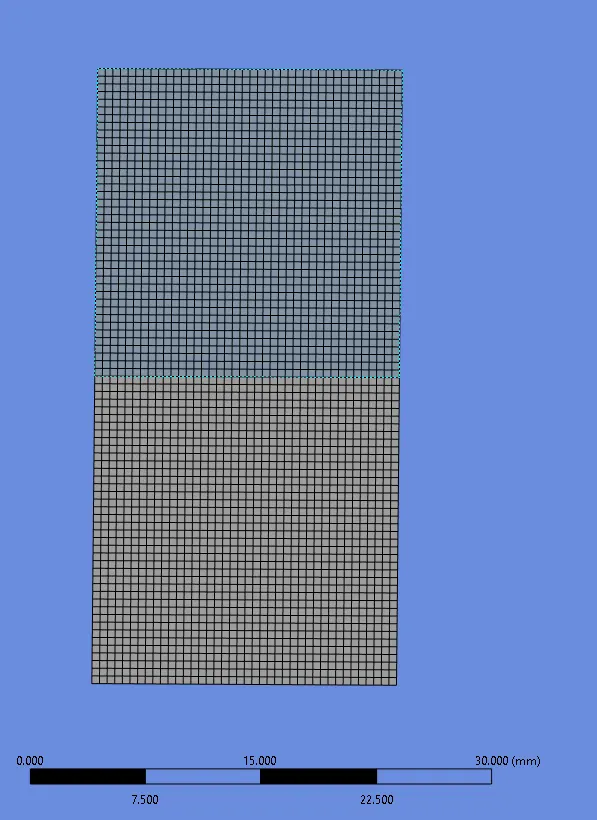
Baseline mesh: A base mesh with element size 0.5 mm was created.
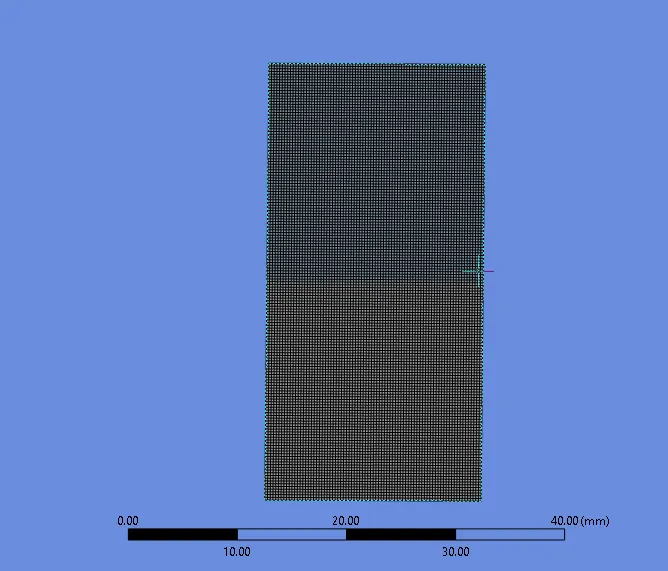
Refined Mesh: A mesh with element size 0.25 mm was created.
Solving Fluent setup
Flow is considered as Laminar. Pressure based solver is selected and simulation is considered transient. Gravity was selected in the y direction as -9.81 m/s.
Material selection: Air was already given and Water was selected from Ansys fluent data base.
Properties of Material:
for air: density= 1.22 kg/m^3
viscosity= 0.0000181 kg/m.s
for water: density= 997 kg/m^3
viscosity= 0.0000890 kg/m.s
From the multi phase flow, Volume of fluid method was selected, implicit method was selected.
Primary phase was selected as air and secondary phase was selected as water.
After Standard initialization, patching was done after that. Volume fraction was selected as 1 for water and 0 to air and user defined.
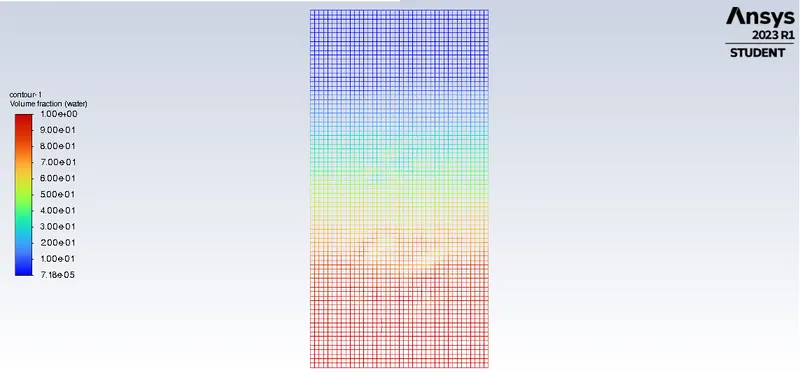
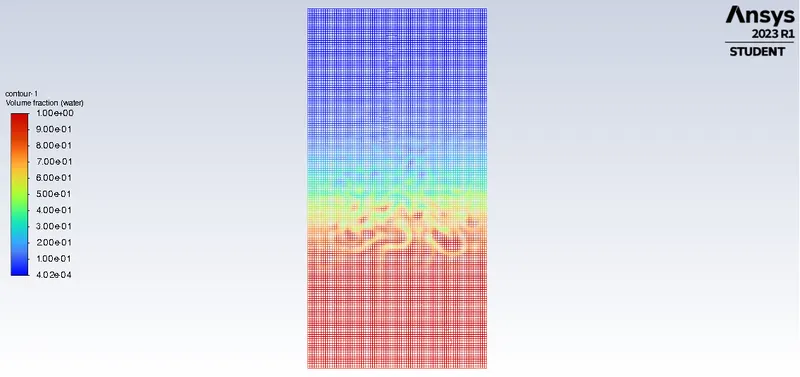
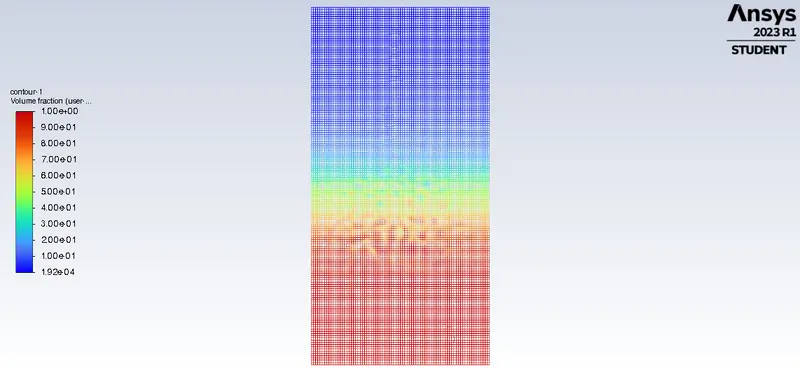
After solving for 1500 Time steps with 5e-3 dt (time step size), the solution/animation was obtained:
Base mesh: Element size 0.5 mm
material: Air-water
Refined mesh: Element size 0.25 mm
Material: air-water
Refined mesh: Element size 0.25 mm
Material: air-user-defined material
Conclusion
It is observed that, in the more refined the mesh is, the simulation results get smoother at the irregularities that take place at the interface of the two fluids.
Since the simulation involves capturing instabilities that are changing in an unpredictable manner as a function of time, the transient approach is preferred over the steady-state approach.
RTI evolves in three distinct stages: Linear stability, mushroom head(falling) or bubble(rising) formation, long term evolution due to bubble merging and mixing. For low Atwood number, bubble and mushroom head shape is relatively symmetrical, and the disturbances or perturbations are linear for a larger time. In contrast, for large Atwood number, bubble and mushroom head shape is less symmetrical, also it occurs very rapidly at an accelerating rate which leads to a nonlinear growth rate.