Week 5 - Rayleigh Taylor Instability
AIM:-
To conduct the Rayleigh Taylor CFD simulation.
OBJECTIVE:-
- Explain different CFD models used for solving Rayleigh Taylor instability problem.
- Perform a Rayleigh Taylor instabillity analysis using the volume of Fluid multiphase model for air and water for two different mesh element size.
- Run one more simulation with water and user-defined material(density = 400 kg/m3, viscosity = 0.001 kg/m-s) for refined mesh.
- Define the Atwood Number. Find out the Atwood number for both the cases and explain how the variation in Atwood number in the above two cases affects the behavior of the instability.
- So there are 3 cases.
- Case 1:- Mesh size-0.5mm,water and air.
- Case 2:- Mesh size-0.1mm,water and air.
- Case 3:- Mesh size-0.1mm,water and user defined fluid
SOLUTION:-
Case 1:-
GEOMETRY
- Open the geometry space claim, generate two square with 20x20mm size one over other for the two fluids.
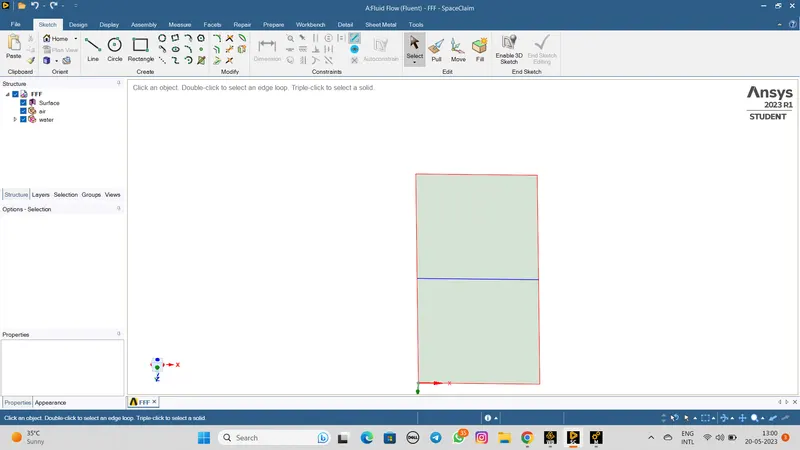
After this step done. we will close the space claim and open the mesh module.
MESH:-
Open the mesh module and under the mesh details give CFD fluent as preference and Element size is 0.5mm.
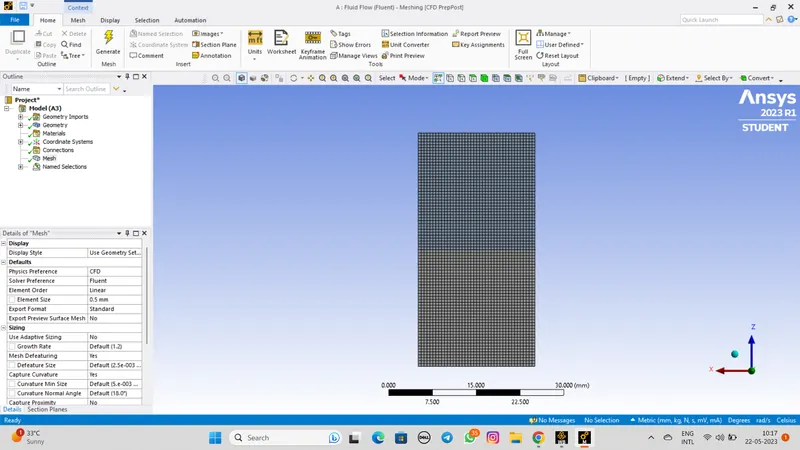
After the mesh is done check name the faces of the volume as water and air.
SOLUTION:-
After the mesh and faces naming are done move on to fluent solution.
Here select Pressure based type solver.
Select Laminar Model.
Then select Material air and water from fluent databse
After that click multiphase and select volume of two fluids in the phase tab. Also select Implict formulation.
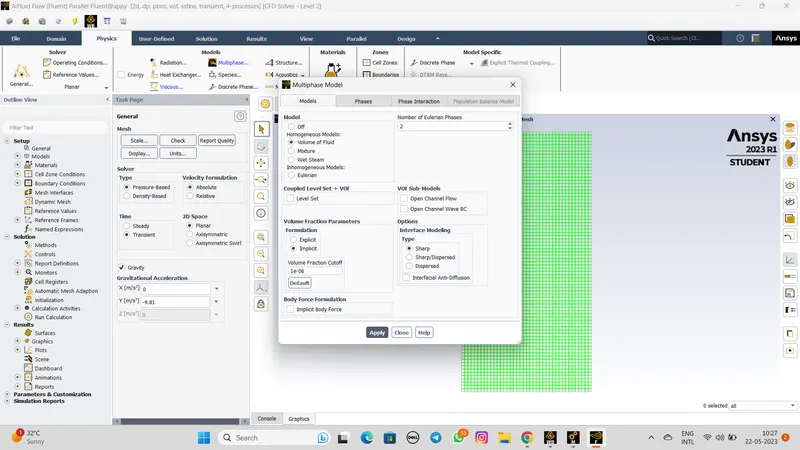
Then move to the solution part, Initialise the simulation first select hybrid method.
Created the patch region with the fluid, set the fluid and select volume fraction set the values to 1 and 0.
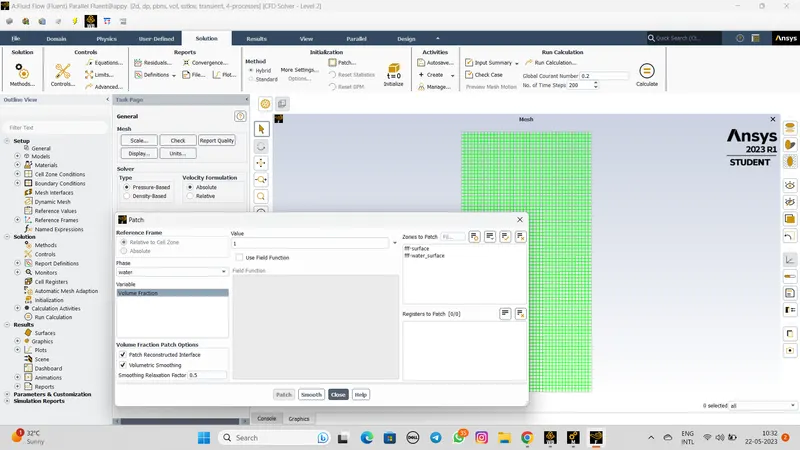
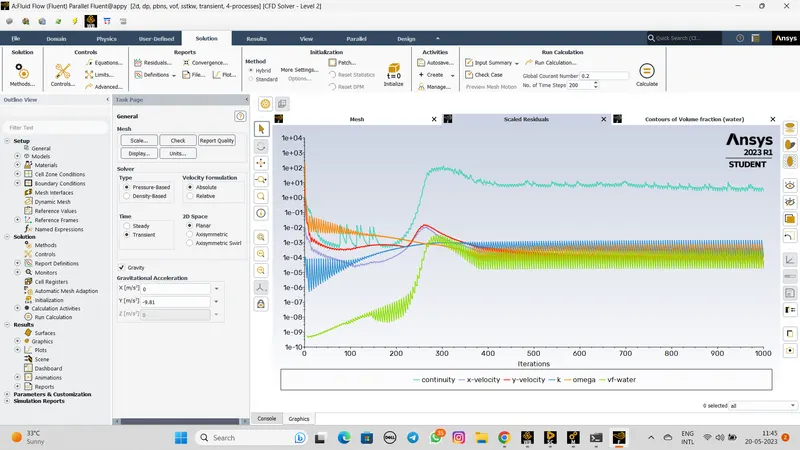
Then run the calculation for a given number of iteration till the convergence is obtained.
After the solution and calculation to the result module to get different graphs.
RESULT:-
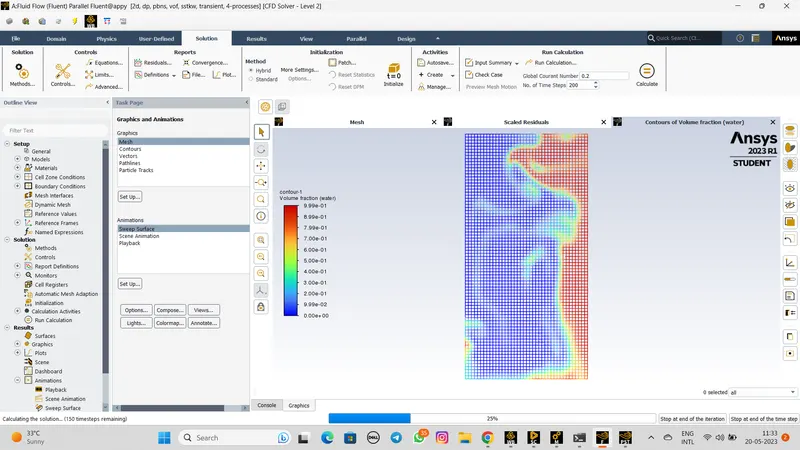
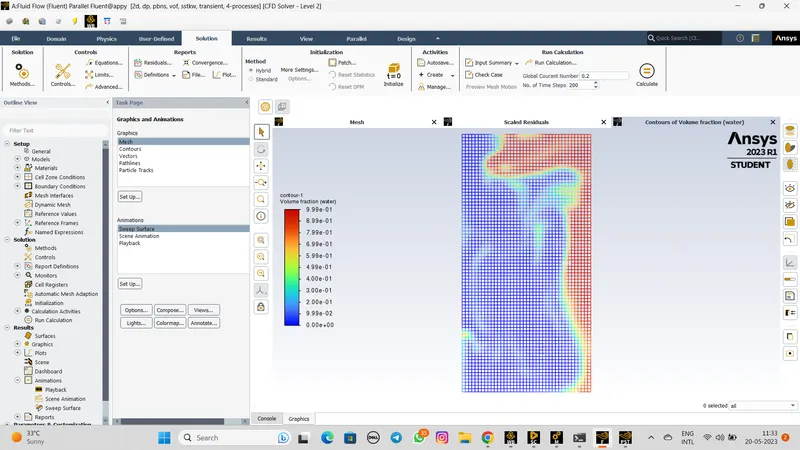
Mesh size is 0.5mm,
Fluid water and air.
Counter volume fraction :-
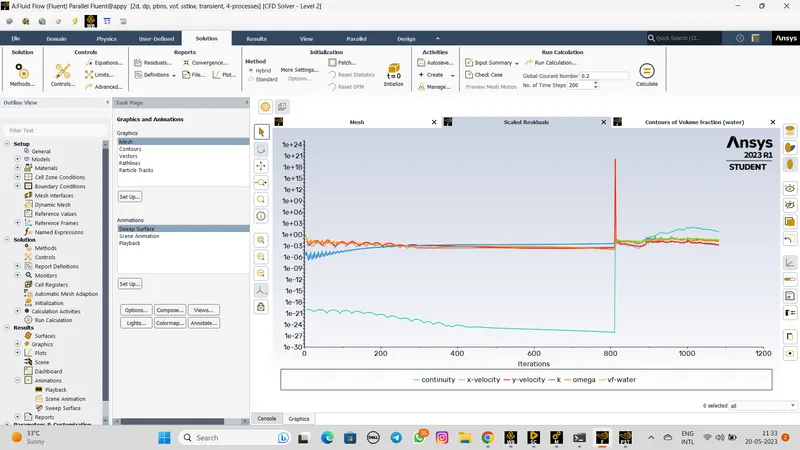
RESIDUALS :-
CASE 2:-
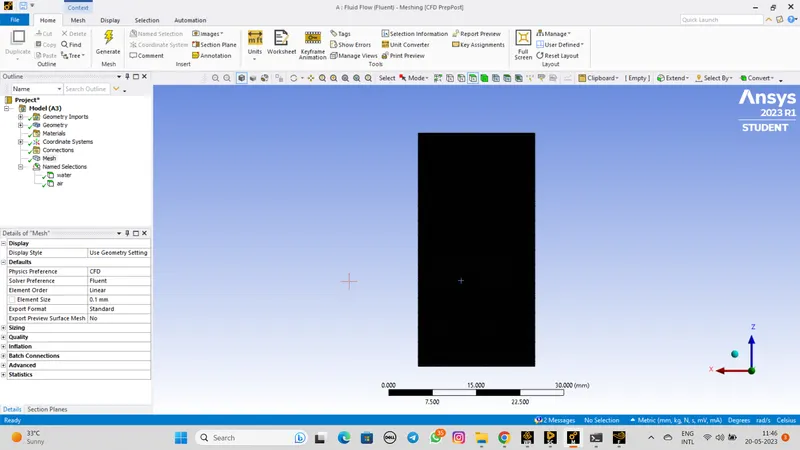
Mesh size 0.1mm
Fluid water and air.
Mesh ghraph
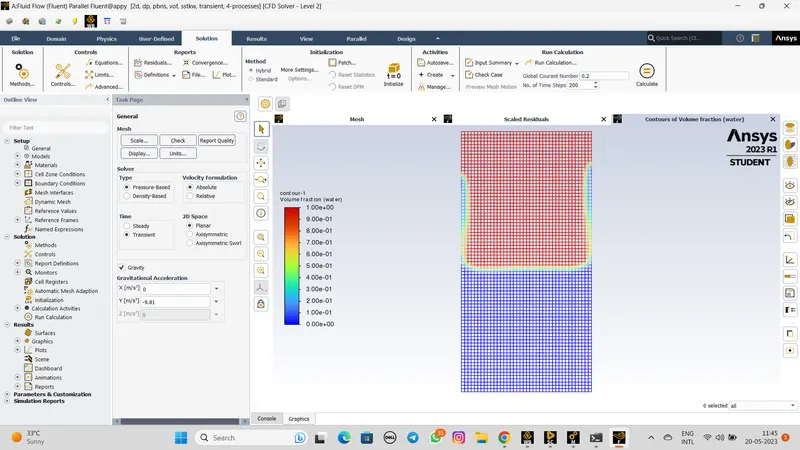
Counter volume fraction:-
Residuals plot:-
ATWOOD NUMBER:-
It is a dimensionless number that is used to study hydrodynamic instabillities density stratified flows.
`A=rho1-rho2 // rho1+rho2`
Where,
ρ1 is density of heavier fluid
ρ2 is density of lighter fluid
for air-water instabillity,
ρ1=998.2 kg/m^3 [water density]
ρ2=1.225 kg/m^3 [air density]
A = `A=998.2-1.225 // 998.2 + 1.225`
A = 0.998
Why Steady State simulation is not suitable ?
- We know that steady state simulation is a time independent approach.
- Based on the simulation we know there is high turbulence involve and the change in the flow occurs between very small time variation. This is not possible to capture in steady state solution
- Also steady state solver ignore the time differential terms involved in the simulation and thus even if it may be able to capture the state of equilibrium, it skips to capture the non-linearities in the simulation precisely.
CONCLUSION:-
- From the above cases, we observe that finer mesh captures the instability better than the coarse mesh, but it takes more time for the heavier fluid to settle down. As computational time is long but produces results with better accuracy.
- Since the simulation involves capturing instabilities that are changing in an unpredictable manner as a function of time, the transient approach is preferred over the steady-state approach.
- For Atwood number close to 0, RT instability flows take the form of symmetric fingers of fluid.
- when Atwood number close to 1, the much lighter fluid below the heavier fluid takes the form of larger bubble-like plumes.