Week 5 - Rayleigh Taylor Instability
Aim-Perform the transient simulation on Rayleigh Taylor Instability of different mesh sizes.
Define the Atwood Number. Find out the Atwood number for both the cases and explain how the variation in Atwood numbers in the above two cases affects the behaviour of the instability.
Theory-
The Rayleigh–Taylor instability or RT instability is the instability of an interface between two fluids of different densities which occurs when the lighter fluid is pushing the heavier fluid. As the RT instability develops, the initial perturbations progress from a linear growth phase into a non-linear growth phase, eventually developing "plumes" flowing upwards (in the gravitational buoyancy sense) and "spikes" falling downwards. In the linear phase, the fluid movement can be closely approximated by linearly, and the amplitude of perturbations is growing exponentially with time. In the non-linear phase, perturbation amplitude is too large for a linear approximation, and non linearity is required to describe fluid motions.
Water suspended atop oil is an everyday example of Rayleigh–Taylor instability, and it may be modeled by two completely plane-parallel layers of immiscible fluid, the denser fluid on top of the less dense one and both subject to the Earth's gravity. The equilibrium is unstable to any disturbances of the interface. If a parcel of heavier fluid is displaced downward with an equal volume of lighter fluid displaced upwards, the potential energy of the configuration is lower than the initial state. Thus the disturbance will grow and lead to a further release of potential energy, as the denser material moves down under the effect of the gravitational field, and the less dense material is displaced upwards. The image shows a typical RT instability case.
Process-
Geometry Creation:
First create 2 rectangle having dimensions 20mmX20mm. one for lighter density and another for heavier density fluid.
After creating the rectangles use pull option for creating the surface.
After enable the share topology option, Click workbench in space claim.
In workbench click the share option for conformal mesh.
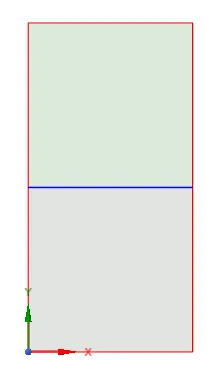
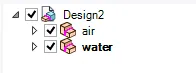
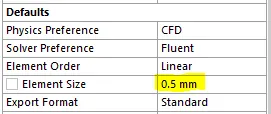
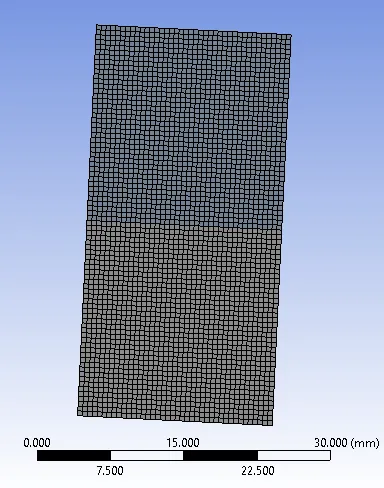
Mesh - Basic quad mesh is created. Baseline mesh size = 0.5mm. Refined = 0.25 mm and 0.1 mm
Setup-
Setting up Physics - Transient, Pressure based, Multi-phase -> VOF -> laminar-> Implicit, Create 2 phase -> Air (Primary phase) & Water (secondary phase)
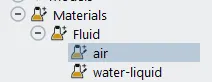
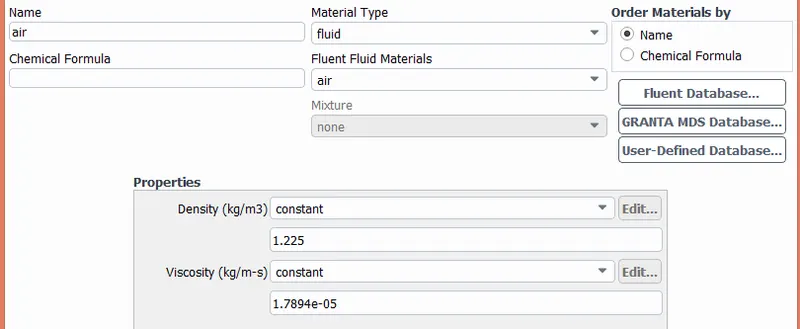
Air:
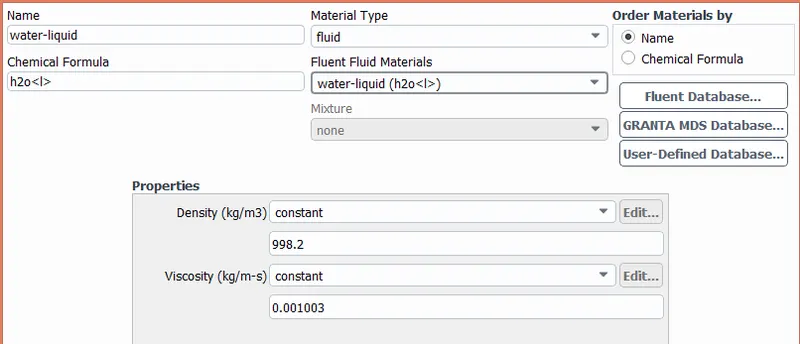
Water:
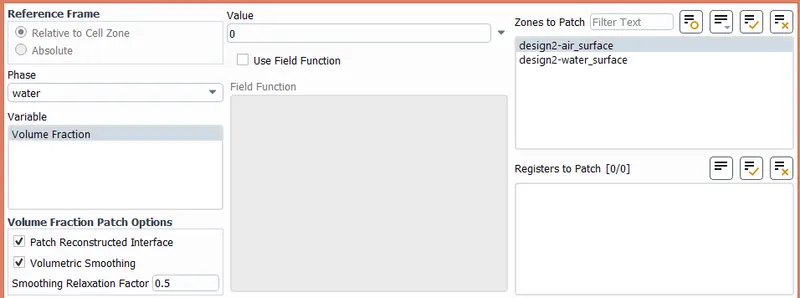
contour animation-(mesh size 0.2mm air/water)
contour animation (mesh size 0.2mm user-defined material(density = 400 kg/m3, viscosity = 0.001 kg/m-s))-
Atwood Number:
The Atwood number (A) is a dimensionless number in fluid dynamics used in the study of hydrodynamic instabilities in density stratified flows. It is a dimensionless density ratio defined as

density of water = 998.2
density of air = 1.225
A = (998.2-1.225)/(998.2+1.225)
= 0.997
For Case 2:
density of water = 998.2
density of user-defined material = 400
A = (998.2-400)/(998.2+400)
= 0.427