Week 5 - Rayleigh Taylor Instability
Aim:
To analysis the Rayleigh Taylor waves
- What are some practical CFD models that have been based on the mathematical analysis of Rayleigh Taylor waves? In your own words, explain how these mathematical models have been adapted for CFD calculations.
- Perform the Rayleigh Taylor instability simulation for 2 different mesh sizes with the base mesh being 0.5 mm. Compare the results by showing the animations( Attach them from your google drive). Observe the differences in the animation and explain the effect of mesh size on simulation. Also, explain why a steady-state approach might not be suitable for these types of simulation.[ Choose Air and Water for this simulation]
- Run one more simulation with water and user-defined material(density = 400 kg/m3, viscosity = 0.001 kg/m-s) for refined mesh.
- Define the Atwood Number. Find out the Atwood number for both the cases and explain how the variation in Atwood number in the above two cases affects the behavior of the instability.
Theory:
Introduction:
The theory of the Rayleigh-Taylor instability of accelerated fluid layers is systematically developed from basic fluid equations. Starting with the classical potential flow theory for moving contact surfaces, the discussion extends to various fluid systems describing inhomogeneous, viscous, compressible, and isobaric flows. Thereby an overview on the major stability issues under a broad variety of physical conditions can be given. In particular, the stability analysis is addressed to layered materials in plane and spherical geometries under various dynamical conditions, to inhomogeneous media with variable gradients and different boundary conditions, to viscous boundary layers, compressible atmospheres, and to stationary ablation fronts in laser-driven plasma experiments. The stability theory is further extended to the nonlinear stage of the Rayleigh-Taylor instability and to a discussion of bubble dynamics in two and three dimensions for closed and open bubble domains. For this purpose simple flow models are studied that can describe essential features of bubble rise and bubble growth in buoyancy-driven mixing layers.
Since linearized Rayleigh–Taylor theory predicts exponential growth of the interface, the linearizing assumption itself becomes invalid within finite time, and nonlinear effects must be included. The difficult question of how nonlinearity affects the shapes of the growing droops and bubbles at the interface has consequently been of great interest and relevance. Earlier numerical solutions for free-flowing inviscid fluids separated by a sharp interface observed that there was a finite time at which the solution abruptly failed, and the review by Sharp mentions this as something of a mystery. However, Moore had shown, in the related Kelvin–Helmholtz instability, that the sharp interface develops a curvature singularity within finite time, and this is the reason for the sudden failure of the inviscid solution at this critical time. Cowley et al. confirmed Moore’s analysis with their own asymptotic theory, and Baker et al. have shown that curvature singularities may also occur within the finite time for the classical Rayleigh–Taylor problem.
It might be expected that the inclusion of viscosity in the fluids would avoid a curvature singularity from forming at the interface, but Forbes et al. and Forbes and Bassom have indicated that the situation is a little more nuanced than this. They showed that very large curvature spikes still form at the interface, even when viscosity is included, and to avoid them, a certain amount of fluid mixing is required, at an interface that must be of finite width. This explains why ‘vortex blob’ methods, introduced by Krasny and used later by Baker and Pham, are able to continue an otherwise inviscid solution past the critical time at which curvature singularity would be expected since they effectively replace the sharp interface with a diffuse vortex sheet of finite width.
The Rayleigh–Taylor problem has numerous applications, where it may help explain certain cloud formations in meteorology and finger formation in astrophysics and has thus been the subject of extensive research. A review by Kelley et al. has emphasized the way in which Rayleigh–Taylor instability can occur over vast length scales, from the microscopic to the galactic. Furthermore, flows of this type are not just restricted to two-dimensional planar geometry. They have been studied in cylindrical geometry by Forbes, corresponding to outflow from a line source, and recently by Zhao et al. These flows also occur in a spherical-type outflow from a point source, (see Forbes where they have a possible application to the formation of one-sided jet flows in astrophysics, observed by Gómez et al. . The review article by Abarzhi discusses Rayleigh–Taylor flows as mechanisms for fluid mixing, comparing and contrasting them with mixing due to turbulence.
Rayleigh–Taylor-type flows may also occur in porous media, perhaps in situations where leaching fluid is pumped into an ore-bearing rock, in an attempt to dissolve and extract the ore. In such cases, the density difference between the two fluids present in the rock would occur as a result of the presence of dissolved minerals or leaching lixiviants. The presence of such minerals in each fluid of a two-fluid system was taken into account explicitly by Trevelyan et al., in their study of fluid instabilities in porous media. They used a Boussinesq approach, combined with Darcy’s law relating the fluid seepage velocity in the porous medium, the gradient of the fluid pore pressure, and the fluid density, and they invoked a type of equation of state in which the density varied linearly with the concentrations of two different chemical species dissolved in the fluid. These concentrations followed prescribed convection-diffusion equations. They carried out detailed quasi-steady stability analyses of various scenarios and also obtained numerical solutions to the nonlinear equations, obtaining long unstable fingers of heavier fluid moving into the region formerly occupied by the lighter fluid. In a recent review article, Hewitt discusses unstable fluid flows in porous media, under conditions where convection strongly dominates diffusion. A state equation is considered, in which the fluid density may depend upon both the concentration of a dissolved chemical species and the temperature.
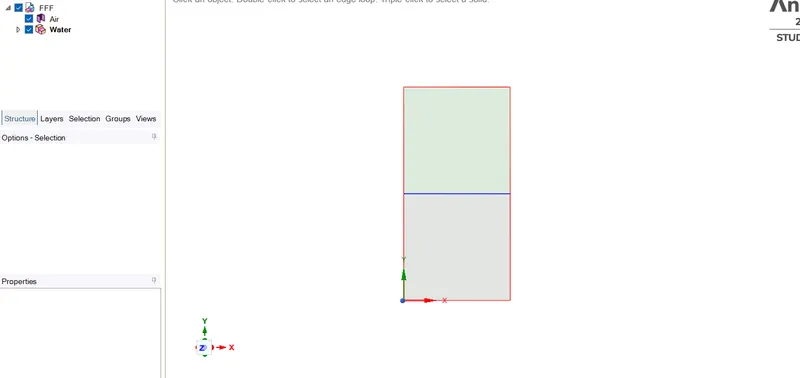
Geometry:
Solving and Modelling approach:
Meshing:
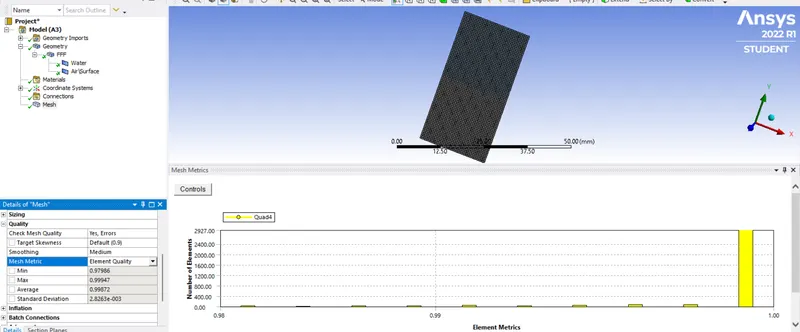
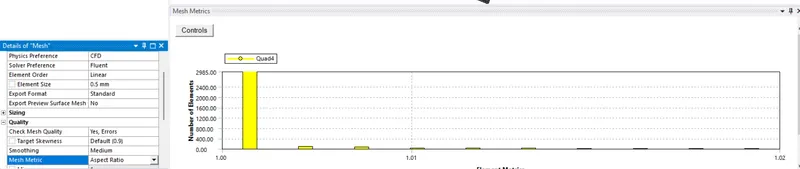

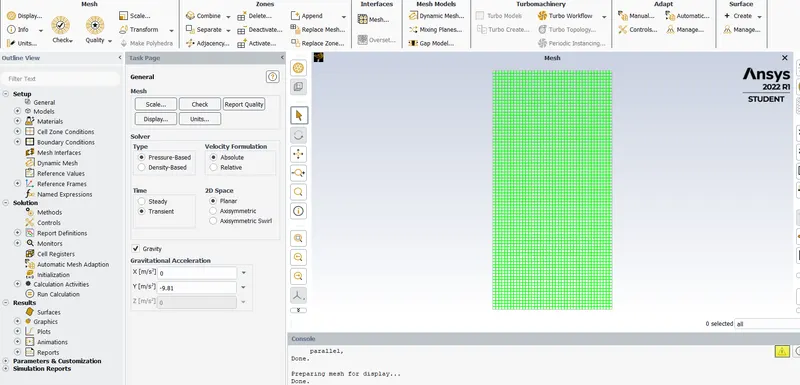
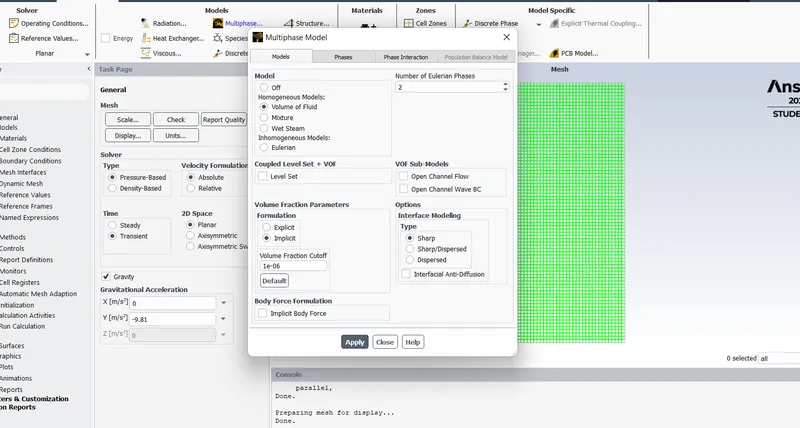
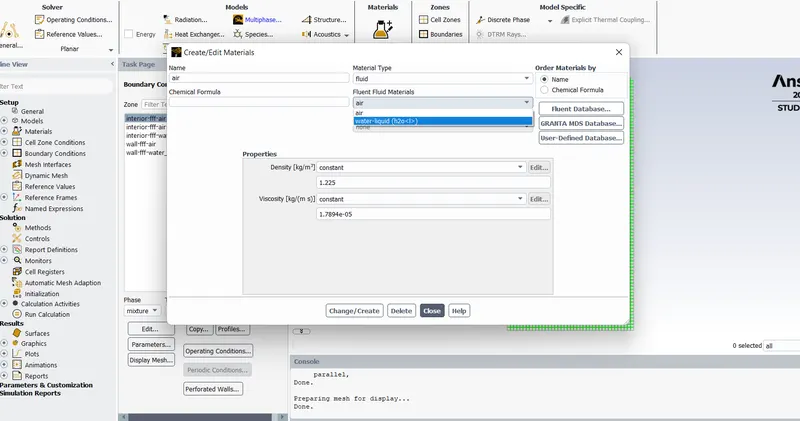
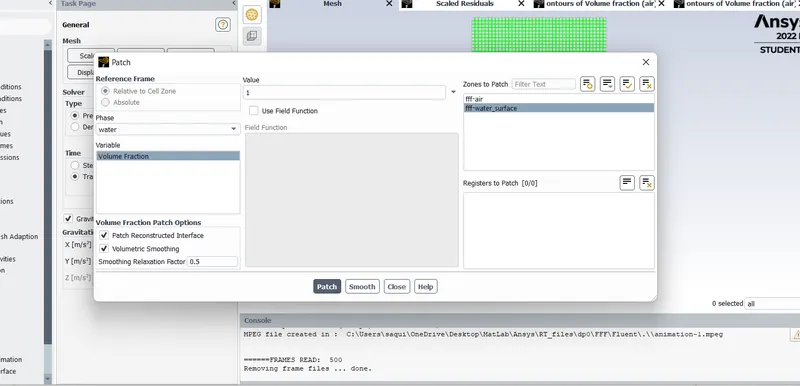
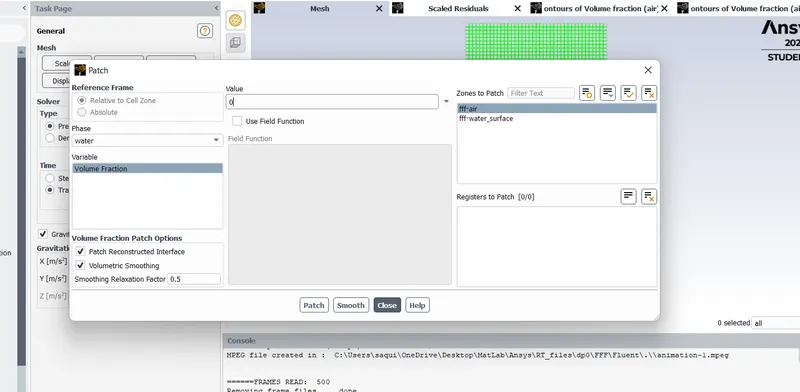
Pre-processing and solver setting:
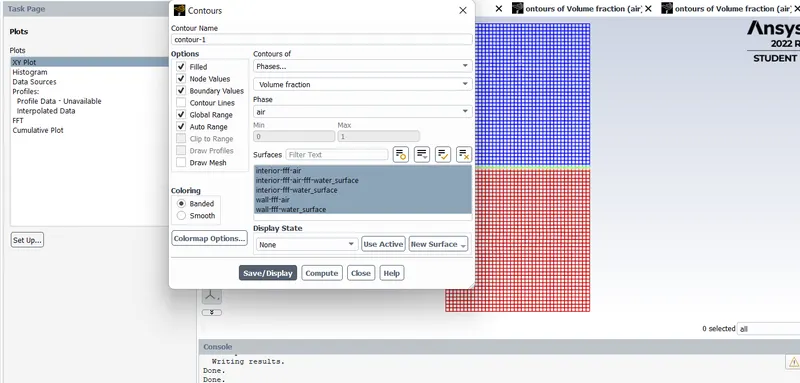
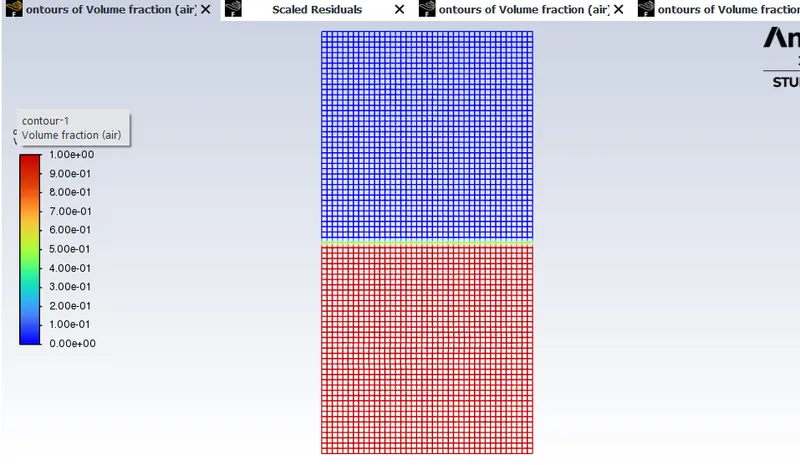
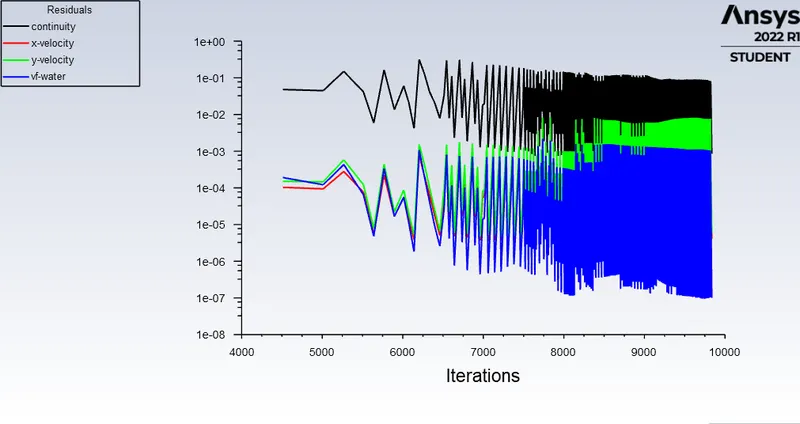
Result:
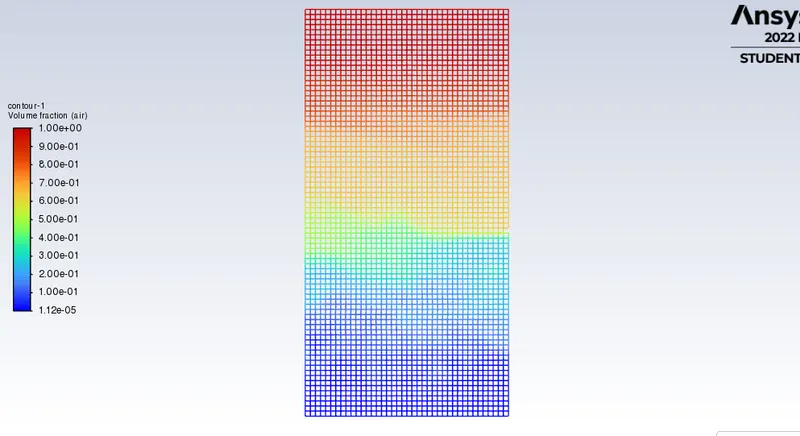
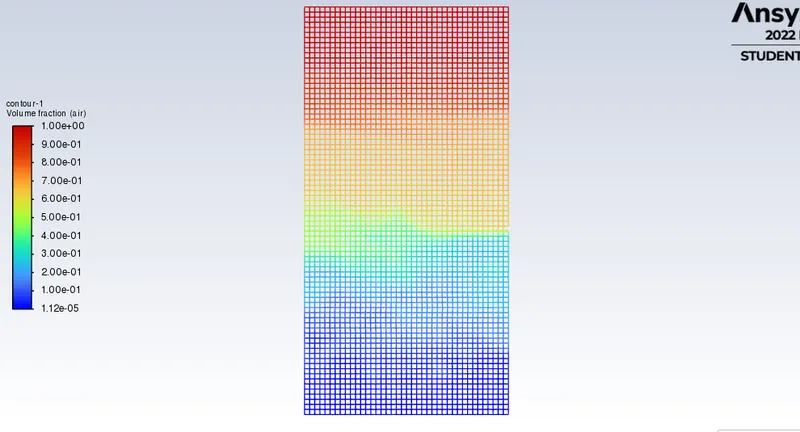
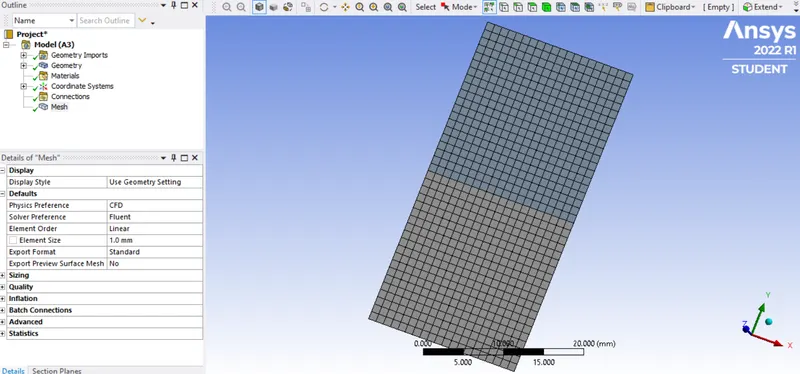
Meshing at 1mm:
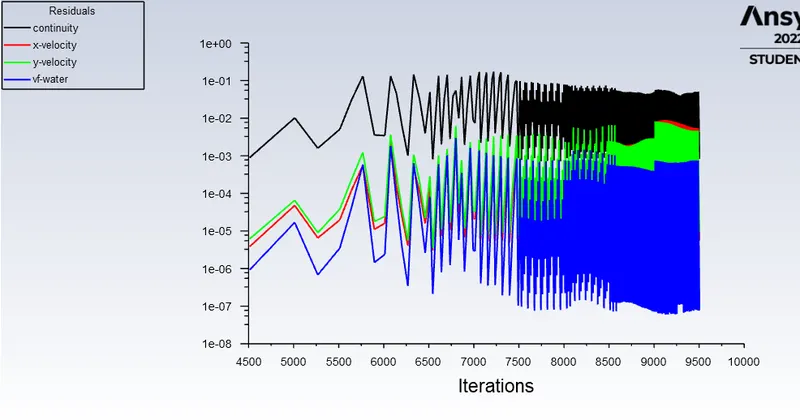
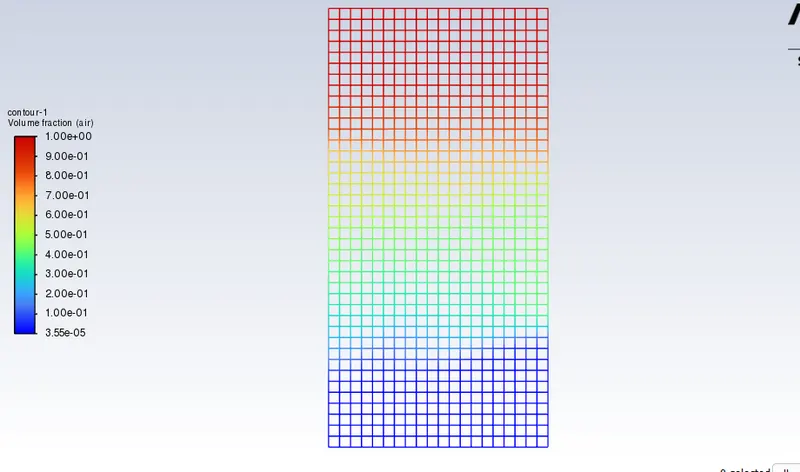
Conclusion:
Hence we have obtained practical CFD models that have been based on the mathematical analysis of Rayleigh Taylor.
We have seen how 2 fluids mixed with each other at different meshing styles. As shown above the water is denser than air which comes down after the iteration begins after finishing time the liquid settles at the bottom of the model.